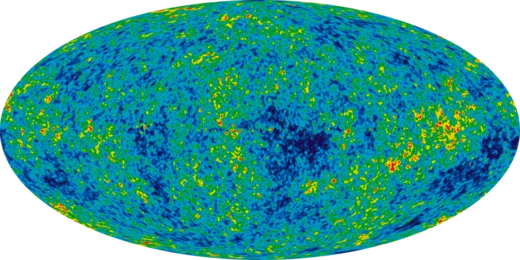
Expansion of the universe
The increase in distance between gravitationally unbound parts of the universe.

The expansion of the universe is the increase in distance between gravitationally unbound parts of the observable universe with time. It is an intrinsic expansion, meaning the universe does not expand into anything or require space outside it. Discovered through separate theoretical and observational work in the 1920s, cosmic expansion has become a core aspect of cosmology and a key feature of Big Bang cosmology, modeled mathematically with the Friedmann–Lemaître–Robertson–Walker metric within general relativity. The standard Lambda-CDM model posits different expansion rates over cosmic time, depending on the contents of spacetime. The earliest phase, inflation, saw the universe expand by a factor of at least 10²⁶ in every direction about 10⁻³² seconds after the Big Bang. Expansion then decelerated until roughly 4 billion years ago, when it began to accelerate again, a phenomenon attributed to dark energy, often represented as a cosmological constant. The expansion was first hinted at by Vesto Slipher’s observations of redshifted light from remote galaxies between 1912 and 1914. Alexander Friedmann provided theoretical evidence using Einstein’s field equations in 1922. Knut Lundmark found observational evidence in 1924, though his methods relied on unproven measurements. Georges Lemaître derived solutions to general relativity in 1927, proposing a linear relationship between galaxy distance and recessional velocity using data from Slipher and Hubble. Edwin Hubble firmly established this linear relationship in 1929, though his constant was off by a factor of seven. Subsequent refinements came from Walter Baade in the 1940s, and later from the Hubble Space Telescope’s repairs in 1994, which enabled more accurate measurements. Wendy Freedman’s Key Project and Adam Riess’s work on Type Ia supernovae further refined the Hubble constant, with later analyses from the Wilkinson Microwave Anisotropy Probe agreeing with local estimates. To any observer, all but the nearest gravitationally bound galaxies appear to recede at speeds proportional to their distance. While nothing can exceed light speed locally, this limit does not apply to the recession rates of cosmologically distant objects.
- discovery_period
- 1920s
- key_contributors
- Vesto Slipher, Alexander Friedmann, Knut Lundmark, Georges Lemaître, Edwin Hubble
- field
- Cosmology
- defining_law
- Hubble's law (Hubble–Lemaître law)
- current_model
- Lambda-CDM model
Lore & Background
The expansion of the universe is an intrinsic increase in the distance between parts of the observable universe that are not bound together by gravity. This expansion does not imply that the universe is expanding into any pre-existing space or that anything exists outside it. From the perspective of any observer within the universe, all but the very nearest galaxies appear to be moving away, with their recession speed, on average, proportional to their distance. While nothing can travel faster than light within a local reference frame, this speed limit does not restrict the recession rates of cosmologically distant objects.
The discovery of cosmic expansion came from both theoretical and observational work in the 1920s. Early observational evidence included the redshift of light from remote galaxies, first noted by Vesto Slipher, and a linear relationship between galaxy distances and their recessional velocities, proposed by Georges Lemaître and firmly established by Edwin Hubble. Alexander Friedmann had earlier provided theoretical evidence using Einstein's field equations. The expansion is a key feature of Big Bang cosmology and is mathematically modeled using the Friedmann–Lemaître–Robertson–Walker metric within general relativity. The standard Lambda-CDM model describes different expansion rates over time. The very earliest phase, known as inflation, saw the universe suddenly expand by a factor of at least 10²⁶ in every direction about 10⁻³² seconds after the Big Bang. Expansion then decelerated until roughly 9.8 billion years after the Big Bang, when it began to gradually accelerate, a trend that continues today. This late-time acceleration is attributed to dark energy, often represented as a cosmological constant. The expansion is difficult to conceptualize, leading to many common misconceptions.
Reader's Guide
The expansion of the universe is a foundational concept in modern cosmology, providing the observational and theoretical framework for the Big Bang model. Its discovery in the 1920s through the work of Slipher, Friedmann, Lundmark, Lemaître, and Hubble transformed humanity's understanding of the cosmos from a static to a dynamic entity. The expansion is quantified by the scale factor and the Hubble parameter, with the present-day Hubble constant remaining a subject of precise measurement. The Lambda-CDM model, the current standard model, incorporates different expansion rates over time, including an early inflationary epoch and a recent acceleration driven by dark energy. This concept has driven major scientific projects, such as the Hubble Space Telescope and WMAP satellite, to characterize expansion and its effects. The expansion does not imply motion through space but rather the intrinsic stretching of space itself, and it does not violate the speed limit of light in local reference frames. Understanding cosmic expansion is essential for studying the universe's origin, evolution, and ultimate fate.
Did You Know?
- The expansion of the universe was discovered through separate theoretical and observational work in the 1920s.
- The very earliest expansion, called inflation, saw the universe suddenly expand by a factor of at least 10²⁶ in every direction about 10⁻³² of a second after the Big Bang.
More in Cosmology Concepts 1-24
Spotted an error? Know more?
This is a living reference — every entry is fact-audited, and reader corrections feed straight into our audit queue. Suggest an edit · See this site's audit record