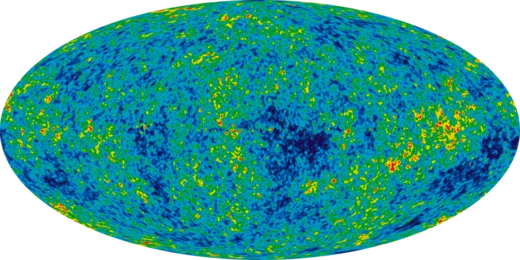
Electroweak epoch
Epoch when electromagnetism and weak force were unified.

The electroweak epoch is a phase in the early universe’s evolution defined by a specific temperature range. At this time, the universe had cooled enough that the strong nuclear force had already separated from the combined electronuclear interaction, but temperatures remained above the critical threshold for electroweak symmetry breaking, measured at 159.5±1.5 GeV in the Standard Model. This kept electromagnetism and the weak force unified as a single electroweak interaction. Cosmologists differ on when this epoch began; some place its start at the onset of cosmic inflation, roughly 10⁻³⁶ seconds after the Big Bang, while others situate it later, around 10⁻³² seconds, when the inflaton field’s potential energy was released, filling the universe with a dense, hot quark–gluon plasma.
During this period, particle interactions were sufficiently energetic to produce large numbers of exotic particles, including W and Z bosons and Higgs bosons. As the universe expanded and cooled, these interactions weakened. By the time the universe was about 10⁻¹² seconds old, W and Z bosons were no longer created at observable rates; the remaining ones decayed rapidly, causing the weak interaction to become a short-range force as the quark epoch began.
The electroweak epoch concluded with an electroweak phase transition, whose nature was initially unknown. In the 1990s, speculation that it might be a first-order transition raised the possibility that it could generate a gravitational wave background and drive baryogenesis, provided the Sakharov conditions were met and the Higgs boson mass was below 45 GeV. However, subsequent work with the Standard Model and a measured Higgs mass above 114 GeV showed the transition was not first- or second-order but a continuous crossover. With the actual Higgs mass of 125 GeV, the crossover width is about 5 GeV around the crossover temperature. This rules out electroweak baryogenesis and observable gravitational waves peaking in the mHz range from this transition. Nonetheless, many extensions to the Standard Model, such as supersymmetry and the two-Higgs-doublet model, can still feature a first-order electroweak phase transition, though they require additional sources of CP violation.
- field
- Physical cosmology
- start_time_disputed
- 10⁻³⁶ seconds or 10⁻³² seconds after the Big Bang
- end_time
- Approximately 10⁻¹² seconds after the Big Bang
- associated_particles
- W and Z bosons, Higgs bosons
Lore & Background
In physical cosmology, the electroweak epoch was the period in the early universe when the strong force had already separated from the combined electronuclear interaction, but the universe remained hot enough that electromagnetism and the weak interaction were still unified as a single electroweak force. This condition persisted above a critical temperature of approximately 159.5±1.5 GeV, as defined by the Standard Model of particle physics. The exact timing of this epoch is debated: some cosmologists place its start at the onset of the inflationary epoch, roughly 10⁻³⁶ seconds after the Big Bang, while others date it to around 10⁻³² seconds, when the inflaton field’s potential energy was released, filling the universe with a dense, hot quark–gluon plasma. During this phase, particle interactions were sufficiently energetic to produce large numbers of exotic particles, including W and Z bosons and Higgs bosons. As the universe expanded and cooled, these interactions weakened; by about 10⁻¹² seconds, W and Z bosons ceased to be created at observable rates, and the remaining ones decayed quickly, causing the weak interaction to become a short-range force in the subsequent quark epoch. The electroweak epoch ended with an electroweak phase transition, the nature of which remains uncertain. Speculation in the 1990s suggested it could be a first-order transition, potentially sourcing a gravitational wave background and baryogenesis if the Sakharov conditions were met and the Higgs boson energy was below 45 GeV. However, subsequent work with the Standard Model and a measured Higgs mass of 125 GeV showed the transition is not first- or second-order but a continuous crossover, with a width of about 5 GeV around the crossover temperature. In this scenario, no electroweak baryogenesis or observable gravitational wave background peaking in the mHz range occurs. Many extensions to the Standard Model, such as supersymmetry and the two-Higgs-doublet model, do predict a first-order transition, though they require additional CP violation.
Reader's Guide
The electroweak epoch began when the universe’s temperature dropped enough for the strong force to separate from the combined electronuclear interaction, yet remained above the critical temperature for electroweak symmetry breaking, which in the Standard Model is 159.5±1.5 GeV. Some cosmologists place this epoch at the start of the inflationary epoch, roughly 10⁻³⁶ seconds after the Big Bang, while others set it at about 10⁻³² seconds, when the inflaton field’s potential energy was released, creating a dense, hot quark–gluon plasma. During this phase, particle interactions were sufficiently energetic to produce large numbers of exotic particles, including W and Z bosons and Higgs bosons. As the universe expanded and cooled, interactions became less energetic; by the time the universe was about 10⁻¹² seconds old, W and Z bosons ceased forming at observable rates, and the remaining ones decayed quickly, making the weak interaction a short-range force in the subsequent quark epoch. The epoch ended with an electroweak phase transition, whose nature was initially unknown. Speculation in the 1990s suggested it could be a first-order transition, potentially sourcing a gravitational wave background and baryogenesis if the Higgs boson energy was below 45 GeV. However, subsequent work with the Standard Model and a measured Higgs mass over 114 GeV showed the transition is not first- or second-order but a continuous crossover; with the actual Higgs mass of 125 GeV, the crossover width is about 5 GeV around the crossover temperature. In this case, no electroweak baryogenesis or observable gravitational wave background peaking in the mHz range occurs. Many extensions to the Standard Model, such as supersymmetry and the two-Higgs-doublet model, still allow a first-order electroweak phase transition, though they require additional CP violation. The epoch’s significance is that it directly preceded the quark epoch and involved the last unification of electromagnetism and the weak interaction before their separation, constraining models of baryogenesis and early-universe physics.
Did You Know?
- The electroweak epoch ended when the universe was about 10⁻¹² seconds old, after which W and Z bosons ceased to be created at observable rates.
- Extensions to the Standard Model such as supersymmetry and the two-Higgs-doublet model can have a first-order electroweak phase transition but require additional CP violation.
More in Cosmology Concepts 1-24
Spotted an error? Know more?
This is a living reference — every entry is fact-audited, and reader corrections feed straight into our audit queue. Suggest an edit · See this site's audit record