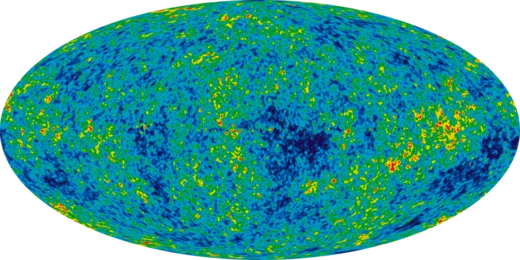
Discovery of cosmic microwave background radiation

The discovery of cosmic microwave background radiation reshaped modern physical cosmology. In 1964, American physicist Arno Allan Penzias and radio-astronomer Robert Woodrow Wilson, while working with the Holmdel Horn Antenna, detected this radiation and calculated its temperature at roughly 3.5 K. Their measurement became a key piece of evidence supporting the Big Bang theory—the idea of a hot early universe—and undermined the rival steady state theory. Theoretical work around 1950 had already indicated that a cosmic microwave background was necessary for consistency with the simplest relativistic universe models. For this joint measurement, Penzias and Wilson received the Nobel Prize in Physics in 1978.
A prior measurement existed: in 1941, Andrew McKellar, using CN stellar absorption lines observed by W. S. Adams, found an effective temperature of 2.3 K. McKellar did not connect this to the cosmic background, and its significance was only recognized well after Penzias and Wilson’s work.
By the mid-20th century, cosmologists had two competing theories for the universe’s origin. The steady-state theory held that the universe always existed and remained largely unchanged. The Big Bang theory proposed a massive, explosive beginning billions of years ago (later dated to about 13.8 billion years). In 1941, McKellar measured a blackbody background temperature of 2.3 K from CN absorption lines in a B-type star’s spectrum, but he described it as a “rotational” temperature of interstellar molecules, with “perhaps limited” significance.
More than two decades later, in 1964, Penzias and Wilson, at a Bell Telephone Laboratories facility on Crawford Hill in Holmdel, New Jersey, were testing a supersensitive 6-meter horn antenna built to detect radio waves from Echo balloon satellites. To measure faint signals, they eliminated all recognizable interference: they removed effects from radar and radio broadcasts and cooled the receiver with liquid helium to just 4 K above absolute zero. After reducing their data, they found a low, steady, mysterious noise—100 times more intense than expected, uniform across the sky, and present day and night. They confirmed it did not come from Earth, the Sun, or our galaxy. After checking their equipment and removing pigeon droppings from the antenna, the noise persisted. They concluded it originated outside our galaxy, though they knew of no radio source that could produce it.
At the same time, astrophysicists Robert H. Dicke, Jim Peebles, and David Wilkinson at Princeton University were preparing to search for microwave radiation in that spectrum region. They reasoned that the Big Bang would have scattered matter forming galaxies and also released a huge blast of radiation, which, due to massive redshift, should now be detectable as microwaves. When Bernard F. Burke, a physics professor at MIT, told Penzias about a preprint by Peebles on leftover radiation from the universe’s explosive beginning, Penzias and Wilson realized the significance of their detection. The radiation’s characteristics matched exactly what Dicke and his team had predicted. Penzias called Dicke, who sent him the unpublished Peebles paper. After reading it, Penzias invited Dicke to Bell Labs to see the antenna and hear the background noise. Dicke, Peebles, Wilkinson, and P. G. Roll interpreted the noise as a signature of the Big Bang.
To avoid conflict, the two groups published jointly. Two notes went to the *Astrophysical Journal Letters*. One, by Dicke and his associates, outlined the cosmic background radiation’s importance as evidence for the Big Bang. The other, signed by Penzias and Wilson, titled “A Measurement of Excess Antenna Temperature at 4080 Megacycles per Second,” reported a 3.5 K residual background noise after accounting for a 2.3 K sky absorption component and a 0.9 K instrumental component, and attributed a “possible explanation” to Dicke’s companion letter.
In 1978, Penzias and Wilson shared the Nobel Prize in Physics for their detection (with Pyotr Kapitsa for unrelated work). In 2019, Jim Peebles also received the Nobel Prize in Physics for theoretical discoveries in physical cosmology.
- field
- Physical cosmology, radio astronomy
- known_for
- Discovery of cosmic microwave background radiation
- nationality
- American
- estimated_temperature
- 3.5 K
- instrument
- Holmdel Horn Antenna
Lore & Background
After removing pigeons nesting in the antenna and cleaning out droppings, the noise remained, leading them to conclude it came from outside our galaxy. At the same time, astrophysicists Robert H. Dicke, Jim Peebles, and David Wilkinson at Princeton University were preparing to search for microwave radiation from the Big Bang. Penzias learned of Peebles' preprint paper through Bernard F. Burke and contacted Dicke, who sent a copy of the paper. Dicke, Peebles, Wilkinson, and P. G. Roll interpreted the radiation as a signature of the Big Bang. To avoid conflict, they published jointly: Dicke's group outlined the CMB's importance, while Penzias and Wilson reported a 3.5 K residual background noise, attributing a possible explanation to Dicke's companion letter.
Reader's Guide
The discovery of the cosmic microwave background radiation fundamentally shifted cosmology from a speculative field to an empirical science. In 1964, while testing a sensitive horn antenna originally built for satellite communications, Arno Penzias and Robert Wilson encountered a persistent, uniform noise that resisted all attempts at elimination. After ruling out terrestrial, solar, and galactic sources, and even cleaning pigeon droppings from the antenna, they measured an excess antenna temperature corresponding to a residual background of about 3.5 K. At the same time, a Princeton group led by Robert Dicke, including Jim Peebles and David Wilkinson, had theoretically predicted that a relic radiation field should exist as a remnant of a hot, dense early phase of the universe. Once Penzias learned of this work, the two teams jointly published their findings: the Princeton group interpreted the signal as evidence for the Big Bang, while Penzias and Wilson reported their measurement. This detection provided decisive evidence against the steady state theory, which could not account for such a uniform background. The CMB is now used to determine the universe's age, composition, and large-scale structure. An earlier measurement by Andrew McKellar in 1941, using CN absorption lines observed by W. S. Adams, had recorded an effective temperature of 2.3 K, but its cosmological significance was only recognized after the 1964 discovery. Penzias and Wilson received the Nobel Prize in Physics in 1978 for their work.
Did You Know?
- Penzias and Wilson initially thought the persistent noise might be due to pigeon droppings in their antenna.
- The CMB temperature they measured was 3.5 K, after accounting for a 2.3 K sky absorption component and a 0.9 K instrumental component.
More in Cosmology Concepts 1-24
Spotted an error? Know more?
This is a living reference — every entry is fact-audited, and reader corrections feed straight into our audit queue. Suggest an edit · See this site's audit record