Aliwal Shoal
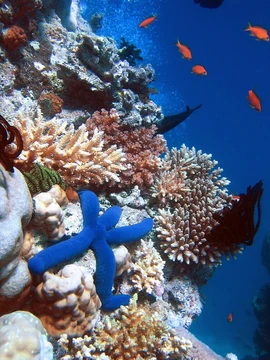
Rocky reef and ancient dune off KwaZulu-Natal, South Africa.
Last updated

Derek Keats from Johannesburg, South Africa · CC BY 2.0
Aliwal Shoal is a rocky reef lying about 5 kilometers off the coast of KwaZulu-Natal, South Africa, formed from the remains of an ancient sand dune. It is home to a wide range of hard and soft corals, marine invertebrates, and both tropical and subtropical fish species.

The reef gets its name from the near-sinking of the three-masted vessel Aliwal, captained by James Anderson, in 1849. Two shipwrecks near the reef—the Norwegian bulk carrier MV Produce (sunk in 1974) and the SS Nebo (sunk in 1884)—are popular recreational dive sites. The shoal is especially known for the large numbers of Grey nurse sharks, locally called ragged tooth sharks or "raggies," that gather there to mate between July and November.
Morphology
The reef is part of a larger offshore complex. The narrow ridge parallel to the coast, about 5 kilometers out, is the section most often referred to as Aliwal Shoal, and this area lies within the sanctuary zone of the Marine Protected Area. The shallowest part, reaching within 6 meters of the surface, is at the northern end of this ridge, known as the Crown.

To the north, the bottom slopes steeply; to the sides, the slope is gentler. The Crown is about 380 meters wide at its northern end, narrowing to the south, and then spreads toward the coast in a section called the Ridge. Average depth on the Crown is about 12.5 meters, while the Ridge averages about 19.5 meters, with a few isolated pinnacles.
Geology
Geologically, the reef is made of aeolianite with some beachrock, thought to be a sunken coastline from the late Pleistocene. Rock samples were recovered from the hull of the vessel Aimée Lykes, which struck the shoal in 1963 and made it to Durban for repairs.

Ecology
Ecologically, Aliwal Shoal is a subtidal, algal-dominated subtropical reef in a transitional zone between the warm-temperate reefs of Pondoland and the tropical to subtropical reefs of Maputaland. The benthic communities are dominated by algae and sponges, with various soft and hard corals, echinoderms, and ascidians also present. The environment is considered marginal, supporting fauna from tropical, subtropical, and warm-temperate reefs, with diversity comparable to similar-latitude reefs in Australia.
Quick Facts
- Location
- Approximately 5 km (3.11 mi) off the coast of KwaZulu-Natal, South Africa
- Named after
- Near-sinking in 1849 of the three-masted vessel Aliwal, captained by James Anderson
- Average depth crown
- 12.5 m / 41 ft
- Average depth ridge
- 19.5 m / 64 ft
- Shallowest depth
- Within 6 m of the surface
- Mpa established
- 1991
- Mpa area original
- 126 km²
Facts from the source article.
Lore & Background
Aliwal Shoal is part of a large offshore reef complex. The narrow ridge parallel to the coastline, more specifically referred to as the Crown, is the part usually called Aliwal shoal, and this area is inside the sanctuary zone of the Marine Protected Area. The shallowest part, extending to within 6 m of the surface, is at the north end of the Crown.
The shoal is about 380 m wide to the north, narrower to the south, and then spreads out towards the coast in the section known as the Ridge. The reef consists of aeolianite with subordinate beachrock and is thought to be a sunken coastline of the late Pleistocene. The type of rock was determined from samples recovered from the hull of the vessel Aimée Lykes, which struck the shoal in 1963.

The shoal is a subtidal, algal-dominated subtropical reef in the transitional region between the warm-temperate reefs of Pondoland and the tropical to subtropical reefs of Maputaland. The benthic communities are dominated by algae and sponges, but various soft and hard corals, echinoderms and ascidians are also present.
The environment can be classified as marginal, supporting fauna of tropical, subtropical and warm temperate reefs. The adjacent coastline has a humid subtropical climate with summer rainfall, and freshwater and riverine sedimentary discharge from the mKomazi River affects turbidity and plankton blooms. The shoal is exposed to heavy wind-driven wave action, with an annual average swell height of 2.5 m.
Benthic communities
Three distinct benthic communities occur on the Crown reef, depending on topography, sediment cover and wave energy. The large shallow areas have the highest abundance of zooxanthellate hard corals and the encrusting zooxanthellate sponge Suberites kelleri. A second community inhabits the steep edges and has a larger proportion of polychaetes, the soft coral Eleutherobia aurea, and the sponge Spheciospongia globularis. A third community lives deeper and is dominated by coralline and red foliose algae.

Geological Origins & Reef Architecture
The Aliwal Shoal is essentially a submerged fragment of an ancient coastline. Composed primarily of aeolianite—a rock formed from cemented wind-blown sand—with some beachrock mixed in, it is believed to be the sunken remnant of a late Pleistocene shoreline. Today it sits roughly five kilometres offshore from KwaZulu-Natal, forming part of a broader offshore reef complex. The section most commonly called the shoal is a narrow ridge running parallel to the coast, locally known as the Crown, which falls within the sanctuary zone of a Marine Protected Area.
The Crown averages about 12.5 metres in depth, with its shallowest point at the northern end reaching within six metres of the surface. The ridge stretches roughly 380 metres wide at its northernmost extent, tapering southward before broadening again in a section called the Ridge, where average depths climb to around 19.5 metres and isolated pinnacles dot the seafloor. The steepest descent occurs to the north, while the lateral slopes are gentler.
Ecological Crossroads & Benthic Communities
Aliwal Shoal sits at a remarkable ecological crossroads. As a subtidal reef dominated by algae, it occupies the transitional stretch where the warm-temperate waters of Pondoland meet the tropical and subtropical conditions of Maputaland. This liminal position means the shoal simultaneously supports fauna from all three thermal regimes, earning it a classification as a marginal environment. Its overall biodiversity rivals that of reefs at comparable latitudes in Australia.

The benthic communities are led by algae and sponges, but hard and soft corals, echinoderms, ascidians, and a wide array of invertebrates also thrive here. Three distinct community assemblages have been identified on the Crown, each shaped by local topography, sediment cover, and wave energy. The shallow reef-top community favours zooxanthellate hard corals and the encrusting sponge Suberites kelleri, while the steeper wall community is characterised by polychaetes and the soft coral Eleutherobia aurea. Deeper still, coralline and red foliose algae take over as the dominant life forms.
The Raggies Season & Maritime Heritage
Between July and November, Aliwal Shoal becomes one of the most anticipated destinations for underwater enthusiasts on the South African coast. During these months, large congregations of Grey nurse sharks—affectionately called raggies or ragged tooth sharks by locals—gather at the reef to mate, drawing divers eager to witness the spectacle alongside other large predators. The shoal's reputation as a recreational scuba diving destination is further enriched by two nearby shipwrecks that serve as popular dive sites: the SS Nebo, which went down in 1884, and the Norwegian bulk carrier MV Produce, lost in 1974.
The reef itself carries a maritime history in its very name. In 1849, the three-masted vessel Aliwal, under the command of Captain James Anderson, nearly sank after striking the shoal, an event that gave the feature its enduring identity. Decades later, in 1963, the vessel Aimée Lykes also struck the reef but managed to limp into Durban for repairs, and samples recovered from her hull helped scientists confirm the shoal's aeolianite composition.
Environmental Pressures & Physical Setting
The shoal exists within a dynamic and sometimes challenging physical environment. The adjacent KwaZulu-Natal coastline enjoys a humid subtropical climate with summer rainfall, and significant freshwater and riverine sedimentary discharge flows into the region, influencing local turbidity and triggering plankton blooms. The mKomazi River, situated at the northern edge of the Marine Protected Area, is the primary source of this input, while a marine pipeline operated by Sappi Saiccor discharges just outside the MPA boundary.
The shoal is also exposed to persistent heavy wind-driven wave action, with an annual average swell height of 2.5 metres, a force that shapes the high-energy communities found on the reef top. Despite these pressures, the reef maintains a rich assemblage of life, from green, red, and brown algae to sponges, gorgonians, sea anemones, black coral, and a variety of hard corals including Pocillopora, Stylophora, and Tubastraea species. The interplay of wave energy, sediment input, and thermal transition creates a habitat that is both fragile and remarkably resilient.
Reader's Guide
Aliwal Shoal is significant as a transitional reef ecosystem between warm-temperate and tropical marine regions, supporting a mix of fauna from both zones. Its diversity is comparable to similar latitude reefs of Australia. The shoal is particularly known for the seasonal congregation of Grey nurse sharks (ragged tooth sharks) for mating, which draws recreational divers. The reef hosts two popular wreck dive sites: the Norwegian bulk carrier MV Produce, which sank in 1974, and the SS Nebo, which sank in 1884.
The Aliwal Shoal Marine Protected Area, established in 1991 and later extended, regulates fishing and protects the reef. The legacy of the shoal includes its role as a research site for understanding marginal reef environments, where high algal biomass indicates nutrient availability, while lower zooxanthellate coral biomass suggests suboptimal light and temperature conditions. The high occurrence of filter-feeding sponges, ascidians and polychaetes indicates that suspended particulates are adequate for their nutrition. The shoal's benthic communities, recorded in detail, provide a baseline for monitoring changes in this subtropical reef system.
More in Coral Reefs
Sources
Compiled from Wikipedia and the sources listed below. Text from Wikipedia is available under CC BY-SA 4.0; this entry is adapted from it.
- Wikipedia: Aliwal Shoal (CC BY-SA 4.0).
- Word definitions: the Codexery glossary, each quoted from its Wikipedia article.
Spotted an error? Know more?
Reader corrections go straight into our review queue. Suggest an edit · How this site is sourced