African coral reefs
African coral reefs span eastern, southern, and northwestern African coasts.
Last updated
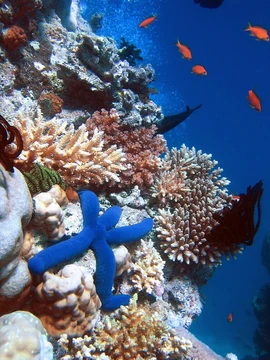
African coral reefs are the coral reefs present in Africa, primarily found along the eastern and southern coasts, extending from the Red Sea to Madagascar. They are notable as an important resource for fishers in Kenya, Tanzania, Mozambique, and Madagascar, and some cold-water reefs also exist off northwestern Africa near the Azores, Madeira, Canary Islands, and Cape Verde.
Quick Facts
- East coast average temperature
- 26 °C (79 °F)
- Trawling ban region
- Azores, Canary Islands, Madeira
- Trawling ban regulation
- EU's Regulation (EC) No 2287/2003
Facts from the source article.
Lore & Background
The east coast corals extend from the Red Sea to Madagascar, with average temperatures around 26 °C over the year. Rainfall peaks between January and April at about 300 mm, and is lowest from August to November at about 100 mm. These reefs support species such as the mantis shrimp, potato grouper, humphead wrasse, maxima clam, and many seaweeds and corals, being more biologically diverse than the surrounding ocean.
Western African reefs near the Azores, Canary Islands, and Madeira have a trawling ban initially set by EU's Regulation (EC) No 2287/2003. Multiple threats affect the eastern and southern reefs, including tourist diving, coral damage, sample taking, industrial run-offs, pollutants, untreated sewage, and increasing sediment flows in rivers. Climate change also threatens the reefs; a severe El Niño in 1997/98 killed 90 percent of corals. The CORDIO NGO has set up an East African task force to monitor reef management.
Reader's Guide
The significance of African coral reefs lies in their ecological and economic roles along the eastern and southern coasts, where they support fisheries for Kenya, Tanzania, Mozambique, and Madagascar. Their biological diversity exceeds that of the surrounding ocean, hosting species like mantis shrimp, potato grouper, humphead wrasse, and maxima clam. However, they face multiple threats: tourist activities, industrial run-offs, pollutants, untreated sewage, and increased sediment flows.
Climate change, particularly the 1997/98 El Niño event that killed 90 percent of corals, underscores their vulnerability. In response, the CORDIO NGO established an East African task force to monitor reef management. Additionally, some western African reefs near the Azores, Canary Islands, and Madeira are protected by a trawling ban under EU Regulation (EC) No 2287/2003.
More in Coral Reefs
Sources
Compiled from Wikipedia and the sources listed below. Text from Wikipedia is available under CC BY-SA 4.0; this entry is adapted from it.
- Wikipedia: African coral reefs (CC BY-SA 4.0).
- Word definitions: the Codexery glossary, each quoted from its Wikipedia article.
Spotted an error? Know more?
Reader corrections go straight into our review queue. Suggest an edit · How this site is sourced