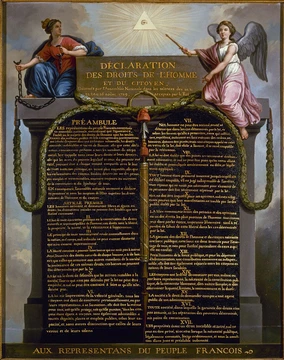
Constitutional court
High court ruling on constitutionality of laws.

A constitutional court is a high-level judicial body focused on constitutional law. Its core function is to determine whether challenged laws violate the constitution—meaning they conflict with established rules, rights, or freedoms.
**History**
Before the creation of independent constitutional courts, the United States, Canada, and Australia had already adopted judicial review within their ordinary courts, following shared principles from their common law systems, which themselves derived from British colonial law. The 1799 constitution of the Parthenopean Republic, drafted by Mario Pagano, proposed a body of magistrates called the *eforato* to review constitutional law, but this republic lasted only six months. Earlier, from 1701 to 1714, the Principality of Catalonia operated the *Tribunal de Contrafaccions*, which could address actions by the king or his officers, as well as royal edicts and minor laws, that violated the Catalan constitutions. The 1776 Pennsylvania Constitution and the 1777 Vermont Constitution each created a "Council of Censors," separate from other branches, tasked with recommending the repeal of laws enacted contrary to constitutional principles—an institution somewhat resembling a modern constitutional court.
The first dedicated constitutional court was established by the First Austrian Republic in 1919, though it existed only in name until October 10, 1920, when Austria’s new constitution took effect and granted it power to review laws of the federal states. Czechoslovakia’s 1920 Constitution, effective February 2, 1920, was the first to provide for a special court for judicial review of parliamentary laws, but the court did not convene until November 1921. The structure and powers of both courts were shaped by Hans Kelsen’s constitutional theories. This model—a separate constitutional court handling only cases about the constitutionality of national legislation—became known as the Austrian System and was later adopted by countries such as Liechtenstein (1925), Greece (1927), Spain (1931), and Germany (1949).
**National**
The list below includes countries with separate constitutional courts. Other nations do not have such dedicated courts; instead, they assign constitutional judicial authority to their ordinary court system, with final decisions resting in the supreme ordinary court. These courts are sometimes also called "constitutional courts."
**Subnational**
**Germany** The Constitutional Court of Baden-Württemberg (Verfassungsgerichtshof für das Land Baden-Württemberg) is the constitutional court for the German state of Baden-Württemberg and a constitutional organ at the state level. Besides judicial review (Normenkontrolle), it has other powers and responsibilities assigned by the state constitution. The Constitutional Court of Bavaria (Bayerischer Verfassungsgerichtshof) is the state constitutional court for the Free State of Bavaria. Along with the state government (Landesregierung) and state parliament (Landtag), it is one of three state constitutional institutions and holds the power of judicial review, examining whether state laws comply with the state constitution. The Constitutional Court of Berlin (Verfassungsgerichtshof des Landes Berlin) is the constitutional court of the city-state of Berlin, which is also Germany’s capital. Located in the same building as the Kammergericht (Oberlandesgericht), it is authorized by Article 84 of Berlin’s constitution. It has the power of judicial review, can review electoral complaints, and hears cases about complaints against referendums and popular initiatives.
**Russia** Before 2020, several republics of Russia had their own constitutional courts, while in other federal subjects (such as oblasts and federal cities) they were called charter courts, since only republics have their own constitutions. These constitutional and charter courts were completely independent and not subordinate to the Constitutional Court of Russia. They heard cases about whether regional laws and governors’ decrees conformed to regional constitutions or charters, acting as courts of single instance in such matters. The 2020 amendments to the Russian Constitution disestablished these courts. As of 2020, constitutional courts remained in force in 12 of the 22 republics: Adygea (known as the Constitutional Chamber until 2000), Bashkortostan, Chechnya, Dagestan, Ingushetia, Kabardino-Balkaria, Karelia, Komi, Mari El, North Ossetia–Alania, Sakha, and Tatarstan. In Buryatia and Tuva, the constitutional courts were abolished by republican constitutional laws in 2018 and 2019, respectively. In Bashkortostan, Tatarstan, and Sakha, the disestablished courts were transformed into constitutional councils without judicial powers. Until 2020, charter courts existed in Kaliningrad Oblast, Saint Petersburg, and Sverdlovsk Oblast. The charter court of Chelyabinsk Oblast was disestablished in 2014.
- Influential theorist
- Hans Kelsen
- Known as
- Austrian System
Lore & Background
A constitutional court is a high court whose primary function is to adjudicate matters of constitutional law, most notably by reviewing legislation to determine if it conflicts with the nation’s constitution, including its established rules, rights, and freedoms. The concept of a dedicated constitutional court originated in the early 20th century, with the First Austrian Republic establishing the first such body in 1919, though it became fully operational in 1920. Czechoslovakia’s 1920 constitution was the first to provide for a specialized court for judicial review of parliamentary laws, convening in 1921. Both institutions were shaped by the theories of Hans Kelsen, giving rise to the “Austrian System,” where a separate court exclusively hears constitutional challenges to national legislation. This model was later adopted by countries such as Liechtenstein, Greece, Spain, and Germany. Prior to this, judicial review existed in common law systems like the United States, Canada, and Australia, where ordinary courts handled constitutional questions. Earlier historical precedents include the Parthenopean Republic’s short-lived eforato of 1799, the Tribunal de Contrafaccions in Catalonia (1701–1714), and the Councils of Censors established by the 1776 Pennsylvania and 1777 Vermont constitutions, which could recommend repealing laws contrary to the constitution. Some nations today still delegate constitutional authority to their ordinary court system, with final decisions resting in the supreme court, though such bodies are occasionally also termed constitutional courts.
Reader's Guide
The concept of a dedicated constitutional court represents a significant development in constitutional law, providing a specialized body to adjudicate the constitutionality of legislation. Originating in early 20th-century Europe, particularly through the Austrian System influenced by Hans Kelsen, this model spread to many countries, offering a distinct alternative to the American system of judicial review by ordinary courts. The establishment of such courts reflects a desire for a focused, expert institution to safeguard constitutional principles, separate from the regular judiciary. Subnational constitutional courts, as seen in German states and former Yugoslav republics, extend this principle to federal or regional levels, allowing for review of local laws against regional constitutions. The existence of these courts, whether at national or subnational level, underscores the importance of constitutional supremacy and the rule of law, though their powers and structures vary.
Frequently Asked Questions
What is a Constitutional court?
A Constitutional court is a high court whose primary focus is constitutional law. Its core function is to determine whether a challenged statute actually conflicts with the constitutionally established rules, rights, and freedoms of a given state.
Which theorist is most associated with the Constitutional court model?
Hans Kelsen is the influential theorist whose ideas shaped the design of what is commonly called the Austrian System of constitutional adjudication.
Why is the Constitutional court important in a legal system?
It acts as the high-court safeguard that ensures ordinary legislation does not override the fundamental rules, rights, and freedoms enshrined in the constitution. Without it, there would be no dedicated judicial mechanism to strike down laws that violate those higher norms.
More in Constitutional Law 1-24
Spotted an error? Know more?
This is a living reference — every entry is fact-audited, and reader corrections feed straight into our audit queue. Suggest an edit · See this site's audit record