Constituent assembly
A body assembled to draft or revise a constitution.

A constituent assembly—sometimes called a constitutional convention, congress, or assembly—is a group convened specifically to write or revise a constitution. Its members can be chosen through popular elections, sortition (random selection), appointments, or a mix of these methods. While it is generally separate from a regular legislature, lawmakers may make up many or even all of its members. Because a constitution is a state’s foundational document, some jurisdictions forbid changing it through normal legislative processes; instead, a constituent assembly or convention, whose rules are usually set out in the existing constitution, must be formed. Such an assembly is created for a particular task, completes it in a relatively short period, and is then dissolved. It operates as a form of representative democracy.
Unlike situations where a constitution is imposed unilaterally by a sovereign ruler, a constituent assembly creates a constitution through “internally imposed” actions: its members are citizens of the country—not necessarily its political leaders. As Columbia University Professor Jon Elster explains, constitutions arise in various ways. At the non-democratic extreme, a sovereign lawgiver sets the constitution for all future generations. At the democratic extreme, a constituent assembly elected by universal suffrage exists solely to write a new constitution. Many intermediate arrangements also exist.
**By country**
**Australia** Australia has held four constitutional conventions: in 1891, 1897, 1973, and 1998.
**Bangladesh** The Constituent Assembly of Bangladesh was the country’s first and only constitution-making body. It was convened in 1972 by Sheikh Mujibur Rahman’s government after independence, drawing its members from those elected in Pakistan’s 1970 national and provincial council elections. Because those elections were held under the Legal Framework Order issued by Pakistan’s military ruler Yahya Khan, several political figures—including Maulana Abdul Hamid Khan Bhashani, Badruddin Umar, A.S.M. Abdur Rab, and Farhad Mazhar—considered the assembly illegitimate. Despite controversy and opposition, Sheikh Mujib’s leadership allowed the assembly to draft and enact a constitution in under a year. Since its drafting, the constitution has often been called “fascist” and criticized for encouraging autocracy and failing to protect human rights. Following the 2024 Non-cooperation movement, Bangladesh’s interim government is considering convening a new constituent assembly to draft an inclusive democratic constitution that guarantees human dignity.
**Chile** As of May 2021, Chile had the most recently elected constitutional assembly. Its 155 members were elected on May 15–16, 2021. The assembly has gender parity (50% women, 50% men) and reserves 17 seats for indigenous peoples. It was given 12 months to draft a new constitution, which must then be ratified by a referendum with compulsory voting.
**Costa Rica** Right after the 1948 Costa Rican Civil War, which overthrew the government of Rafael Ángel Calderón, the victorious leaders called for a Constituent Assembly election that same year. The assembly successfully drafted and approved the current Costa Rican constitution.
**Denmark** The Danish Constituent Assembly (in Danish, *Den Grundlovgivende Rigsforsamling*) met in 1848 to establish Denmark’s 1849 constitution, formalizing the shift from absolute monarchy to constitutional monarchy. Of its members, 114 were directly elected in October 1848, 38 were appointed by the king, and the rest were government ministers. The assembly convened at Christiansborg Palace in Copenhagen on October 23, 1848. It was split into three main groups: the National Liberals, the Friends of Peasants, and the Conservatives. A key debate concerned the political system and election rules. On May 25, 1849, the assembly approved the new constitution, and King Frederick VII signed it on June 5, 1849—hence its name, the June Constitution. Today, June 5 is celebrated as Constitution Day in Denmark.
**European Union** The European Convention (2001) drafted a Constitution for Europe, which was to be approved by the European Council and ratified by member states. This constitution was abandoned after French and Dutch referendums rejected it, and it was replaced by the Treaty of Lisbon in 2007.
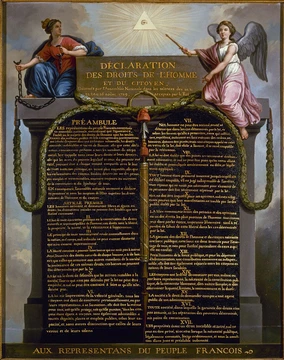
**France** During the French Revolution (July 1789 to September 1791), a National Constituent Assembly formed when representatives, meeting at the only available location—a tennis court—swore the Tennis Court Oath on June 20, 1789, promising not to adjourn until they had drafted a new constitution. King Louis XVI recognized the assembly’s validity on June 27, 1789.
**Germany** The *Parlamentarischer Rat* (Parliamentary Council) in 1948 drafted the Basic Law for the Federal Republic of Germany.
- field
- Constitution-making body
- known_for
- Drafting or revising a constitution
- type
- Representative assembly
- methods_of_selection
- Elected by popular vote, drawn by sortition, appointed, or combination
- duration
- Usually short-term, dissolved after task completion
Lore & Background
Constituent assemblies create constitutions through internally imposed actions, as members are themselves citizens, not necessarily political leaders, of the country for which they are creating a constitution. As described by Columbia University Social Sciences Professor Jon Elster, constitutions arise in different ways, from a sovereign lawgiver at the non-democratic extreme to a constituent assembly elected by universal suffrage solely for writing a new constitution at the democratic extreme, with intermediate arrangements in between. Unlike forms of constitution-making where a constitution is unilaterally imposed by a sovereign lawmaker, the constituent assembly's work is internally imposed.
Reader's Guide
Constituent assemblies function as a distinct form of representative democracy, convened specifically to draft or revise a constitution. Unlike a regular legislature, they are typically temporary bodies, dissolved after completing their task. Their members may be elected by popular vote, chosen by sortition, appointed, or selected through a combination of these methods. As described by scholar Jon Elster, they represent the democratic extreme of constitution-making, where a body elected by universal suffrage writes a new constitution, in contrast to a sovereign lawgiver unilaterally imposing one. Because a constitution is a state’s fundamental document, it often cannot be altered by normal legislative procedures; instead, a constituent assembly, with rules usually laid out in the existing constitution, is required. Historically, notable examples include the Danish Constituent Assembly of 1848, which transitioned Denmark from absolute to constitutional monarchy, and the 2021 Chilean constitutional convention, which featured gender parity and reserved seats for indigenous peoples. The Constituent Assembly of Bangladesh, convened after independence, drafted its constitution in under a year, though its legitimacy was disputed by some political figures. In Costa Rica, a constituent assembly drafted the current constitution following the 1948 civil war. The European Convention drafted a constitution for Europe that was later abandoned after rejection in referendums. The outcomes and legitimacy of such assemblies can be subject to controversy, as seen in Bangladesh, where the resulting constitution has been criticized for fostering autocracy.
Did You Know?
- Members of a constituent assembly may be elected by popular vote, drawn by sortition, appointed, or some combination.
- The European Convention drafted a Constitution for Europe that was abandoned after being rejected in French and Dutch referendums.
Frequently Asked Questions
What is a constituent assembly?
It is a temporary representative body convened specifically to draft a new constitution or substantially revise an existing one. It also goes by names like constitutional convention or constitutional congress, but all refer to the same constitution-making function.
How are members of a constituent assembly selected?
There is no single universal method; members may be elected by popular vote, chosen by random drawing (sortition), appointed by an authority, or selected through a combination of these approaches. The selection mechanism is typically defined by the political context that calls the assembly into being.
How long does a constituent assembly typically last?
It is designed as a short-term body that dissolves once its drafting or revision task is completed. Unlike a standing parliament, it does not continue to operate indefinitely after its constitution-making work is done.
How does a constituent assembly differ from a regular legislature?
A constituent assembly is created for one specific purpose and a limited timeframe, whereas a regular legislature handles ongoing, broad governance. In practice, sitting legislators may make up a large share or even the entirety of the assembly's membership, but the assembly's mandate and lifespan remain distinct.
Why is the concept of a constituent assembly important in constitutional law?
It provides a dedicated, legitimate mechanism for a people to create or fundamentally reshape their foundational legal document outside the normal legislative process. Its temporary, purpose-built nature underscores that constitution-making is treated as a distinct act from ordinary lawmaking.
More in Constitutional Law 1-24
Spotted an error? Know more?
This is a living reference — every entry is fact-audited, and reader corrections feed straight into our audit queue. Suggest an edit · See this site's audit record