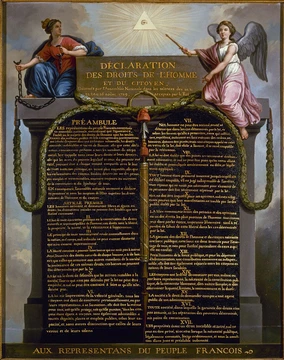
Constitution
A constitution is the supreme law defining governance and limits.

A constitution, also known as a supreme law, is the collection of core principles and established precedents that form the legal foundation of a political entity, organization, or other type of body. It typically sets out how that entity will be governed. If these principles are recorded in one document or a group of legal documents, those texts are considered a written constitution. When they are contained in a single, all-encompassing document, it is called a codified constitution. The United Kingdom provides a well-known example of an uncodified constitution, as its rules are found across numerous legislative acts, court rulings, and treaties.
Constitutions apply to various levels of organization, from sovereign nations to businesses and unincorporated groups. A treaty that creates an international organization also serves as its constitution, defining how that organization is structured. Within countries, a constitution outlines the principles the state is built on, the process for making laws, and who makes them. Some constitutions, particularly codified ones, also limit state power by drawing lines that rulers cannot cross, such as protecting fundamental rights. Changing a constitution often requires a consensus or a supermajority.
The Constitution of India is the longest written constitution of any country, with 146,385 words in its English version, while Monaco’s is the shortest at 3,814 words. San Marino may have the oldest active written constitution, as some of its core documents have been in use since 1600, whereas the United States Constitution is the oldest active codified one. Since 1789, the average lifespan of a written constitution has been about 19 years. There are also different types, such as liberal, absolutist, Islamic, and communist state constitutions.
The word “constitution” comes through French from the Latin *constitutio*, which was used for regulations and orders like imperial enactments (*constitutiones principis*: edicta, mandata, decreta, rescripta). Later, it was widely used in canon law for important determinations, especially decrees issued by the Pope, now called apostolic constitutions. William Blackstone applied the term to serious and egregious violations of public trust so severe that they would justify a revolutionary response. For Blackstone, it did not refer to a legal text, nor did it include the later American idea of judicial review, because that would place the judicial power above the legislature, which he saw as subversive of all government.
Generally, every modern written constitution grants specific powers to an organization or institution, on the condition that it follows the constitution’s limits. According to Scott Gordon, a political organization is constitutional to the extent that it contains institutionalized mechanisms for controlling power to protect the interests and liberties of citizens, including minorities. Actions by officials that fall within their constitutional or statutory authority are called “within power” (*intra vires*); if they do not, they are “beyond power” (*ultra vires*). For instance, a students’ union might be prohibited from engaging in non-student activities; if it does, those activities are *ultra vires* its charter, and no one is bound to follow them. In sovereign states, a provincial parliament in a federal system trying to legislate on a matter reserved for the federal parliament, like ratifying a treaty, would be acting *ultra vires*. Such actions can be judicially reviewed and, if found beyond power, must stop. Legislation found beyond power is invalid and has no force, applying to both primary legislation (requiring constitutional authorization) and secondary legislation (usually requiring statutory authorization). Here, “within power,” *intra vires*, “authorized,” and “valid” mean the same; likewise, “beyond power,” *ultra vires*, “not authorized,” and “invalid” are equivalent.
In most modern states, the constitution takes precedence over ordinary statutory law. When an official act is unconstitutional—meaning it is not a power granted by the constitution—that act is null and void from the start (*ab initio*), not from the date of the ruling. It was never law, even if it was adopted through proper legislative procedures. Sometimes the problem is not that a statute itself is unconstitutional, but that its application in a particular case is; a court may decide that while some applications are constitutional, that specific instance was not allowed. In such cases, only that application is ruled unconstitutional. Historically, remedies for these violations involved petitions for common law writs, like *quo warranto*. Scholars debate whether a constitution must be autochthonous, arising from a nation’s “spirit.” Hegel argued that a constitution is the work of centuries, representing the idea and consciousness of rationality as developed in a particular nation. Constitutional legitimacy can be classified into base.
- oldest_unamended_constitution
- No modern constitution is entirely unamended; both the U.S. and Norwegian constitutions have been amended multiple times.
Lore & Background
A constitution is the supreme law of a polity, establishing the fundamental principles and precedents that form the legal basis for governance. It determines how an entity is to be governed, and when these principles are compiled into a single document, it is a written or codified constitution; if scattered across multiple acts, court cases, and treaties, it is uncodified, as exemplified by the United Kingdom. Constitutions apply to various levels of organization, from sovereign states to companies and international bodies, with a treaty founding an international organization serving as its constitution. Within a state, a constitution defines the basis of the state, lawmaking procedures, and who holds power. Codified constitutions often limit state power by establishing boundaries, such as fundamental rights, that rulers cannot cross. Amendments typically require consensus or a supermajority. The longest written constitution is India’s, with 146,385 words in English, while Monaco’s is the shortest at 3,814 words. San Marino’s constitution may be the oldest active written one, with core documents dating to 1600; the United States Constitution is the oldest active codified constitution. Since 1789, the average lifespan of a written constitution is about 19 years. Constitutions vary in type, including liberal, absolutist, Islamic, and communist forms. Every modern written constitution grants specific powers to an institution on the condition it abides by the constitution’s limits. Actions within this authority are termed intra vires; those beyond are ultra vires and may be invalidated. In most modern states, the constitution is supreme over ordinary law; unconstitutional acts are void from inception. Scholars debate whether a constitution must be autochthonous, arising from a nation’s spirit.
Reader's Guide
Constitutions are fundamental to modern governance, establishing the legal basis and limits of state power. They vary widely: some are codified in a single document, like the U.S. Constitution, while others are uncodified, like that of the United Kingdom, which is written in numerous fundamental acts, court cases, and treaties. Constitutions often require consensus or supermajority for changes and may include limiters of state power, such as fundamental rights. They can be classified as liberal, absolutist, Islamic, or communist state constitutions. The concept of intra vires (within power) and ultra vires (beyond power) is central, with actions beyond power subject to judicial review and invalidation.
Definition, Scope, and the Written vs. Uncodified Divide
A constitution serves as the foundational legal architecture for any governing entity, whether that entity is a sovereign nation, a corporation, or an unincorporated association. At its core, it aggregates the fundamental principles or established precedents that determine how the entity operates and is governed. When these principles are consolidated into one or more legal documents, the result is a written constitution; when they fit into a single comprehensive document, it is called codified. The United Kingdom stands as a prominent counterexample, relying instead on a patchwork of legislative acts, judicial rulings, and treaties rather than a single unified text. Even international organizations find their constitutional basis in the treaties that bring them into existence, which define the structure and authority of the body they create. Within any state, a constitution typically outlines the foundational principles of governance, the procedures for lawmaking, and the identity of those who hold legislative power. Many codified constitutions go further, drawing explicit boundaries on state authority and enshrining fundamental rights that rulers may not transgress. Amendments to these documents often demand supermajorities or broad consensus, reflecting their elevated status above ordinary legislation.
Etymology and the Long Road from Imperial Edict to Supreme Law
The word constitution traces its lineage through French back to the Latin term constitutio, which originally denoted regulations and orders, including imperial enactments such as edicts, mandates, decrees, and rescripts. Over time, the term gained prominence in canon law, where it referred to significant determinations, particularly papal decrees now known as apostolic constitutions. The eighteenth-century jurist William Blackstone employed the term in a markedly different sense, applying it to grave violations of public trust so severe that they would justify a revolutionary response. Notably, Blackstone's usage did not refer to a legal document, nor did it encompass the later American doctrine of judicial review. He explicitly rejected the notion of placing judicial power above legislative power, warning that doing so would be subversive of all government. This historical trajectory reveals how the concept evolved from imperial administrative orders and ecclesiastical decrees into the modern framework of supreme law that structures political authority and protects citizen liberties.
Intra Vires, Ultra Vires, and the Supremacy of Constitutional Authority
Modern written constitutions operate on a fundamental principle: they grant specific powers to institutional entities, but only on the condition that those entities remain within the document's stated limitations. Political theorist Scott Gordon frames this as a political organization being constitutional to the degree that it contains institutionalized mechanisms of power control designed to protect the interests and liberties of all citizens, including minorities. Actions by officials that fall within their constitutional or statutory authority are termed intra vires, or within power; those that exceed that authority are ultra vires, or beyond power. A provincial parliament in a federal state attempting to legislate in an area reserved exclusively for the federal level exemplifies ultra vires action. Such overreach can be subjected to judicial review, and if confirmed as beyond power, the act must cease. In most modern states, the constitution holds supremacy over ordinary statutory law. When an official act is found unconstitutional, it is null and void ab initio, meaning it was never valid law from the moment of its inception, regardless of whether proper legislative procedures were followed in its adoption.
Diversity of Forms, Extreme Scales, and the Fragility of Permanence
Constitutions come in many philosophical and political flavors, including liberal, absolutist, Islamic, and communist state constitutions, each reflecting distinct visions of governance and authority. Yet despite their aspirational permanence, written constitutions have a surprisingly limited lifespan. Scholars also grapple with the intergenerational dead hand problem, where earlier, now-deceased generations continue to govern later ones through constitutional frameworks that are difficult to amend. Hegel himself argued that a constitution is the work of centuries, embodying the developed consciousness of rationality within a particular nation.
Frequently Asked Questions
What is a Constitution?
A constitution is the collection of core principles and long-standing precedents that form the legal foundation of any governing body, whether that body is a nation, a corporation, or an unincorporated group. It sets out how the entity is to be organized and how decisions are made within it.
What role does a Constitution play in governance?
It functions as the supreme legal framework that both defines the structure of government and places hard limits on what that government may do. Every other law or rule must conform to it, making it the topmost authority in the hierarchy.
Is there any modern Constitution that has never been amended?
No. Every modern constitution in use today has been revised at some point; even the U.S. and Norwegian constitutions, often cited as among the oldest, carry multiple amendments.
Does a Constitution only apply to sovereign states?
Not at all. The concept extends to any organized entity that needs a governing charter, including companies, professional bodies, and unincorporated associations. What changes is the scope and complexity, not the underlying purpose.
What is the difference between a written and a codified constitution?
A written constitution simply means the fundamental principles have been committed to one or more legal documents. A codified constitution is a stricter subset: all those principles are gathered into a single, comprehensive text rather than scattered across multiple sources.
More in Constitutional Law 1-24
Spotted an error? Know more?
This is a living reference — every entry is fact-audited, and reader corrections feed straight into our audit queue. Suggest an edit · See this site's audit record