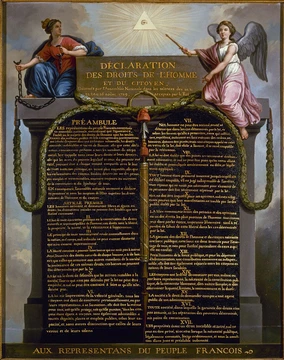
Constitution of the United States
Supreme law of the United States, oldest written national constitution in force.

The Constitution of the United States serves as the highest legal authority in the country. It replaced the earlier Articles of Confederation on March 4, 1789, and originally consisted of seven articles that established the basic framework for the federal government. It remains the world’s oldest written national constitution still in effect.
The document was drafted during the Constitutional Convention, held at Independence Hall in Philadelphia from May 25 to September 17, 1787, with many of the nation’s Founding Fathers participating. Drawing on English common law and Enlightenment thinkers like John Locke and Montesquieu, the first three articles create a separation of powers: a bicameral Congress handles legislation, a president leads the executive branch, and a Supreme Court heads the judiciary. Articles IV, V, and VI outline federalism, covering state government rights and responsibilities, state-federal relations, and the amendment process. Article VII sets the rules for ratification.
Since taking effect in 1789, the Constitution has been amended 27 times. The first ten amendments, called the Bill of Rights, protect individual liberties and limit government power over the states. Amendments 13 through 15 are known as the Reconstruction Amendments. Most later amendments expand civil rights, while some adjust federal authority or government procedures. Unlike many other national constitutions, amendments to the U.S. Constitution are added at the end of the document.
The Constitution has been interpreted, supplemented, and put into practice through a large body of federal constitutional law, and it has shaped the constitutions of other nations.
**History**
**Background**
From September 5, 1774, to March 1, 1781, the Second Continental Congress met in Philadelphia (now Independence Hall) and acted as the country’s provisional government. Delegates to the First Continental Congress in 1774 and the Second Continental Congress from 1775 to 1781 were mostly chosen by revolutionary committees of correspondence, not by colonial governments.
The Articles of Confederation and Perpetual Union was the nation’s first constitution. A committee appointed by the Second Continental Congress drafted it in mid-June 1777, and the full Congress adopted it in mid-November of that year. Ratification by all 13 colonies took over three years, completed on March 1, 1781. The Articles gave the central government very little power. The Confederation Congress could make some decisions but lacked enforcement authority, and most actions—including amendments—required unanimous approval from all 13 states.
Despite these limits, the league of states was considered as strong as any similar republican confederation ever formed, based on the congressional authority in Article 9. The main problem, as George Washington put it, was “no money.” The Congress could print money, but it was worthless; it could borrow but not repay. No state paid its full share of taxes, and some paid nothing. A few states covered interest payments on the national debt owed by their citizens, but nothing more, and no interest was paid on debts to foreign governments. By 1786, the United States faced default on its debts.
Under the Articles, the U.S. could barely defend its sovereignty. Most of the nation’s 625-man army was stationed near non-threatening British forts on American soil. Soldiers went unpaid, some deserted, and others threatened mutiny. Spain closed New Orleans to American trade despite U.S. protests. When Barbary pirates seized American ships, the Treasury had no money for ransom. If a military crisis arose, Congress had no credit or taxing power to respond.
Domestically, the Articles failed to unify the states’ diverse interests. Although the 1783 Treaty of Paris named each American state, several states violated it. New York and South Carolina repeatedly prosecuted Loyalists for wartime actions and redistributed their lands. Individual state legislatures imposed embargoes, negotiated directly with foreign powers, raised armies, and made war—all against the spirit and letter of the Articles.
In September 1786, at the Annapolis convention aimed at reversing protectionist trade barriers between states, James Madison questioned whether the Articles were a binding compact or even a workable government. Connecticut paid nothing and “positively refused” to pay U.S. assessments for two years. A rumor circulated that some New York legislators had opened talks with the Viceroy of Canada. To the south, the British were said to be openly funding Creek Indian raids on Georgia, which was under martial law. Meanwhile, Shays’ Rebellion (August 1786 – June 1787) erupted in Massachusetts.
- Field
- Constitutional law
- Nationality
- United States
- Known for
- Supreme law of the United States, separation of powers, federalism
Lore & Background
Influenced by English common law and the Enlightenment liberalism of philosophers like John Locke and Montesquieu, the Constitution's first three articles embody the doctrine of the separation of powers, dividing the federal government into the legislative, bicameral Congress; the executive, led by the president; and the judiciary, within which the Supreme Court has apex jurisdiction. Articles IV, V, and VI embody concepts of federalism, describing the rights and responsibilities of state governments, the states in relationship to the federal government, and the process of constitutional amendment. Article VII establishes the procedure used to ratify the constitution. The first ten amendments, known collectively as the Bill of Rights, offer specific protections of individual liberty and justice and place restrictions on the powers of government within the U.S. states. Amendments 13–15 are known as the Reconstruction Amendments. The majority of the later amendments expand individual civil rights protections, with some addressing issues related to federal authority or modifying government processes and procedures. Amendments to the United States Constitution, unlike ones made to many constitutions worldwide, are appended to the document.
Reader's Guide
The Constitution of the United States is the oldest and longest-standing written and codified national constitution in force in the world. It has been interpreted, supplemented, and implemented by a large body of federal constitutional law and has influenced the constitutions of other nations. The Constitution established a federal government divided into three branches, embodying separation of powers and federalism. Its amendment process, with 27 amendments appended to the document, has allowed for the expansion of individual civil rights protections, including the Bill of Rights and the Reconstruction Amendments. The Constitution remains the foundational legal document of the United States, shaping its governance and serving as a model for other nations.
Did You Know?
- The first ten amendments, known as the Bill of Rights, offer specific protections of individual liberty and justice.
- Amendments to the United States Constitution are appended to the document, unlike many constitutions worldwide.
The Framing at Philadelphia
This gathering, now called the Constitutional Convention, brought together many of the nation's Founding Fathers to draft what would become the supreme law of the land. The document drew intellectual nourishment from English common law traditions and the liberal philosophical currents of the Enlightenment, particularly the writings of John Locke and Montesquieu. The resulting text was organized into seven articles. The first three laid out a system of separated powers: a bicameral legislative body called Congress, an executive headed by a president, and a judiciary topped by the Supreme Court. Articles four through six addressed federalism—the interplay between state and national authority and the mechanism for constitutional change—while Article seven set the ratification procedure.
The Crisis That Demanded a New Framework
The Confederation Congress could print currency, yet the money proved worthless; it could borrow, yet it could not repay. Abroad, Spain shut New Orleans to American trade, and Barbary pirates seized merchant vessels with the Treasury unable to fund ransoms. Domestically, states violated the Treaty of Paris by prosecuting Loyalists and redistributing their property, while individual legislatures raised armies and negotiated with foreign powers independently.
A Living Document: The Amendment Process
Unlike many constitutions around the world that are periodically rewritten or replaced, the United States Constitution grows by accretion: every amendment is appended to the original text rather than replacing or revising existing language. The first ten additions, collectively called the Bill of Rights, enshrine specific guarantees of individual liberty and justice while placing explicit limits on what governments within the states may do. Amendments thirteen through fifteen, known as the Reconstruction Amendments, addressed the aftermath of the Civil War and the abolition of slavery. The majority of subsequent amendments have broadened protections for individual civil rights, though some have touched on questions of federal authority or altered the mechanics of government processes. This append-only approach means the original seven articles remain visible and intact, serving as a continuous thread through more than two centuries of legal evolution. The result is a document that has been interpreted, supplemented, and implemented through an ever-expanding body of federal constitutional law, adapting to new circumstances without losing its foundational architecture.
Global Standing and Enduring Influence
The Constitution of the United States holds a singular place in the history of governance: it is the oldest written and codified national constitution still in force anywhere in the world. As the first permanent constitution of its kind, it has endured for over two centuries, surviving wars, social upheavals, and profound shifts in public values. Its influence has radiated far beyond American borders, shaping the constitutional frameworks of other nations that have looked to its structure for inspiration. The document's endurance is not merely a matter of age but of continuous legal life; it has been interpreted, supplemented, and implemented through a vast and growing body of federal constitutional law that gives its principles practical force in daily governance. The separation of powers, the federalist balance between state and national authority, and the amendment mechanism together create a framework flexible enough to accommodate change while rigid enough to preserve core structural commitments. In this way, the Constitution functions not as a static relic but as an active, evolving legal instrument that continues to define the relationship between government and the governed.
Frequently Asked Questions
What are the Constitution of the United States's powers/role?
It organizes the federal government into separate branches and distributes authority between the national government and the states. It also serves as the highest legal authority in the country, meaning no other statute can override it.
Why is the Constitution of the United States important?
It is recognized as the oldest written national constitution still in active use anywhere in the world. It established core principles like separation of powers and federalism that continue to shape American governance.
More in Constitutional Law 1-24
Spotted an error? Know more?
This is a living reference — every entry is fact-audited, and reader corrections feed straight into our audit queue. Suggest an edit · See this site's audit record