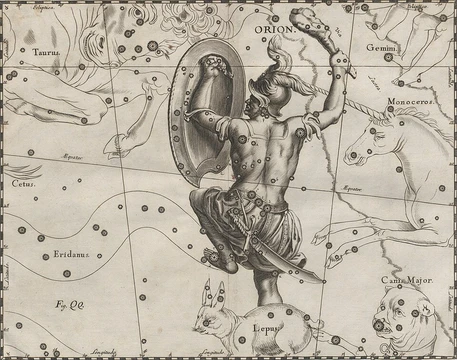
Cepheus
Northern constellation named after a mythical king of Aethiopia.

Cepheus is a constellation located in the deep northern sky, named for the mythical king of Aethiopia. It was one of the 48 constellations cataloged by the second-century astronomer Ptolemy and is still counted among the 88 modern constellations.
Its brightest star, Alderamin (Alpha Cephei), shines at magnitude 2.5. The constellation is home to Delta Cephei, the prototype for the important class of pulsating stars known as Cepheid variables. Several of the largest known stars reside here, including the orange hypergiant RW Cephei and the red supergiants Mu Cephei, MY Cephei, VV Cephei, V381 Cephei, and V354 Cephei. Cepheus also contains the hyperluminous quasar S5 0014+81, which hosts an ultramassive black hole at its core with a mass of about 40 billion Suns—roughly 10,000 times more massive than the Milky Way’s central black hole, making it one of the most massive black holes known.
In Greek mythology, Cepheus was the king of Aethiopia, husband to Cassiopeia, and father of Andromeda. All three are now immortalized as constellations.
The second-brightest star, Gamma Cephei (Errai), has an apparent magnitude of 3.21 and is a binary system composed of an orange giant or subgiant and a red dwarf; its primary star hosts one exoplanet, Gamma Cephei Ab (Tadmor). Delta Cephei is a yellow-hued supergiant 980 light-years away, discovered to be variable by John Goodricke in 1784. It varies between magnitudes 3.5 and 4.4 over 5 days and 9 hours, with a size ranging from 40 to 46 solar diameters. It is also a double star with a wide-set blue-hued companion of magnitude 6.3.
Four red supergiants in Cepheus are visible to the naked eye. Mu Cephei, known as the Garnet Star for its deep red color, is a semiregular variable with a magnitude range of 3.4 to 5.1 over about two years; its radius is estimated between 972 and 1,420 solar radii, which would extend past Jupiter’s orbit if placed at the center of the Solar System. VV Cephei A, a semiregular variable about 5,000 light-years away, varies from magnitude 4.8 to 5.4 and is paired with a blue main-sequence star, VV Cephei B; the red supergiant primary is about 1,050 times larger than the Sun. VV Cephei is also an unusually long-period eclipsing binary, with eclipses every 20.3 years too faint for the unaided eye. Zeta Cephei, the fourth-brightest star at magnitude 3.35, has a diameter less than 200 times that of the Sun, placing its surface between the orbits of Venus and Earth. V381 Cephei Aa, the faintest of the four, has a maximum magnitude of 5.5, is part of a triple star system, and has a diameter 980 times that of the Sun. All four stars had initial masses over eight solar masses and are considered core-collapse supernova candidates.
Nu Cephei is a blue supergiant similar to Deneb, with an initial mass over 20 solar masses, and belongs to the Cepheus OB2 stellar association along with Mu Cephei and VV Cephei. Several prominent double and binary stars exist: Omicron Cephei is a binary with an 800-year period, 211 light-years away, consisting of an orange-hued giant (magnitude 4.9) and a secondary (magnitude 7.1). Xi Cephei, 102 light-years away, has a 4,000-year period, with a blue-white primary of magnitude 4.4 and a yellow secondary of magnitude 6.5. Krüger 60 is an 11th-magnitude binary of two red dwarfs, only 13 light-years away; it was once considered a possible home system for the interstellar comet 2I/Borisov, but that idea was later rejected.
Cepheus is rich in star-forming regions and emission nebulae. Most structures visible in wide-field views lie in the Orion Arm of the Milky Way, about 2,800 to 3,600 light-years away. Notable deep-sky objects include: NGC 188, the closest open cluster to the north celestial pole and one of the oldest known; NGC 6946 (the Fireworks Galaxy), a spiral galaxy where ten supernovae have been observed, more than in any other galaxy; IC 469, a spiral galaxy with a compact nucleus and oval shape; NGC 7538, home to the largest-yet-discovered protostar; NGC 7023, a reflection nebula with an associated star cluster (Collinder 429), magnitude 7.7, 1,400 light-years away near Beta and T Cephei; Sh 2-155 (the Cave Nebula), a dim, diffuse bright nebula within a larger complex; the quasar 6C B0014+8120, one of the most powerful objects in the universe, powered by a 40-billion-solar-mass black hole; and Sh 2-131, ionized by the stars of the region.
- field
- Constellation
Lore & Background
Cepheus is a constellation of the deep northern sky, one of the 48 listed by Ptolemy and still among the 88 modern constellations. It represents the mythical king of Aethiopia, husband of Cassiopeia and father of Andromeda, all of whom are also constellations. In visualizations, Cepheus is typically shown with his arms raised in prayer for his daughter’s life, or as a monarch seated on a throne. Its brightest star is Alderamin, with an apparent magnitude of 2.5. The constellation is notable for Delta Cephei, the prototype of the Cepheid variable stars, which pulsate and change in brightness. Cepheus contains several of the largest known stars, including the orange hypergiant RW Cephei and red supergiants such as Mu Cephei (the Garnet Star), VV Cephei, and V381 Cephei. It also hosts the hyperluminous quasar S5 0014+81, whose core contains an ultramassive black hole of about 40 billion solar masses, among the most massive known. The constellation is rich in star-forming regions and emission nebulae, including the open cluster NGC 188, the spiral galaxy NGC 6946 (the Fireworks Galaxy), and the nebula NGC 7538, which contains the largest known protostar.
Reader's Guide
Cepheus is a constellation in the deep northern sky, one of the 48 listed by Ptolemy and still among the modern 88. It is named for the mythical king of Aethiopia, husband of Cassiopeia and father of Andromeda, all of whom are also constellations. The constellation’s brightest star is Alderamin (Alpha Cephei), with an apparent magnitude of 2.5. Its second-brightest is Gamma Cephei (Errai), a binary system whose primary hosts an exoplanet. Delta Cephei is the prototype of the Cepheid variable stars, a class of pulsating variables; it was discovered to vary by John Goodricke in 1784, cycling between magnitudes 3.5 and 4.4 over about five days. Cepheus contains several of the largest known stars: the red supergiants Mu Cephei (the Garnet Star), VV Cephei A, Zeta Cephei, and V381 Cephei Aa, all accepted core-collapse supernova candidates. Mu Cephei is a semiregular variable; if placed at the Solar System’s center, it would likely extend past Jupiter’s orbit. VV Cephei A is an unusually long-period eclipsing binary with a blue companion. The constellation also hosts the hyperluminous quasar S5 0014+81, whose ultramassive black hole is reported at 40 billion solar masses, about 10,000 times more massive than the Milky Way’s central black hole. Deep-sky objects include NGC 188, the closest open cluster to the north celestial pole and one of the oldest known; NGC 6946 (the Fireworks Galaxy), which has hosted more observed supernovae than any other galaxy; and NGC 7538, home to the largest-yet-discovered protostar.
Did You Know?
- Delta Cephei is the prototype of the Cepheid variable stars, varying between magnitude 3.5 and 4.4 over 5 days and 9 hours.
Common Misconceptions (Editorial)
Some people assume that constellations named after mythological figures are always depicted in a heroic or triumphant pose, but Cepheus is most commonly shown with his arms aloft, praying for his daughter Andromeda's life. Additionally, it is often thought that all variable stars are rare or obscure, but Delta Cephei is the prototype of the famous Cepheid variables and varies predictably between magnitude 3.5 and 4.4 over a well-documented cycle.
Why It Matters (Editorial)
Cepheus endures as a celestial landmark because it bridges ancient storytelling and modern astrophysics, housing both the mythic lineage of a king pleading for his family and some of the most extreme objects in the universe—from ultramassive black holes to the giant stars that gave us the Cepheid variable, a key tool for measuring cosmic distances. Its place among Ptolemy’s original 48 constellations reminds us that our maps of the night sky are woven from both human imagination and scientific discovery.
More in Constellations 1-22
Spotted an error? Know more?
This is a living reference — every entry is fact-audited, and reader corrections feed straight into our audit queue. Suggest an edit · See this site's audit record