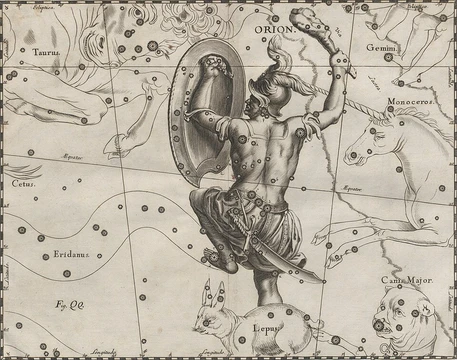
Orion
A winter constellation named after a hunter in Greek mythology.

Orion is a well-known constellation that appears in the winter sky of the Northern Hemisphere. It is one of the 88 officially recognized constellations today and was also one of the 48 that the astronomer Ptolemy cataloged in the 2nd century AD. The constellation gets its name from a hunter in Greek mythology.
During winter evenings in the Northern Hemisphere, Orion stands out, along with five other constellations that are part of the Winter Hexagon asterism. Its two brightest stars, Rigel (designated Beta Orionis) and Betelgeuse (Alpha Orionis), are both supergiants with slight variations in brightness, and each ranks among the brightest stars in the night sky. Six additional stars in Orion shine brighter than magnitude 3.0, including the three that form the short, straight line of Orion’s Belt. The constellation is also home to the radiant of the annual Orionid meteor shower—the strongest meteor shower linked to Halley’s Comet—and the Orion Nebula, one of the sky’s most luminous nebulae.
Orion covers 594 square degrees, making it the 26th largest of the 88 constellations. It is bordered by Taurus to the northwest, Eridanus to the southwest, Lepus to the south, Monoceros to the east, and Gemini to the northeast. The constellation’s official boundaries, set by Belgian astronomer Eugène Delporte in 1930, form a 26-sided polygon. In the equatorial coordinate system, these borders lie between right ascension 04h 43.3m and 06h 25.5m, and declination between 22.87° and −10.97°. The International Astronomical Union assigned Orion the three-letter abbreviation “Ori” in 1922.
Orion is most visible in the evening sky from January to April—winter in the Northern Hemisphere and summer in the Southern Hemisphere. Near the equator (within about 8°), the constellation passes directly overhead at the zenith. From May to July, Orion is in the daytime sky and invisible at most latitudes. However, in much of Antarctica during the Southern Hemisphere’s winter, the Sun stays below the horizon even at midday, so the brightest stars—including Orion’s—can be seen at twilight for a few hours around noon, low in the northern sky where the Sun is just below the horizon. At the South Pole itself, Rigel rises only 8° above the horizon, and the Belt sweeps along it. During the Southern Hemisphere’s summer, Orion is normally visible at night, but it cannot be seen in Antarctica because the Sun never sets south of the Antarctic Circle at that time of year. In countries near the equator, such as Kenya, Indonesia, Colombia, and Ecuador, Orion appears overhead in December around midnight and in the February evening sky.
Orion is a handy tool for finding other stars. Extending the line of the Belt southeastward leads to Sirius; northwestward, to Aldebaran. A line eastward across the two shoulders points toward Procyon. A line from Rigel through Betelgeuse points to Castor and Pollux. Rigel is also part of the Winter Circle asterism, and both Sirius and Procyon—which can be located using imaginary lines from Orion—are part of the Winter Triangle and the Winter Circle.
The seven brightest stars in Orion form a distinctive hourglass shape. Four stars—Rigel, Betelgeuse, Bellatrix, and Saiph—make a large, roughly rectangular frame, with the three stars of Orion’s Belt (Alnitak, Alnilam, and Mintaka) at the center. An eighth star, Meissa, marks the hunter’s head and is fairly bright. Below the Belt hangs a smaller line of three stars known as Orion’s Sword; the middle “star” is actually the Orion Nebula. Many of these stars are hot, luminous blue supergiants, and the stars of the Belt and Sword belong to the Orion OB1 association. Betelgeuse, with its distinct red hue, may be a runaway member of the same group.
Betelgeuse (Alpha Orionis) is a massive M-type red supergiant nearing the end of its life. It is the second-brightest star in Orion and a semiregular variable. It represents the hunter’s right shoulder (assuming he faces the observer). Usually the 11th-brightest star in the night sky, its brightness has varied from 10th to 23rd by the end of 2019. Its eventual supernova explosion is expected to be highly visible from Earth, possibly outshining the Moon and appearing during the day, likely within the next 100,000 years.
Rigel (Beta Orionis) is a B-type blue supergiant and the seventh-brightest star in the night sky. Like Betelgeuse, it is fusing heavy elements in its core and will soon (on an astronomical timescale) leave its supergiant stage, possibly ending in a supernova. It marks the hunter’s left foot.
Bellatrix (Gamma Orionis) is the 27th-brightest star in the night sky. It is a B-type blue giant, but too small to explode as a supernova; its brightness comes from its high temperature, not a large radius. Bellatrix marks Orion’s left shoulder. Its name means “the female warrior,” and it is sometimes called the “Amazon Star.” At 244.6 light-years away, it is the closest major star in Orion.
Mintaka (Delta Orionis) is the faintest of the three Belt stars, despite its designation. Its name means “the belt.” It is a multiple star system with a large B-type blue giant and a more massive O-type main sequence star.
- Type
- Constellation
- Abbreviation
- Ori
- Brightest Stars
- Rigel (β) and Betelgeuse (α)
- Notable Asterisms
- Orion's Belt, Winter Hexagon, Winter Triangle
- Meteor Shower
- Orionids (radiant)
- Nebula
- Orion Nebula
Lore & Background
Orion is a prominent constellation visible during winter in the Northern Hemisphere, listed among the 48 constellations by the 2nd-century astronomer Ptolemy and now one of the 88 modern constellations. Named after a hunter in Greek mythology, its seven brightest stars form a distinctive hourglass shape: four stars—Rigel, Betelgeuse, Bellatrix, and Saiph—create a large rectangle, with the three stars of Orion’s Belt (Alnitak, Alnilam, and Mintaka) at the center. Betelgeuse, a red supergiant and semiregular variable, marks the hunter’s right shoulder and is among the brightest stars in the night sky, while Rigel, a blue supergiant, serves as the left foot. The constellation also hosts the Orion Nebula, one of the brightest nebulae, and the radiant of the annual Orionids meteor shower, linked to Halley’s Comet. Covering 594 square degrees, Orion ranks 26th in size among constellations. Its boundaries, set by Eugène Delporte in 1930, form a 26-sided polygon. Orion is bordered by Taurus, Eridanus, Lepus, Monoceros, and Gemini. It is most visible in evening skies from January to April in the Northern Hemisphere and summer in the Southern Hemisphere; near the equator, it appears overhead in December around midnight and in February evenings. The constellation is a useful navigational aid: extending the Belt southeastward leads to Sirius, northwestward to Aldebaran, and a line across the shoulders points to Procyon.
Reader's Guide
Orion is very useful as an aid to locating other stars. Extending the line of the Belt southeastward finds Sirius; northwestward, Aldebaran. A line eastward across the two shoulders indicates Procyon. A line from Rigel through Betelgeuse points to Castor and Pollux. Rigel is part of the Winter Circle asterism. Orion's seven brightest stars form a distinctive hourglass-shaped asterism. Four stars—Rigel, Betelgeuse, Bellatrix, and Saiph—form a large rectangle, with the three stars of Orion's Belt at the center. Descending from the Belt is Orion's Sword, which contains the Orion Nebula, one of the brightest nebulae in the sky. Many stars are luminous hot blue supergiants, forming the Orion OB1 association. Rigel is a blue supergiant that will also eventually end in a supernova. Orion hosts the radiant of the annual Orionids, the strongest meteor shower associated with Halley's Comet.
Did You Know?
- The Orion Nebula, located in Orion's Sword, is one of the brightest nebulae in the sky.
- Betelgeuse is a semiregular variable star that may end in a supernova visible during the day.
- The Orionids meteor shower is the strongest meteor shower associated with Halley's Comet.
Mythological Roots & Astronomical Legacy
Orion carries one of the oldest names in Western astronomy, drawn from Greek mythology where it represents a great hunter. This celestial figure was already catalogued by the 2nd-century AD astronomer Ptolemy, who included it among his 48 constellations—a list that formed the backbone of Western star lore for centuries. Today, Orion stands as one of the 88 officially recognized modern constellations, with its boundaries formally defined by Belgian astronomer Eugène Delporte in 1930 as a 26-sided polygon. The International Astronomical Union adopted the three-letter abbreviation "Ori" in 1922. Its borders are shared with Taurus, Eridanus, Lepus, Monoceros, and Gemini, placing it at a crossroads of the winter sky. The constellation's right ascension stretches from 04h 43.3m to 06h 25.5m, while its declination ranges from +22.87° to −10.97°, giving it a broad equatorial presence visible from both hemispheres.
The Hunter's Form & Stellar Cast
The seven brightest stars of Orion arrange themselves into a striking hourglass silhouette that has guided stargazers for millennia. Four of these—Rigel, Betelgeuse, Bellatrix, and Saiph—outline a broad rectangle, while the three stars of the Belt (Alnitak, Alnilam, and Mintaka) sit at its center like a girdle. An eighth star, Meissa, marks the hunter's head, and a short descending line called the Sword drops below the Belt, its middle "star" actually being the luminous Orion Nebula. The stellar population skews toward hot blue supergiants; the Belt and Sword stars together form the Orion OB1 association. Rigel, a blue supergiant and the constellation's brightest star, is also fusing heavy elements and may one day detonate.
A Navigator's Compass in the Winter Sky
Orion has long served as a celestial wayfinding tool, its geometry offering reliable pointers to neighboring stars and constellations. Extending the Belt's line toward the southeast leads the eye to Sirius, while the same line stretched northwestward finds Aldebaran in Taurus. Drawing a line eastward across the two shoulder stars points toward Procyon, and a line from Rigel through Betelgeuse directs the observer to Castor and Pollux in Gemini. Rigel also anchors the Winter Circle asterism, and both Sirius and Procyon appear in the Winter Triangle as well. Seasonally, Orion dominates winter evenings in the Northern Hemisphere (roughly January through April) and summer nights in the Southern Hemisphere. In tropical regions near the equator, the constellation transits nearly at the zenith. During Northern Hemisphere summer, Orion is lost in daylight at most latitudes, though in Antarctica's polar winter the Sun stays below the horizon, allowing the brightest stars to shimmer low in the northern twilight around local noon.
Nebulae, Meteors & the Orionids
Beyond its brilliant stars, Orion shelters two of the most celebrated deep-sky phenomena visible to the naked eye. The Orion Nebula, nestled in the middle of the Sword, is one of the brightest nebulae in the entire sky—a vast stellar nursery that has captivated observers since the invention of the telescope. The constellation also hosts the radiant point of the Orionids meteor shower, the most powerful meteor stream linked to Halley's Comet. Each year, Earth passes through debris left along the comet's orbit, and the meteors appear to stream outward from a point within Orion's boundaries. The constellation's coordinate range—right ascension between 04h 43.3m and 06h 25.5m, declination from +22.87° to −10.97°—places it squarely in the equatorial zone, making both the nebula and the meteor shower accessible to observers across a wide band of latitudes. Together, these features ensure that Orion remains a focal point of both amateur and professional astronomy throughout the year.
Common Misconceptions (Editorial)
Some people think Orion is only visible in the Northern Hemisphere, but it can be seen overhead near the equator in December and in the summer evening sky in the Southern Hemisphere. Another common misconception is that Orion’s brightest star is Betelgeuse, when in fact Rigel and Betelgeuse share the title as the constellation’s brightest stars. Additionally, the Orionid meteor shower is sometimes mistakenly attributed solely to Orion, but it is actually the strongest meteor shower associated with Halley’s Comet.
Why It Matters (Editorial)
Orion endures because it bridges ancient mythology and modern astronomy, offering a familiar landmark in the night sky that guides both casual stargazers and scientists. Its rich features—from the brilliant Orion Nebula to the volatile Betelgeuse—keep it a subject of ongoing fascination and discovery, reminding us that the stars above are both timeless and dynamic.
Frequently Asked Questions
Who is Orion?
Orion is a legendary hunter from Greek mythology, and the constellation bearing his name is one of the most instantly recognizable star patterns in the night sky. It was catalogued by Ptolemy in the 2nd century AD as one of his 48 constellations and remains one of the 88 officially recognized today.
What makes Orion stand out among constellations?
Orion holds two of the brightest stars in the sky—Betelgeuse and Rigel—and features the famous three-star row known as Orion's Belt. It also hosts the Orion Nebula, one of the most studied deep-sky objects, and serves as an anchor point for both the Winter Triangle and the Winter Hexagon asterisms.
How does Orion's story end?
In the most widely told version, the boastful hunter was slain by a scorpion sent by the earth goddess Gaia after he claimed he could slay every creature on the planet. Zeus then placed the two on opposite sides of the sky so they would never meet again, which is why Scorpius rises as Orion sets.
Why is Orion important to stargazers?
Orion acts as a winter navigation anchor for northern-hemisphere observers, and its distinctive hourglass shape plus the bright belt stars make it a reliable landmark for locating nearby stars and deep-sky targets. It is also the radiant for the Orionids meteor shower, adding a seasonal event to its already rich sky presence.
When and where is the best time to see Orion?
Orion is a winter constellation, so it dominates the evening sky from roughly November through February in the northern celestial hemisphere. Look for the three aligned belt stars first, then trace the surrounding hourglass to confirm you have found the full figure.
More in Constellations 1-22
Spotted an error? Know more?
This is a living reference — every entry is fact-audited, and reader corrections feed straight into our audit queue. Suggest an edit · See this site's audit record