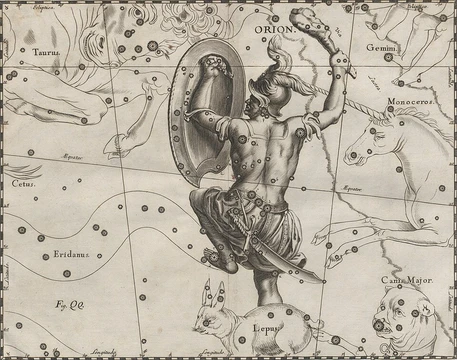
Taurus
An ancient zodiac constellation featuring the Pleiades and Crab Nebula.

Taurus, meaning "Bull" in Latin, is a zodiac constellation found in the northern celestial hemisphere. It dominates the winter sky of the Northern Hemisphere as a large, prominent grouping of stars. Recognized since at least the Early Bronze Age, it once marked the Sun's position during the spring equinox. This connection to the agricultural calendar helped shape bull imagery in the myths of several ancient cultures, including Sumer, Akkad, Assyria, Babylon, Egypt, Greece, and Rome. Its astrological symbol, ♉︎, is designed to look like a bull's head.
Several features in Taurus draw astronomers' attention. The constellation contains two of the closest open star clusters to Earth: the Pleiades and the Hyades, both visible without a telescope. Its brightest star is Aldebaran, a red giant of first magnitude. In the northeastern part of Taurus lies Messier 1, better known as the Crab Nebula—a supernova remnant that houses the Crab Pulsar. The Taurus-Auriga complex, one of the nearest regions where stars are actively forming, extends into the northern part of the constellation. The variable star T Tauri serves as the prototype for a class of pre-main-sequence stars.
Taurus sits between Aries to the west and Gemini to the east, with Perseus and Auriga to the north, Orion to the southeast, Eridanus to the south, and Cetus to the southwest. It reaches opposition—its farthest point from the Sun—in late November to early December, making it visible all night. By late March, it sets at sunset, and from May to July it vanishes entirely in the Sun's glare. As a zodiac constellation, the ecliptic passes through it, marking the Sun's apparent annual path. Because the Moon and planets orbit near this plane, they can often be found in Taurus at some point each year. The Milky Way's galactic plane cuts across the northeast corner, and the galactic anticenter lies near the Taurus-Auriga border. Taurus is unique among constellations in that it is crossed by all three of the galactic equator, celestial equator, and ecliptic. Gould's Belt, a ring-like galactic structure, also passes through it.
The International Astronomical Union adopted "Tau" as the constellation's three-letter abbreviation in 1922. Belgian astronomer Eugène Delporte defined its official boundaries in 1930 using a 26-sided polygon. In equatorial coordinates, its right ascension ranges from 03h 23.4m to 05h 53.3m, and its declination from 31.10° to −1.35°. Because a small portion lies south of the celestial equator, Taurus is not completely circumpolar at any latitude.
Bayer assigned designations Alpha through Omega and Latin letters A through u to the most prominent stars. He later designated three stars as Delta and two each as Theta, Kappa, Sigma, Omega, and the Latin letter A. The star g Tauri was dropped after being identified as a duplicate of Kappa Ceti (Kappa1 and Kappa2). Four stars in Taurus shine above magnitude 3. The brightest, Aldebaran, is an orange-hued K5 III giant. Its Arabic name, al-dabarān, means "the follower," likely because it trails the Pleiades across the night sky. A V- or K-shaped asterism forms the bull's face, created by bright members of the Hyades—the nearest distinct open cluster after the Ursa Major Moving Group. In this pattern, Aldebaran represents the bull's bloodshot eye, described as glaring at Orion to the southeast. Aldebaran has about 116% of the Sun's mass and hosts a candidate exoplanet. The Hyades span roughly 5° of sky, best viewed with binoculars or the naked eye, and include the naked-eye double star Theta Tauri (Theta2 Tauri's proper name is Chamukuy), with a separation of 5.6 arcminutes.
In the northwestern quadrant lies the Pleiades (M45), one of the most famous open clusters, easily visible without aid. Its seven brightest stars, all at least magnitude six, give it the nickname "Seven Sisters." A modest telescope reveals many more stars; astronomers estimate the cluster contains 500 to 1,000 stars, all about 100 million years old, though they vary widely in type. The Pleiades include large, bright stars as well as many brown dwarfs and white dwarfs. The cluster is expected to dissipate in another 250 million years. It is classified as Shapley class c and Trumpler class I 3 r n, meaning it is irregular and loose but concentrated at its center and detached from the surrounding star field.
To the east, the bull's two horns are formed by Beta (β) Tauri and Zeta (ζ) Tauri, separated by 8°. Beta, a white B7 III giant known as El Nath (from the Arabic for "the butting"), is the constellation's second-brightest star at magnitude 1.65. It shares a border with Auriga and also carries the designation Gamma Aurigae. Zeta Tauri, whose proper name is Tianguan, is an eclipsing binary that completes an orbit every 133 days.
- type
- Constellation
- abbreviation
- Tau
- brightest_star
- Aldebaran
- nearest_open_clusters
- Pleiades and Hyades
- notable_deep_sky_objects
- Crab Nebula (M1), Taurus-Auriga complex
- zodiac_member
- Yes
- traditional_symbol
- ♉︎
Lore & Background
The brightest star in Taurus is Aldebaran, an orange-hued giant of spectral class K5 III. Its name comes from the Arabic for 'the follower,' likely because it follows the Pleiades. Aldebaran forms the bull's bloodshot eye in a V-shaped asterism created by the Hyades open cluster. The Pleiades (M45) are another prominent open cluster, easily visible to the naked eye and known as the 'Seven Sisters.' The two horns of the bull are formed by Beta Tauri (El Nath) and Zeta Tauri (Tianguan), separated by 8°. The constellation also contains the variable star T Tauri, the prototype of a class of pre-main-sequence stars.
Reader's Guide
Taurus holds significance both historically and astronomically. As one of the oldest constellations, it marked the spring equinox during the Early Bronze Age and influenced bull imagery in multiple ancient cultures. Astronomically, it hosts two of the nearest open clusters to Earth—the Pleiades and the Hyades—both visible to the naked eye. The Crab Nebula (M1), a supernova remnant from an explosion observed in 1054, lies in the northeast part of Taurus and contains the Crab Pulsar. The Taurus-Auriga complex, one of the closest regions of active star formation, crosses into the northern part of the constellation. The star T Tauri is the prototype for a class of young stellar objects. The constellation's boundaries were officially set in 1930 by Eugène Delporte, and its three-letter abbreviation 'Tau' was adopted in 1922. Taurus is the only constellation crossed by all three of the galactic equator, celestial equator, and ecliptic.
Did You Know?
- Taurus is the only constellation crossed by all three of the galactic equator, celestial equator, and ecliptic.
- The Crab Nebula (M1) was created by a supernova observed on Earth on July 4, 1054, and was bright enough to be seen during the day.
- The star T Tauri is the prototype of a class of pre-main-sequence stars.
- Aldebaran, the brightest star in Taurus, has a candidate exoplanet.
Ancient Roots & Mythological Resonance
Taurus stands as one of humanity's oldest recognized constellations, with evidence stretching back to the Early Bronze Age. During that era, it marked where the Sun sat at the spring equinox, making it a critical anchor point for agricultural calendars across the ancient world. This practical importance rippled outward into the mythologies of nearly every major civilization of the ancient Near East and Mediterranean—Sumer, Akkad, Assyria, Babylon, Egypt, Greece, and Rome all developed their own bull figures, likely inspired by the constellation's seasonal prominence. The traditional astrological symbol, a stylized bull's head (♉︎), has carried this identity forward through millennia. What makes Taurus remarkable is not merely its age but the way a single celestial pattern became a shared cultural thread binding disparate civilizations together through the universal language of the winter sky.
Aldebaran & the Hyades Face
The heart of Taurus is Aldebaran, an orange-hued K5 III giant star that reigns as the constellation's brightest member at first magnitude. Its Arabic name, al-dabarān, translates to "the follower," a fitting title given its nightly pursuit of the Pleiades across the sky. But its most iconic role is visual: nestled within the V-shaped asterism formed by the Hyades cluster, it plays the bull's bloodshot eye, long described as glaring menacingly at Orion, the hunter constellation lying just to the southeast. The Hyades itself is the nearest distinct open star cluster after the Ursa Major Moving Group, spanning roughly five degrees of sky—wide enough that only binoculars or a keen unaided eye can take in the full pattern. Among its members sits Theta Tauri, a naked-eye double star whose brighter component carries the proper name Chamukuy, with the two components separated by 5.6 arcminutes.
The Pleiades & Stellar Nurseries
In the northwestern quadrant of Taurus, the Pleiades—catalogued as M45—shine as one of the most celebrated open clusters in the night sky. Commonly called the Seven Sisters for its seven most prominent stars, all at least visual magnitude six, the cluster actually contains an estimated 500 to 1,000 members, all roughly 100 million years old. The population is remarkably diverse: alongside the large, bright stars that give the cluster its fame, astronomers have identified numerous small brown dwarfs and white dwarfs. Classified as a Shapley class c and Trumpler class I 3 r n cluster, the Pleiades is irregularly shaped and loosely structured, though concentrated at its center and clearly detached from the surrounding star field. Beyond the Pleiades, Taurus also shelters the Taurus-Auriga complex, one of the closest regions of active star formation, and the prototype pre-main-sequence star T Tauri, which gives its name to an entire class of young stellar objects.
Celestial Geometry & Astronomical Distinctions
Taurus occupies a uniquely privileged position in celestial geometry. It is the only constellation in the entire sky crossed by all three major reference circles simultaneously: the galactic equator, the celestial equator, and the ecliptic. The galactic plane of the Milky Way clips its northeast corner, while the galactic anticenter sits near the Taurus-Auriga border. A ring-like galactic structure called Gould's Belt also threads through the constellation. As a zodiac constellation, Taurus is intersected by the ecliptic—the apparent path of the Sun over Earth's annual orbit—which means the Moon and planets regularly pass through it. Its official boundaries, defined by Belgian astronomer Eugène Delporte in 1930 as a 26-segment polygon, span right ascension from 03h 23.4m to 05h 53.3m and declination from +31.10° to −1.35°. Because a small sliver dips below the celestial equator, Taurus can never be fully circumpolar at any latitude. The IAU adopted "Tau" as its three-letter abbreviation in 1922.
Common Misconceptions (Editorial)
- Some may think the Crab Nebula (M1) is a typical nebula, but it was actually created by a supernova observed on Earth in 1054 and was bright enough to be seen during the day. - It is sometimes assumed that Aldebaran is part of the Hyades cluster, but it actually forms the bull's bloodshot eye in a V-shaped asterism created by the Hyades, not as a member of the cluster itself.
Why It Matters (Editorial)
Taurus endures because it bridges practical astronomy and cultural mythology, marking the location of the Sun during the spring equinox in the Early Bronze Age and grounding agricultural calendars across ancient civilizations. Its star Aldebaran and iconic clusters like the Pleiades and Hyades remain visible anchors in the winter sky, while the Crab Nebula's recorded supernova connects modern astrophysics directly to medieval observations, showing how this constellation continues to link humanity to the cosmos.
Frequently Asked Questions
Who is Taurus?
Taurus represents the bull from Greek mythology, most famously the creature Zeus transformed himself into to abduct Europa. In the night sky it appears as a V-shaped star cluster (the Hyades) with the orange star Aldebaran marking the bull's eye, set against the northern winter sky.
What role does Taurus play in the zodiac?
As a zodiac member, Taurus marks the stretch of the Sun's annual path that it crosses each spring, a position it held at the spring equinox during the Early Bronze Age. That agricultural timing made the bull a central figure in farming calendars across Sumerian, Egyptian, Greek, and Roman cultures.
How does Taurus's myth end?
In the most widely told Greek version, Zeus becomes a white bull, carries the Phoenician princess Europa across the sea to Crete, and the two eventually share children there. The constellation preserves that moment of transformation and flight, with the Pleiades sometimes read as Europa's startled attendants.
Why is Taurus important to astronomers?
It hosts the Crab Nebula (M1), the glowing remnant of a supernova witnessed in 1054 CE, making it a key target for studying stellar death. The constellation also contains the Pleiades and Hyades open clusters plus the Taurus-Auriga molecular cloud complex, an active star-forming region visible to amateur observers.
When and where is Taurus easiest to see?
Taurus dominates the northern hemisphere's winter sky and is best viewed from roughly October through March. Its brightest star, Aldebaran, sits just above the Hyades cluster, and the whole figure rides fairly low on the horizon for mid-northern latitudes at peak season.
More in Constellations 1-22
Spotted an error? Know more?
This is a living reference — every entry is fact-audited, and reader corrections feed straight into our audit queue. Suggest an edit · See this site's audit record