Computer hardware
Physical parts of a computer directed by software.
Last updated
Computer hardware encompasses the tangible components of a computing system, such as the central processing unit (CPU), random-access memory (RAM), motherboard, data storage devices, graphics and sound cards, and the computer case, along with peripherals like monitors, keyboards, mice, and speakers. It operates under the direction of software—written instructions that can be stored and executed—and together they form a functional computing system. The term "hardware" reflects its rigid, unchangeable physical nature, contrasting with the easily modifiable "software."
The history of hardware stretches back to the seventeenth century. In 1642, Blaise Pascal created the Pascaline, a gear-based adding and subtracting machine. Gottfried Leibniz later invented the stepped reckoner in 1676, capable of multiplication and division, though design flaws limited its practicality; similar Leibniz wheel mechanisms persisted into the 1970s. In the nineteenth century, Charles Babbage designed the difference engine for calculating polynomials and a general-purpose computer that was never built, but its concepts—punch cards, memory, an arithmetic unit, and a primitive programming language—influenced early computers.
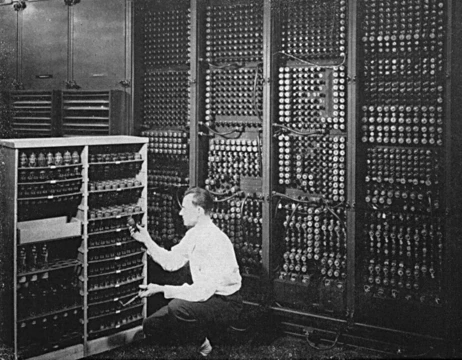
Alan Turing’s 1936 universal Turing machine modeled any computer’s operations via stored programs, linking hardware and software. George Boole’s mid-nineteenth-century Boolean algebra became the foundation for modern integrated circuit logic. By 1945, relays and vacuum tubes enabled the first computers, such as George Stibitz’s relay machines and Howard Aiken’s MARK I. John von Neumann’s 1945 architecture—centralized memory storing both data and programs, a CPU with memory priority, and I/O units—became the template for most modern computers, though its single bus created the von Neumann bottleneck when fetching data and programs simultaneously.
Computer architecture
Computer architecture balances cost, speed, availability, and energy efficiency, requiring knowledge from compilers to integrated circuit design. Cost pressures have driven manufacturers to lower prices and reduce profit margins, while improved manufacturing has steadily dropped component costs. The most common instruction set architecture (ISA) derives from von Neumann’s 1945 design.
Quick Facts
- Known for
- Physical components of computing systems
- including CPU
- RAM
- motherboard
- storage
- and peripherals
Facts from the source article.
Lore & Background
In the 19th century, Charles Babbage designed the difference engine and a general-purpose computer that was never built, but his design influenced later computers with punch cards, memory, an arithmetic unit, and a primitive programming language. In 1936, Alan Turing developed the concept of the universal Turing machine, a stored-program computer model that could mimic any Turing machine based on software instructions. Boolean algebra, invented by George Boole in the mid-19th century, became the basis for circuits in modern hardware. In 1945, John von Neumann devised the von Neumann architecture, featuring centralized memory for data and programs, a CPU, and input/output units, though its single bus created the von Neumann bottleneck.
Reader's Guide
Computer hardware is significant as the tangible foundation of all computing systems, enabling the execution of software instructions. Its development from mechanical calculators to electronic computers was driven by advances in relays, vacuum tubes, and integrated circuits. The von Neumann architecture, introduced in 1945, became the template for most modern computers, though its design introduced performance limitations.
Instruction set architectures (ISAs), such as CISC and RISC, define the interface between hardware and software; RISC, invented in the 1980s, displaced CISC in many applications due to its simplicity and efficiency. Cooling and power delivery have become critical constraints, as processors generate heat that can throttle performance or damage components, leading to air and liquid cooling solutions. The personal computer remains a common type due to its versatility and relatively low price.
Did You Know?
- The term 'hardware' derives from the fact that it is hard or rigid with respect to changes, unlike software which is easy to change.
Frequently Asked Questions
What is Computer hardware?
Computer hardware refers to every tangible, physical part that makes up a computing system, from the internal chips and boards to the peripherals you plug in and interact with daily.
How does Computer hardware work together with software?
Hardware on its own cannot act; it follows the written instructions provided by software to carry out specific tasks. Together, the physical components and the code running on them form a fully functional computing system.
More in Computing & Digital
Sources
Compiled from Wikipedia and the sources listed below. Text from Wikipedia is available under CC BY-SA 4.0; this entry is adapted from it.
- Wikipedia: Computer hardware (CC BY-SA 4.0).
Spotted an error? Know more?
Reader corrections go straight into our review queue. Suggest an edit · How this site is sourced