Computer simulation
Last updated
Computer simulation is the running of a mathematical model on a computer to represent the behavior of a real-world or physical system.[1] Since the 1940s, scientists have increasingly relied on computer simulations to understand phenomena that cannot be experienced directly.[2] New technologies can be investigated and the performance of systems that are too intricate for analytic approaches can be assessed through simulation.[1]
Quick Facts
- Field
- Computational science
- Early example
- Simulation of 12 hard spheres using a Monte Carlo algorithm
Facts from the source article.
Key facts and history
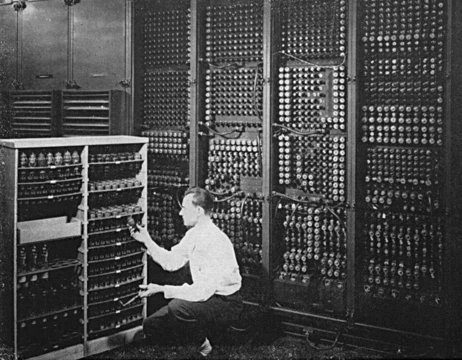
Computer simulation first saw large-scale deployment during the Manhattan Project in World War II to model nuclear detonation.[3] Human computers, often the wives of scientists, performed calculations to support the development of the first atomic bombs.[2] Over time, human computers were replaced by mechanical and then electronic computers such as the MANIAC.[2] Today, supercomputers perform billions of calculations per second.[2]
In 1997, a desert-battle simulation modeled 66,239 tanks, trucks and other vehicles on simulated terrain around Kuwait.[4] A 2005 simulation modeled the ribosome using 2.64 million atoms.[4] The Blue Brain project at EPFL, begun in May 2005, aims to create the first computer simulation of the entire human brain.[4] A Monte Carlo algorithm was used to simulate a dozen hard spheres in an early computer model.[3]
Programs that execute on networked computers, ranging from quick, small-scale runs to extensive simulations lasting many hours or days, are how computer simulations are implemented.[4]
What the cited sources add
The Los Alamos National Laboratory account states that computer simulations let scientists conduct virtual experiments using mathematical models that attempt to replicate natural behavior.[2] The Laboratory’s supercomputers are used for non-weapons work, including the fight against COVID-19 and understanding biology, climate, and space.[2] Uri Wilensky and William Rand (2007) note that scientists have increasingly employed computer models in their work.[5] They also describe that a model could be replicated in a different computer language or a different modeling toolkit.[5]
Moss (2000) developed a "canonical environment" to facilitate the docking of social simulation models.[5]
References
- Wikipedia, "Computer simulation" (CC BY-SA 4.0), which cites: Strogatz, "What is your dangerous idea?", HarperCollins, 2007 (we also read that source) en.wikipedia.org
- "Los Alamos National Laboratory has led the world in developing and using computer simulations to understand the world around us.", Los Alamos National Laboratory, December 2020. facts only, no text reused. lanl.gov
- Wikipedia, "Computer simulation" (CC BY-SA 4.0), which cites: Bratley, "A Guide to Simulation", Springer Science & Business Media, 2011-06-28 (we also read that source) en.wikipedia.org
- Wikipedia, "Computer simulation" (CC BY-SA 4.0), which cites: "Researchers stage largest Military Simulation ever", Jet Propulsion Laboratory, December 4, 1997; "Molecular Simulation of Macroscopic Phenomena", IBM Research - Almaden; "Los Alamos National Laboratory has led the world in developing and using computer simulations to understand the world around us.", Los Alamos National Laboratory, December 2020; Graham-Rowe, "Mission to build a simulated brain begins", New Scientist, June 6, 2005 (we also read that source) en.wikipedia.org
- Wilensky, "Making Models Match: Replicating an Agent-Based Model", Journal of Artificial Societies and Social Simulation, 2007, p. 2. facts only, no text reused. jasss.soc.surrey.ac.uk
Each numbered sentence above was checked against the source it cites before publication. Sentences citing Wikipedia adapt text from the English Wikipedia article Computer simulation (contributors), used under CC BY-SA 4.0; this entry is available under the same licence. Other sources were used for facts only; no text or images are copied from them.
More in Computing & Digital
Sources
Compiled from Wikipedia and the sources listed below. Text from Wikipedia is available under CC BY-SA 4.0; this entry is adapted from it.
- Wikipedia: Computer simulation (CC BY-SA 4.0).
Spotted an error? Know more?
Reader corrections go straight into our review queue. Suggest an edit · How this site is sourced