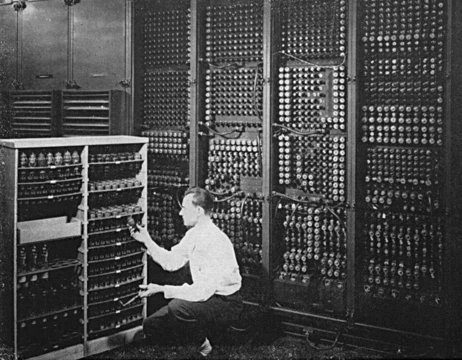
Data storage
Last updated
Recording information onto a physical substance like handwriting, magnetic tape, or optical discs constitutes data storage.[1] Information is held by the physical material known as a recording medium.[2] General-purpose computers rely on storing digital data in machine-readable form as a fundamental operation.[3]
Key facts and history
Electronic channels in 2002 contained three and a half times more new information than was stored.[4] In 1986, about 1% of the world's storage capacity was digital; by 2007 it was 94%.[5] By 2025, an estimated 181 zettabytes of data were generated.[6][7] The decreasing cost of magnetic hard drives and optical media like CD-ROMs and DVDs drove the surge in personal digital storage.[4]
The same UC Berkeley report indicated that the volume of new information stored on paper, film, optical, and magnetic media had doubled over the three years prior to 2002.[4] A 2011 Science article by Hilbert identified 2002 as the start of the digital age for storage, when digital devices began holding more information than analog ones.[5] The International Data Corporation found that in 2007, total digital data reached 281 exabytes, marking the first time this amount exceeded worldwide storage capacity.[8][9] Between 1986 and 2007, digital storage capacity grew from under three compressed exabytes to 295 compressed exabytes, with the amount doubling approximately every three to four years.[10]
What the cited sources add
The UC Berkeley press release notes that the 2002 study was supported by Microsoft Research, Intel, HP, and EMC.[4] Intel's storage division general manager Mike Wall stated that technology must manage data blocks the size of the Library of Congress without losing a bit.[4] Roy Sanford of EMC said the study highlights the challenge of managing information according to its value at every life stage.[4] The same report states that videos account for about 82% of all global internet data traffic.[7]
References
- Wikipedia, "Data storage" (CC BY-SA 4.0), which cites: ; Hubert, "DNA seen through the eyes of a coder", 9 January 2021 (we also read that source) en.wikipedia.org
- Wikipedia, "Data storage" (CC BY-SA 4.0), which cites: Lyman, "HOW MUCH INFORMATION 2003?", UC Berkeley, School of Information Management and Systems, October 23, 2003 (original not read by us) en.wikipedia.org
- Wikipedia, "Data storage" (CC BY-SA 4.0), which cites: Rotenstreich, "The Difference between Electronic and Paper Documents", George Washington University (original not read by us) en.wikipedia.org
- Maclay, "Amount of new information doubled in last three years, UC Berkeley study finds", University of California, Berkeley, 28 October 2003. facts only, no text reused. berkeley.edu
- Wikipedia, "Data storage" (CC BY-SA 4.0), which cites: Hilbert, "The World's Technological Capacity to Store, Communicate, and Compute Information", Science, 2011, p. 60–65 (original not read by us) en.wikipedia.org
- Wikipedia, "Data storage" (CC BY-SA 4.0), which cites: Duarte, "Amount of Data Created Daily (2023)", April 3, 2023 (we also read that source) en.wikipedia.org
- Duarte, "Amount of Data Created Daily (2023)", April 3, 2023. facts only, no text reused. explodingtopics.com
- Wikipedia, "Data storage" (CC BY-SA 4.0), which cites: Theirer, "IDC's "Diverse & Exploding Digital Universe" report", 14 March 2008 (we also read that source) en.wikipedia.org
- Theirer, "IDC's "Diverse & Exploding Digital Universe" report", 14 March 2008. facts only, no text reused. techliberation.com
- Wikipedia, "Data storage" (CC BY-SA 4.0), which cites: Hilbert, "The World's Technological Capacity to Store, Communicate, and Compute Information", Science, 2011, p. 60–65; Hilbert, "Video animation on The World's Technological Capacity to Store, Communicate, and Compute Information from 1986 to 2010", 15 June 2011 (original not read by us) en.wikipedia.org
Each numbered sentence above was checked against the source it cites before publication. Sentences citing Wikipedia adapt text from the English Wikipedia article Data storage (contributors), used under CC BY-SA 4.0; this entry is available under the same licence. Other sources were used for facts only; no text or images are copied from them.
More in Computing & Digital
Sources
Compiled from Wikipedia and the sources listed below. Text from Wikipedia is available under CC BY-SA 4.0; this entry is adapted from it.
- Wikipedia: Data storage (CC BY-SA 4.0).
Spotted an error? Know more?
Reader corrections go straight into our review queue. Suggest an edit · How this site is sourced