Computer keyboard
Last updated
A computer keyboard is a peripheral input device modeled after the typewriter keyboard, using buttons or keys as mechanical levers or electronic switches.[1] Characters are typically engraved or printed onto keyboard keys, and a single written symbol is usually the result of pressing one key.[2] To generate certain symbols, a user may need to press and hold multiple keys at the same time or in a specific order.[2]
Quick Facts
- Type
- Input device
- Ancestor
- Typewriter
- Key spacing (ansi)
- 0.75 inches (19 mm) centers
- Key travel (ansi)
- at least 0.15 inches (3.8 mm)
Facts from the source article.
Key facts and history
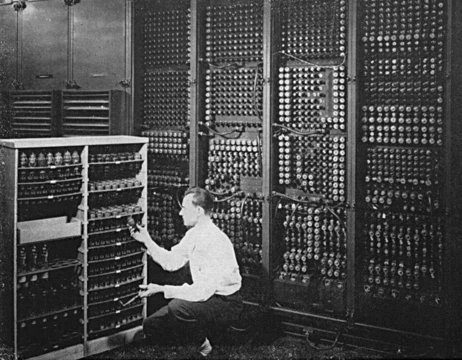
The development of the ENIAC computer incorporated a keypunch device as both input and paper-based output.[3] The BINAC computer used an electromechanically controlled typewriter for data entry onto magnetic tape and data output.[3] The first keypunch devices were created by Herman Hollerith, and by the 1930s these had evolved to include keys for entering text and numbers, similar to typewriters.[4] Throughout most of the 20th century, the teleprinter's keyboard was crucial for both point-to-point and point-to-multipoint communication.[3]
Until the mouse was introduced as a consumer product in 1984, the keyboard was the most essential and integrated computer peripheral.[5] Despite the use of virtual keyboards on mobile devices like smartphones, physical keyboards remain essential for human-computer interaction.[5] Keyboards sold in the US typically have 104 keys, while those sold elsewhere usually have 105 keys.[6] Omitting the numeric keypad is the most frequent way to make a keyboard more compact; this design is called "tenkeyless" or TKL.[7]
What the cited sources add
The Nelson-Miller account states that flexible keyboards are designed to bend and flex without breaking, and they contain a full arrangement of keys with shorter key distances than traditional mechanical keyboards.[8] The same source notes that silicone rubber is the most popular material for flexible keyboards, creating an impermeable shell that protects against moisture and foreign objects.[8] That article also reports that in the late 1970s, companies like Cherry, Key Tronic, and Micro Switch took off with their own approaches to mimicking the mechanical feel of a typewriter with computer keyboard circuitry.[9] The same guide states that tenkeyless keyboards have 87 or 88 keys with about 80% of the width of a full-size keyboard.[10]
The Keyboard Company guide notes that full-size keyboards have 104, 105, or 108 keys, corresponding to ANSI (used in the USA), ISO (used in the EU), and JIS (used in Japan) layouts.[10]
References
- Wikipedia, "Computer keyboard" (CC BY-SA 4.0), which cites: "computer keyboard", TheFreeDictionary.com; "Keyboard and mouse basics nidirect", www.nidirect.gov.uk, 2015-12-04 (original not read by us) en.wikipedia.org
- Wikipedia, "Computer keyboard" (CC BY-SA 4.0), which cites: Khalid Saeed, "New Directions in Behavioral Biometrics", CRC Press, 2016 (we also read that source) en.wikipedia.org
- Wikipedia, "Computer keyboard" (CC BY-SA 4.0), which cites: "Past is prototype: The evolution of the computer keyboard", ComputerWorld.com, 2 November 2012 (we also read that source) en.wikipedia.org
- Wikipedia, "Computer keyboard" (CC BY-SA 4.0), which cites: Smith, Andy, "Gallery: IBM: 100 Years of THINKing Big", ZDNet, 15 June 2011 (original not read by us) en.wikipedia.org
- Wikipedia, "Computer keyboard" (CC BY-SA 4.0), which cites: D Kocielinski, "Proceedings of the 15th international conference on Human-computer interaction with mobile devices and services - MobileHCI '13", 2013, p. 546 (we also read that source) en.wikipedia.org
- Wikipedia, "Computer keyboard" (CC BY-SA 4.0), which cites: Judd, "Full-size, TKL, 60% and more: a guide to mechanical keyboard sizes", The Keyboard Company, 9 August 2017 (we also read that source) en.wikipedia.org
- Wikipedia, "Computer keyboard" (CC BY-SA 4.0), which cites: "TENKEYLESS <nowiki>", Cambridge Dictionary (original not read by us) en.wikipedia.org
- "What is a Flexible Keyboard?", Nelson-Miller.com, 31 August 2017. facts only, no text reused. nelson-miller.com
- "Past is prototype: The evolution of the computer keyboard", ComputerWorld.com, 2 November 2012. facts only, no text reused. computerworld.com
- Judd, "Full-size, TKL, 60% and more: a guide to mechanical keyboard sizes", The Keyboard Company, 9 August 2017. facts only, no text reused. keyboardco.com
Each numbered sentence above was checked against the source it cites before publication. Sentences citing Wikipedia adapt text from the English Wikipedia article Computer keyboard (contributors), used under CC BY-SA 4.0; this entry is available under the same licence. Other sources were used for facts only; no text or images are copied from them.
More in Computing & Digital
Sources
Compiled from Wikipedia and the sources listed below. Text from Wikipedia is available under CC BY-SA 4.0; this entry is adapted from it.
- Wikipedia: Computer keyboard (CC BY-SA 4.0).
Spotted an error? Know more?
Reader corrections go straight into our review queue. Suggest an edit · How this site is sourced