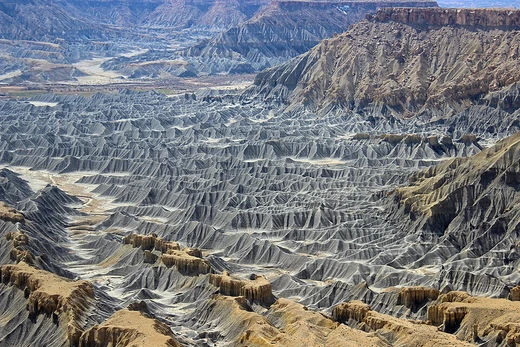
Cut bank
Erosional outer bank of a meandering stream.

A cut bank—sometimes called a river cliff or river-cut cliff—is the outer bank of a meander bend in a stream, where erosion is constant. It sits opposite the point bar (or slip-off slope) on the inner side of the curve. Resembling a small cliff, it forms when the stream’s flow hits the bank directly. Unlike the point bar, which collects sediment washed downstream from a cut bank, the cut bank itself is a site of material loss.
These banks are typically steep, often nearly vertical. Erosion can undercut them, causing chunks of bank, trees, and other vegetation to collapse or slide into the water. Flooding and ongoing bank erosion may also damage nearby buildings and infrastructure. Over time, the combined effects of erosion on cut banks and deposition on point bars can create an oxbow lake.
Cut banks are not only steep and unstable; they also mark the fastest and often deepest part of the stream. The higher velocity and energy of the water along the outer bend drive the erosion that shapes the cut bank.
- field
- Geomorphology
- known_for
- Erosional landform on the outer bend of a meandering stream
- characteristics
- Steep, nearly vertical, unstable, area of fastest and deepest water flow
Lore & Background
Cut banks, also referred to as river cliffs or river-cut cliffs, form on the outer side of meander bends in a water channel, where the stream’s flow collides directly with the bank. This outer bank is continually undergoing erosion, in contrast to the opposite inner side of the bend, which features a point bar or slip-off slope where material is deposited. The defining shape of a cut bank resembles a small cliff, often steep and nearly vertical. The water along this outer bend flows with greater velocity and energy, making it both faster and deeper than other parts of the stream, which drives the erosion process. Erosion can undercut the bank, causing masses of bank material, trees, and vegetation to collapse or slide into the river. Flooding and ongoing bank erosion may also damage nearby property and structures. Over extended periods, the combined effects of erosion on cut banks and deposition on point bars can lead to the formation of an oxbow lake. Cut banks are notably unstable, and their steep, eroding faces are a key characteristic of meandering streams.
Reader's Guide
Cut banks are significant as a primary site of lateral erosion in meandering streams, shaping river valleys over time. Their steep, unstable nature poses hazards to nearby structures and vegetation, as undercutting can cause collapse. The faster, deeper flow along cut banks drives the erosion that, paired with deposition on point bars, can eventually isolate meander loops into oxbow lakes. Understanding cut banks is essential for managing riverbank stability, predicting channel migration, and interpreting fluvial landscapes. They represent a key component of the dynamic balance between erosion and deposition in river systems.
Did You Know?
- Cut banks are also known as river cliffs or river-cut cliffs.
- They occur on the outer side of meander bends, opposite the point bar.
- Erosion of a cut bank can cause trees and vegetation to collapse into the river.
- The combination of cut bank erosion and point bar deposition can form an oxbow lake.
More in Coastal And Fluvial Geomorphology 1-24
Spotted an error? Know more?
This is a living reference — every entry is fact-audited, and reader corrections feed straight into our audit queue. Suggest an edit · See this site's audit record