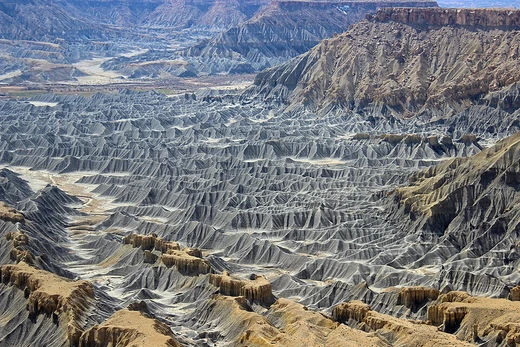
Bedform
Geological features formed at fluid-moveable bed interfaces.

A bedform is a geological feature that forms where a fluid meets a movable bed, created when the fluid flow shifts bed material. Riverbeds, for instance, can display ripples and dunes. These features often survive in the rock record if they formed in a depositional setting. Because bedforms typically correspond to specific flow conditions, they can help estimate flow depth, velocity, and thus the Froude number. **Bedform Initiation** Bedforms appear in many settings—rivers, deserts, glacial outwash, deltas, and deep seas—but how they first develop is still debated. Two main models exist, which are not mutually exclusive: defect initiation and instantaneous initiation. **Defect Initiation** This theory holds that turbulent sweeps in flowing water pick up sediment, which then settles and creates small irregularities, or defects, in a non-cohesive bed. These defects spread downstream through flow separation, building up fields of bedforms. The defects likely start from packets of hairpin vortex structures. These coherent turbulent features produce corridors where sediment is entrained, forming grain lineations. These lineations interact with low-speed streaks, causing grains to clump together. Once a clump reaches a critical height, flow separates over it. Sediment erodes near the reattachment point and deposits farther downstream, forming a new defect. That defect triggers another, and the process repeats, propagating downstream as grain piles quickly grow into small bedforms. **Instantaneous Initiation** Defect propagation tends to dominate when sediment transport is low; at high transport rates, defects may wash away, and bedforms can arise across the entire bed at once. In this model, a cross-hatch pattern first appears, then develops into chevron-shaped forms that move independently of the pattern. These chevrons reorganize into the future crest lines of the bedforms. This instantaneous initiation may stem from a Kelvin-Helmholtz type instability at the interface between a fast-moving pseudofluid sediment layer and the fluid above. Unlike defect initiation, this process does not seem linked to coherent turbulent structures, since random events in space and time could lock into place to create the cross-hatch pattern. The role of turbulence is unclear because bedforms can also occur under laminar flows. Studies of laminar-generated bedforms have used time-averaged flow conditions to confirm laminar Reynolds numbers, yet infrequent bursts and sweeps—still present at low Reynolds numbers—might drive formation. Whether bedforms truly form in laminar flows remains debated; if they do, it suggests other defect-formation processes exist beyond the one proposed by Best (1992), especially at low sediment transport rates. **Bedform Phase Diagrams** Phase diagrams (or stability diagrams) are graphs showing the flow and sediment conditions under which one or more stable bed states exist. A stable bed is in dynamic equilibrium—it changes and adjusts but remains constant in form for a given flow. This is not a static or frozen shape. These diagrams serve two main purposes: predicting bed states from known flow and sediment conditions, and reconstructing past environments from preserved bed states or sedimentary structures. Despite their usefulness, such diagrams are hard to construct, often leaving them incomplete or difficult to interpret because of the many variables needed. **Bedforms vs. Flow** For typical unidirectional flows over sands and silts, specific bedforms correspond to specific water velocities and depths. A general chart (shown below) can help interpret depositional environments, with increasing water velocity moving down the chart. However, changes in grain size or flow depth can alter which bedform appears, sometimes skipping certain forms. In bidirectional environments like tidal flats, similar bedforms occur, but reworking by opposing flows complicates the structures. The sequence can also be illustrated diagrammatically. **Types of Bedforms**
**Lower Plane Bed** A "lower plane bed" is a flat riverbed configuration that forms under low rates of sediment transport. **Upper Plane Bed** An "upper plane bed" is also flat but occurs under unidirectional flow with high sediment transport, both as bed load and suspended load. These conditions can produce parting current lineations—subtle streaks on the bed surface from the high-energy flow.
- field
- Geology, sedimentology
- known_for
- Geological features formed by fluid flow on a moveable bed
- types
- Ripples, dunes, lower plane bed, upper plane bed
- initiation_models
- Defect initiation, instantaneous initiation
Lore & Background
Bedforms are omnipresent in many environments, including fluvial, eolian, glaciofluvial, deltaic and deep sea, although there is still debate on how they develop. Two separate, though not mutually exclusive, models of bedform initiation exist: defect initiation and instantaneous initiation. The defect theory proposes that turbulent sweeps entrain sediment that upon deposition generates defects in a non-cohesive material, which then propagate downstream via flow separation. The origin of these defects is thought to be linked to packets of hairpin vortex structures, which give rise to entrainment corridors and grain lineations that interact with low-speed streaks, forming an agglomeration of grains. Once a critical height is reached, flow separation occurs, and sediment is eroded near the reattachment point and deposited downstream, creating a new defect that propagates the process.
Reader's Guide
Bedforms are significant because they are preserved in the rock record and can be used to infer past flow conditions, such as depth, velocity, and the Froude number, aiding in the reconstruction of paleoenvironments. Phase or stability diagrams are used for prediction of bed states in known flow and sediment transport conditions and as a tool for paleoenvironmental reconstruction, though they are difficult to construct due to the number of variables needed. The study of bedforms also highlights ongoing scientific debates, such as whether bedforms can occur under laminar flows, which would suggest alternative processes for defect development beyond those proposed for turbulent flows. This uncertainty underscores the complexity of bedform dynamics and the need for further research.
Did You Know?
- Bedforms are often preserved in the rock record as a result of being present in a depositional setting.
- There are two separate, though not mutually exclusive, models of bedform initiation: defect initiation and instantaneous initiation.
- The defect theory proposes that defects originate from packets of hairpin vortex structures in turbulent flows.
- Instantaneous initiation may be a manifestation of an interfacial hydrodynamic instability of Kelvin-Helmholtz type between a pseudofluid sediment layer and the fluid above it.
Frequently Asked Questions
What is a Bedform in coastal and fluvial geomorphology?
A bedform is a shaped feature that develops where a flowing fluid interacts with a mobile sediment bed, produced as the current transports and reorganizes the bed material into distinct morphologies.
What are the main types of Bedforms?
The principal categories include ripples, dunes, lower plane bed, and upper plane bed, each reflecting different flow regimes acting on the same moveable substrate.
How do Bedforms initiate?
Two classic models explain their onset: defect initiation, where a small irregularity grows into a full form, and instantaneous initiation, where the entire bed transitions to a new morphology at once once a critical flow threshold is crossed.
Why do geomorphologists care about preserved Bedforms in the rock record?
Because bedforms fossilize in depositional settings, their geometry lets researchers back-calculate ancient flow depth, velocity, and Froude number, effectively turning a rock layer into a flow meter.
Where are Bedforms most commonly observed today?
They are routinely seen on the beds of rivers and in coastal shallow-water environments wherever unconsolidated sediment is exposed to sustained fluid motion.
More in Coastal And Fluvial Geomorphology 1-24
Spotted an error? Know more?
This is a living reference — every entry is fact-audited, and reader corrections feed straight into our audit queue. Suggest an edit · See this site's audit record