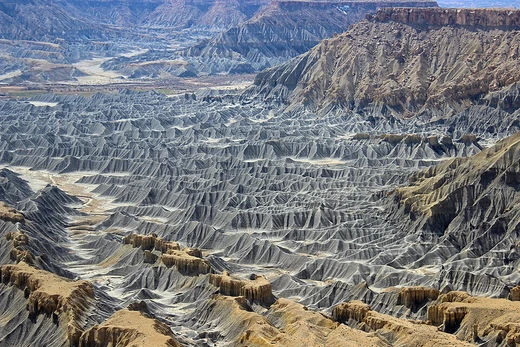
Bay mud
Soft, water-saturated estuarine sediment with geotechnical and ecological significance.

Bay mud is a soft, water-saturated silty clay that accumulates in thick deposits on the floors of certain temperate-region estuaries, particularly those shaped by cyclical glacial cycles. These deposits are found in locations such as San Francisco Bay, the Bay of Fundy, Florida Bay, the Bristol Channel, and the Wadden Sea, among others. The mud originates from two main sources: alluvial clays, silts, and sands carried by tributary streams, and layers of silts, sands, and organic detritus—including decomposed diatoms—deposited during periods of high glaciation. As a result, bay muds serve as important geological records of glacial activity and streamflow throughout the Quaternary period. The timing of deposition varies widely; for example, much of Florida Bay’s mud has accumulated since 2000 BCE, accreting at rates of 0.5 to 2.0 centimeters per year, while the Bristol Channel’s mud formation dates back at least 130,000 years to the Eemian Stage. In San Francisco Bay, sea-level changes have created distinct layers known as Young bay mud and Older bay mud, with nearly half of the Young Bay Mud deposited between 1855 and 1865 due to placer mining debris from the Sierra Nevada. Bay mud typically has a bulk density of about 1.3 grams per cubic centimeter, high organic content, and low shear strength, high compressibility, and low permeability. These properties make construction hazardous in seismically active areas; buildings often require deep piles anchored to firmer strata below, as seen with the Dakin Building in Brisbane, California, which uses piles 150 feet deep. When exposed by low tides, bay mud forms mudflats, critical ecological zones for shorebirds and marine life. Dredging of shipping channels is common, requiring chemical testing for heavy metals and PCBs, and channels often need repeated dredging every ten to thirty years due to sediment redeposition.
- typical bulk density
- approximately 1.3 grams per cubic centimetre
- geological abbreviations
- Qobm (Quaternary older bay mud) and Qybm (Quaternary younger bay mud)
- common locations
- Cape Cod Bay, Florida Bay, San Francisco Bay, Bay of Fundy, Bristol Channel, Wadden Sea, Banc d'Arguin, Chongming Dongtan Reserve
- primary hazards
- low shear strength, high compressibility, low permeability
- ecological role
- mudflats provide habitat for shorebirds, molluscs, estuarine arthropods, eelgrass, cordgrass, pickleweed
Lore & Background
Bay mud consists of thick deposits of soft, unconsolidated silty clay, saturated with water, found at the bottom of certain estuaries in temperate regions that have experienced cyclical glacial cycles. It typically has a bulk density of about 1.3 grams per cubic centimetre and exhibits low shear strength, high compressibility, and low permeability, making construction hazardous in seismically active areas like the San Francisco Bay Area. The mud often has high organic content from decayed organisms at depth, while the upper layer, when exposed by low tides, forms mudflats that serve as important ecological zones for shorebirds and marine life. Bay mud originates from two sources: alluvial deposits of clays, silts, and sand from tributary streams, and deposits from periods of high glaciation containing silts, sands, and organic or inorganic detritus, such as decomposed diatoms. These layers act as time records of glacial activity and streamflow throughout the Quaternary period. In San Francisco Bay, deposition was interrupted by sea-level changes, creating distinct strata known as Young bay mud and Older bay mud, with official geological abbreviations Qybm and Qobm. Human activities, such as placer mining in the Sierra Nevada foothills, placed nearly half of the Young Bay Mud in San Francisco Bay between 1855 and 1865. Notable structures built over bay mud include the Dakin Building in Brisbane, California, which uses piles 150 feet deep anchored to the Franciscan formation, and Boston’s Back Bay district, Logan International Airport, and San Francisco International Airport. Dredging of shipping channels is often necessary, with chemical analyses performed to detect heavy metals, PCBs, or other toxic substances.
Reader's Guide
Bay mud is significant for its dual role as a geological record and a challenging substrate for construction. The muds also pose hazards in seismically active regions like the San Francisco Bay Area. Ecologically, exposed mudflats provide critical habitat for shorebirds and marine organisms, while also trapping larger mammalian predators. Dredging of bay muds for shipping channels requires chemical analysis for heavy metals and PCBs, and regulatory frameworks in the United States often mandate environmental impact reports and permits from the Army Corps of Engineers. The data from such investigations have revealed concentrations of mercury, lead, chromium, and other pollutants, reflecting human activities of the last century.
Did You Know?
- Bay mud has official geological abbreviations: Qobm for Quaternary older bay mud and Qybm for Quaternary younger bay mud.
- In Florida Bay, bay mud has accumulated since 2000 BCE, accreting at rates of 0.5 to 2.0 centimeters per year.
- Humphrey the humpback whale became stuck on a mudflat in San Francisco Bay at Sierra Point in Brisbane, California.
Frequently Asked Questions
What exactly is Bay mud?
Bay mud is a thick, soft, water-saturated silty clay that accumulates on the floors of temperate estuaries over repeated glacial cycles. It remains unconsolidated, highly compressible, and typically carries a bulk density near 1.3 g/cm³.
What makes Bay mud so dangerous to build on?
Its very low shear strength, high compressibility, and poor permeability mean structures can settle unpredictably, and in seismically active zones the saturated clay can lose nearly all load-bearing capacity during shaking. This is why cities like San Francisco treat it as a major engineering challenge.
Where are the most well-known Bay mud deposits?
Notable occurrences include San Francisco Bay, Cape Cod Bay, Florida Bay, the Bay of Fundy, the Bristol Channel, the Wadden Sea, and the Banc d'Arguin. The Chongming Dongtan Reserve in China is another prominent example.
What's the difference between Qobm and Qybm?
These are standard geological abbreviations used to separate two stratigraphic units: Qobm refers to Quaternary older bay mud, while Qybm designates Quaternary younger bay mud. The split reflects distinct depositional episodes within the Quaternary period.
Why is Bay mud ecologically important?
When low tides expose the upper layers, they form mudflats that serve as critical feeding and nesting habitat for shorebirds, molluscs, estuarine arthropods, and plants like eelgrass, cordgrass, and pickleweed. These zones rank among the most productive ecosystems in temperate coastal regions.
More in Coastal And Fluvial Geomorphology 1-24
Spotted an error? Know more?
This is a living reference — every entry is fact-audited, and reader corrections feed straight into our audit queue. Suggest an edit · See this site's audit record