
OV7
Mexican Latin pop group formed in 1989, disbanded indefinitely in 2023.

Unknown author · CC0
OV7, first known as La Onda Vaselina, were a Mexican Latin pop group that started in 1989. Over more than three decades, they scored numerous hits across Latin America and are counted among the most successful acts in Latin pop history. The group broke up in 2003, got back together in 2010, and in 2023 said they were splitting up for an indefinite period.
The group came out of a trend started in the 1980s by the pop group Timbiriche. In 1989, after the Mexican run of the stage show *Grease* (called *Vaselina* in Spanish) ended, singer and producer Julissa decided to create her own version of it. She put together a group based on the play, first called La Onda Vaselina. Their first album was a success, with the singles "Qué Buen Reventón" and a cover of Neil Sedaka's "Breaking Up Is Hard to Do" ("Qué Triste Es El Primer Adiós") becoming big hits in the early 1990s. That album sold over 100,000 copies and led to a successful tour. Their second album, *Onda Vaselina 2*, became one of Mexico's best-selling records of the 1990s, with songs like "El Calendario" and "Voy Voy Voy" becoming widely known. The third album, *Dulces Para Ti*, featured hits "Tú Serás Mi Baby" and "La Llorona Loca" and was followed by live shows at Mexico City's Teatro Aldama.
For their fourth album, *La Banda Rock*, the group made a regional Mexican music record. Its biggest hit was "Pónganse Botas, Quítense Tennis." They also had several hits in Spain from this album. After a long break, they returned with *Hoy*, a teen-market album mixing alternative rock and pop with strong lyrics. The singles "Sube y Baja" and "Perdón" did not do well, and the group considered splitting up.
In 1997, La Onda Vaselina made a strong comeback with *Entrega Total*, which hit number one in Mexico and across Latin America. The singles "Mírame a los Ojos," "Un Pie Tras Otro Pie," and "Te Quiero Tanto Tanto" (which reached number one on the Billboard Latin chart) became lasting hits. The group toured and filled the Auditorio Nacional four times while releasing *Vuela Más Alto*, which included the hit "No Es Obsesión." After that, they took a break and ended their relationship with manager and creator Julissa.
Eight years later, the group returned without Julissa.
Quick Facts
- Background
- group_or_band
- Landscape
- yes
- Alias
- La Onda Vaselina
- Origin
- Mexico
- Genre
- Latin pop
- Instrument
- Vocals
- Years Active
- 1989–2003 · 2010–2023 · 2026-Present Day
- Label
- Melody / Fonovisa / Columbia / Epic / RCA / Sony Music
- Current Members
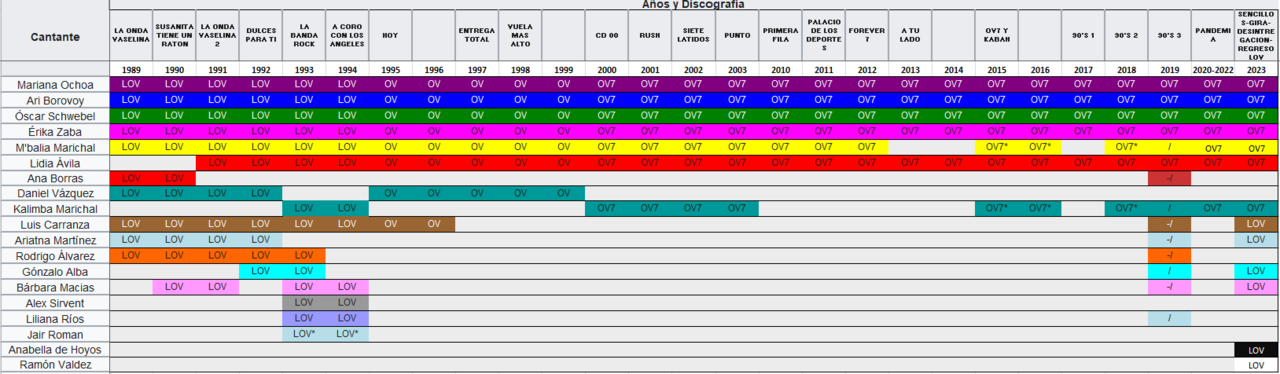
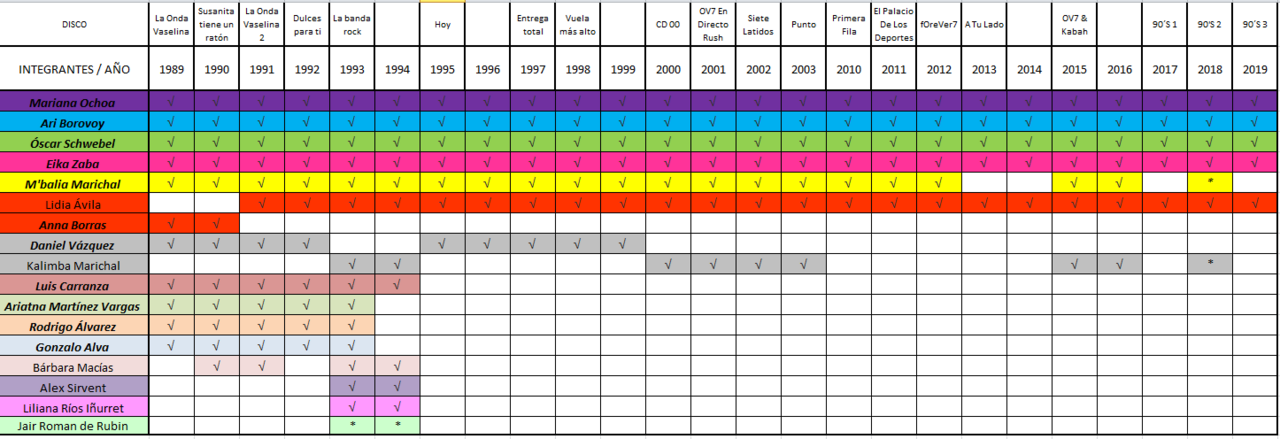
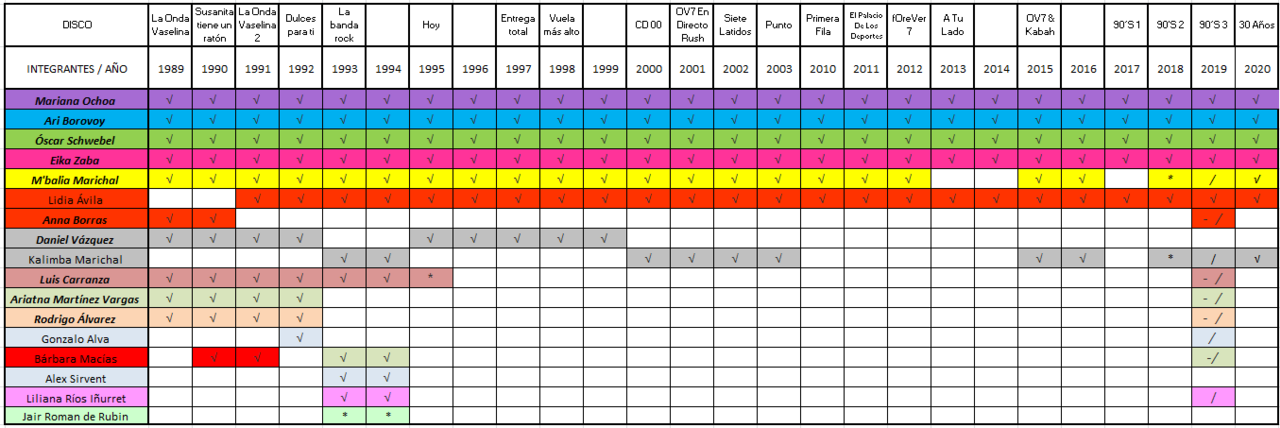
- Kalimba Marichal / Ari Borovoy / Lidia Ávila / Mariana Ochoa / Érika Zaba Beltrán / Oscar Schwebel Arizmendi / M'Balia Marichal
- Past Members
- (see below)
Facts from the source article.
Lore & Background
OV7 began as La Onda Vaselina in 1989, created by Mexican singer and producer Julissa after the theatrical run of Grease ('Vaselina' in Spanish) ended in Mexico. The group followed a trend started by Timbiriche in the 1980s. Their debut album sold over 100,000 copies and included hits 'Que Buen Reventón' and 'Que Triste Es El Primer Adios' (a cover of Neil Sedaka's 'Breaking Up Is Hard to Do'). Their second album, Onda Vaselina 2, became one of the most successful albums of the 1990s in Mexico, with songs like 'El Calendario' and 'Voy Voy Voy' becoming public property.
After a regional Mexican album, La Banda Rock, and a failed teen-market album, Hoy, the group took a long pause. In 1997, they made a comeback with Entrega Total, which reached number one in Mexico and Latin America. Hits included 'Mirame A Los Ojos' and 'Te Quiero Tanto Tanto', the latter reaching number one on the Billboard Latin chart. After Vuela Más Alto, they ended their relationship with Julissa. In 2000, they changed their name to OV7 for legal reasons and released CD00, which sold 2 million copies in Mexico and included hits 'Enloquéceme', 'Shabadabada', 'Más Que Amor', and 'Jam'. They attempted an English-language crossover with 'Love Colada' and participated in the 2002 World Cup Official Album with 'Bringing The World Back Home'. The group announced their split in November 2002 on Operacion Triunfo, released a greatest hits album Punto in 2003, and officially disbanded on June 14, 2003.
Reader's Guide
OV7's significance lies in their sustained success over more than three decades, making them one of the most successful acts in Latin pop history. They evolved from a theatrical children's group (La Onda Vaselina) into a mature pop act that dominated Latin American charts. Their album CD00 sold 2 million copies in Mexico alone, and songs like 'Te Quiero Tanto Tanto' remain staples at clubs and weddings throughout Latin America. The group's ability to fill major venues—such as the Auditorio Nacional 10 times during the CD00 era—demonstrates their enduring popularity. Their legacy includes influencing later Latin pop groups and maintaining a loyal fanbase through multiple reunions. The 2023 indefinite disbandment marks the end of an era for a group that helped define Latin pop for generations.
Did You Know?
- OV7 originally formed as La Onda Vaselina after the Mexican theatrical run of Grease ('Vaselina' in Spanish) ended.
- Their song 'Te Quiero Tanto Tanto' reached number one on the Billboard Latin chart.
OV7's Place in Mexico's 'Grupos Mixtos' Tradition
In Latin American music, mixed-gender vocal ensembles carry a specific cultural label: "grupos mixtos" or "bandas mixtas," a term that literally translates to "mixed bands." OV7 stands as one of the most celebrated names in this Mexican tradition, sharing that distinction with other landmark acts such as Timbiriche, Fresas con Crema, Kabah, RBD, and Garibaldi. What makes Mexico particularly notable in this space is that it became the country that most aggressively launched these mixed-gender groups into the commercial market. A defining characteristic of the genre is that these ensembles typically feature both male and female vocalists, often drawn from their teenage years or early twenties. Many of the most recognizable acts in this category did not emerge from traditional record-label pipelines but instead originated in soap operas, television series, and other programs built around musical themes. OV7's position within this lineage reflects a distinctly Mexican approach to teen pop that embraced gender diversity on stage at a time when the global industry largely favored single-sex formations.
The Marketing Paradox of Mixed-Gender Pop
The commercial viability of co-ed groups like OV7 has long been questioned within the music industry. Pundits and writers have consistently noted that these mixed-gender ensembles face a unique marketing challenge: the typical target audience for teen pop—pre-teen and teenage girls—responds to girl groups and boy groups in fundamentally different ways. Music writer Jake Austen argued that girl groups are positioned as aspirational role models while boy groups are sold as objects of romantic desire, and that combining both genders on stage creates what he called "unnecessarily confusing" messaging for young fans. Slate contributor Dann Halem added a more personal dimension to the critique, observing that it becomes difficult to convincingly sing about teenage yearning and heartbreak when you are literally harmonizing alongside the very object of that affection. This structural tension in the market meant that OV7 and its Mexican peers operated in a niche that was commercially less straightforward than the single-sex groups dominating global pop charts.
OV7's Enduring Influence and the Search for a Successor
More than a decade after OV7 defined the Mexican co-ed group sound, the act's cultural footprint remains visible in how the industry approaches new mixed-gender projects. The most telling example is LemonGrass, a Mexican ensemble explicitly positioned as aiming to become the successor of OV7. Discovered in 2015 by producer Ari Borovoy, LemonGrass mirrors the original's structure with seven young singers and dancers, suggesting that the seven-member mixed-gender format OV7 popularized still carries commercial and artistic weight in the Mexican market. The group launched with the single "Mi mundo gira contigo" and followed in 2016 with "Vértigo," a Spanish-language adaptation of the Korean hit "Bar Bar Bar" by the girl group Crayon Pop. This cross-cultural borrowing underscores how the global teen pop landscape continues to feed into the Mexican co-ed tradition. The very fact that a new group is marketed in direct reference to OV7 speaks to the original act's lasting authority as a benchmark for mixed-gender teen pop in the region.
OV7 in the Global Landscape of Co-Ed Groups
Placing OV7 within a worldwide context reveals that mixed-gender teen pop is a genuinely uncommon format across most major music markets. In South Korea, co-ed groups were more prevalent during the 1990s—with acts like Koyote, Roo'ra, Sharp, and Cool finding success—but have become increasingly rare since the 2000s, a shift sociologist John Lie attributes to the "accentuation of gender archetypes" that solidified single-sex group creation. Japan offers only scattered examples such as AAA, Folder, and lol, while Thailand has produced groups like 3.2.1. In Europe, mixed-gender acts enjoyed a notable run in the early 2000s, particularly in Scandinavia and the UK, with names like Aqua, Vengaboys, S Club 7, A-Teens, and Steps. By contrast, Latin America—and Mexico in particular—has consistently produced the highest concentration of these groups, with OV7 sitting alongside Timbiriche, Kabah, RBD, and Garibaldi as the region's most recognizable mixed-gender acts, and newer entries like MIX5 continuing the tradition.
Gallery



Frequently Asked Questions
Who is OV7?
OV7 is a Mexican co-ed Latin pop group that first appeared under the name La Onda Vaselina in 1989. They went on to become one of the most commercially successful acts in the history of Latin pop, with a career spanning more than three decades.
What are OV7's most famous songs?
Their biggest charting tracks include "Te Quiero Tanto Tanto" and "Shabadabada," both of which became staples across Latin American radio. Their album CD00 alone moved over two million copies in Mexico.
How did OV7 get started?
The group was born from the co-ed pop wave that Timbiriche helped launch in the 1980s. Singer and producer Julissa put the lineup together in 1989, right after the Mexican staging of the musical Grease (retitled Vaselina) wrapped up.
What happened to OV7 over the years?
The group first disbanded in 2003, then reunited in 2010 to tour and release new material. In 2023 they announced an indefinite split, leaving their final status open-ended.
Why is OV7 important to Latin pop?
They are widely regarded as one of the defining co-ed acts of the genre, with a string of hits that dominated charts throughout Latin America for over thirty years. Their longevity and commercial reach set a benchmark that later groups in the Timbiriche lineage still measure against.
More in Co-ed groups 1-22
Spotted an error? Know more?
Reader corrections go straight into our review queue. Suggest an edit · How this site is sourced