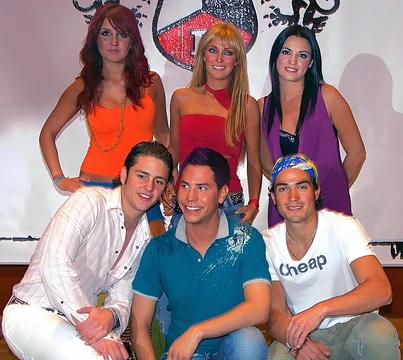
Erreway
Argentine pop group formed from the television series Rebelde Way.

Erreway was an Argentine pop group that came together through the television series *Rebelde Way*. The band had four members: Camila Bordonaba, Felipe Colombo, Luisana Lopilato, and Benjamín Rojas. Over their career, they put out three studio albums: *Señales*, *Tiempo*, and *Memoria*. (Note: *Vuelvo* is a compilation, not a studio album.) Worldwide, they sold one million records and earned multiple Platinum and Gold certifications in Argentina, Spain, and Israel.
The group’s roots trace back to the children’s series *Chiquititas*, created by producer Cris Morena. Bordonaba joined first in 1996, playing Pato, and later returned as Camila Bustillo in 1999. Colombo started in the Mexican version of *Chiquititas* before joining the Argentine cast in 1999 alongside Lopilato. Rojas was cast in 1998. In 2001, they all reprised their roles in the film *Chiquititas: Rincón de Luz*. Their time on the show helped them discover their musical abilities.
In 2002, the four actors were cast in *Rebelde Way*, another Cris Morena Group production, playing Marizza Pía Spirito, Manuel Aguirre, Mía Colucci, and Pablo Bustamante. The show became an international hit, filming through 2002 and 2003. As the lead quartet, they signed with Sony Music. Their debut album, *Señales*, came out in 2002 and sold approximately 500,000 copies worldwide, earning Platinum certification in Argentina. Its singles—including "Sweet Baby," "Bonita de Más," "Resistiré," "Inmortal," "Amor de Engaño," and "Será Porque Te Quiero"—topped charts across Latin America, Spain, Greece, and Israel. In December 2002, Erreway played a sold-out show at the Grand Rex in Buenos Aires.
Their second album, *Tiempo*, released in 2003, sold approximately 500,000–600,000 copies worldwide and was praised by critics as their best work. Singles like "Tiempo," "Será de Dios," "Para Cosas Buenas," "Que Estés," "Te Soñé," and "Vas A Salvarte" found international success. The band then launched the *Nuestro Tiempo* tour, supported by other *Rebelde Way* cast members, with Victoria Maurette and Piru Sáez occasionally performing solo songs. *Rebelde Way* ended in December 2003.
After the series wrapped, Erreway signed on for one more album and a *Rebelde Way* spin-off film, *4 Caminos*, in which they played their TV characters. The film premiered on 1 June 2004. Though critics panned it, it did well at the box office.
Quick Facts
- Background
- group_or_band
- Alias
- RWay
- Origin
- Buenos Aires, Argentina
- Genre
- Latin pop / teen pop / rock
- Years Active
- 2002–2004 / 2006–2007 / 2024–present
- Label
- Sony / Warner (Spain)
- Associated Acts
- Cris Morena / Floricienta y Su Banda / Rolabogan / Teen Angels
- Current Members
- Camila Bordonaba / Felipe Colombo / Benjamín Rojas
- Past Members
- Luisana Lopilato
- Landscape
- yes
Facts from the source article.
Lore & Background
Erreway's members first met while acting in the Argentine television series Chiquititas, where they discovered their musical talents. In 2002, Bordonaba, Colombo, Lopilato and Rojas were cast in the Cris Morena Group television series Rebelde Way as Marizza Pía Spirito, Manuel Aguirre, Mía Colucci and Pablo Bustamante. The series enjoyed international success, and the four signed a recording contract with Sony Music. Their debut album Señales was released in 2002, selling approximately 500,000 records worldwide and achieving Platinum certification in Argentina. Its singles topped charts throughout Latin America, Spain, Greece and Israel. Erreway held a sold out concert at the Grand Rex in Buenos Aires in December 2002.
Their second album, Tiempo, was released in 2003 and sold approximately 500,000–600,000 records worldwide, named their best work by critics. Luisana Lopilato left the group in 2004. After the group disbanded, former member Camila Bordonaba later formed the band La Miss Tijuana in 2009.
Reader's Guide
Erreway emerged from the popular Argentine television series Rebelde Way, becoming a significant pop music group in Latin America and beyond. Their debut album Señales achieved double Platinum certification in Argentina and sold 1 million records worldwide, with singles topping charts in Latin America, Spain, Greece and Israel. Their second album Tiempo sold 2 million records and was critically acclaimed. The group's success extended to Spain and Israel, where they earned Platinum and Gold certifications. Their single 'Memoria' became their most successful, debuting at number 1 on the Argentine Billboard Chart. Erreway's legacy includes influencing later Latin pop groups, such as the Mexican band RBD, which formed from a Mexican version of Rebelde Way. Despite the departure of Luisana Lopilato in 2005, the group continued with three members and later reunited in 2024 for a 2025 tour. Their music remains popular, and they are remembered as a key part of the early 2000s Latin pop scene.
Did You Know?
- Erreway sold one million records and achieved several Platinum and Gold album certifications in Argentina, Spain and Israel.
- Their single 'Memoria' debuted at number 1 on the Argentine Billboard Chart and is one of the most successful songs written by Cris Morena.
- Luisana Lopilato left the band in 2005 due to conflicting work commitments, though she stated she might return in the future.
- In 2010, Camila Bordonaba and Felipe Colombo formed a new band, La Miss Tijuana, with Willie Lorenzo, marking the final split of Erreway.
Identity and Classification in the Co-Ed Tradition
Erreway was a South American vocal group that brought together both male and female singers, fitting squarely within the tradition of what the music world calls a co-ed or mixed-gender group. In Latin America, such ensembles carry the Spanish designation "grupos mixtos" or "bandas mixtas," a straightforward label meaning "mixed bands." The typical co-ed group features performers in their teenage years or twenties, and Erreway operated within that demographic window. They are recognized as one of the most notable mixed-gender acts to emerge from South America during the period spanning the early 2000s through 2010, a distinction they share with fellow South American groups Teen Angels and Kudai. Their existence as a mixed-sex ensemble places them in a relatively uncommon category within the broader pop landscape, where single-gender groups have historically dominated both the stage and the marketing strategies behind it.
The South American Co-Ed Landscape
Within the broader Latin American music scene, co-ed groups have a distinct history, with Mexico serving as the primary launching pad for mixed-gender acts. Mexican groups such as Timbiriche, Fresas con Crema, Kabah, OV7, RBD, and Garibaldi became household names, and many of these ensembles originated from soap operas, television series, or programs with musical themes. South America, by contrast, produced comparatively fewer mixed-gender groups, making the acts that did emerge all the more significant. Erreway stands out in this context as one of the most notable South American co-ed groups of the early 2000s through 2010, a period during which the region's mixed-gender scene was still developing. They share this recognition with Teen Angels and Kudai, the three groups collectively representing the pinnacle of South American co-ed pop in that era. This scarcity underscores how unusual mixed-gender teen pop remains across the continent, even as Mexico's television-driven model produced a steady stream of such acts.
Marketing Challenges and Global Rarity
The very structure of a co-ed group like Erreway presents a marketing paradox that has kept such ensembles rare worldwide. Industry analysts have long noted that teen pop's primary audience, pre-teen and teenage girls, responds to girl groups as aspirational role models and to boy groups as objects of romantic desire. Blending both genders into one act, as Erreway did, creates what one music writer called an "unnecessarily confusing" positioning for that demographic. Another observer pointed out the lyrical difficulty: it becomes hard to sing convincingly about adolescent yearning and heartache when you are literally harmonizing with the person who would be the object of that affection. In Asia, sociologists have traced the near-absence of mixed-gender groups to a cultural "accentuation of gender archetypes" that solidified single-sex formations. Erreway's South American context meant they navigated these same structural headwinds, existing in a niche that the global pop machine has consistently found difficult to package and promote.
Erreway's Era and the Co-Ed Legacy
Erreway's active period, stretching from the early 2000s to 2010, placed them in a specific window of the global co-ed group timeline. In Europe, that same era saw a wave of mixed-gender teen pop success, with acts like Aqua, Vengaboys, S Club 7, A-Teens, Hear'Say, Ace of Base, Steps, KidToniK, A Touch of Class, and Liberty X finding audiences particularly in Scandinavia and the United Kingdom. One music writer attributed the British appetite for such groups to a cultural acceptance of pop acts as disposable entertainment. In South America, Erreway, Teen Angels, and Kudai represented the most prominent examples of the form during that decade. After their era, a new generation of Latin American co-ed groups emerged, including Mexico's LemonGrass, discovered in 2015 and positioned as a successor to OV7, and MIX5, the multinational winning band of the 2016 reality show La Banda. Erreway's legacy, therefore, sits at a pivotal point in the ongoing, if intermittent, story of mixed-gender pop.
Frequently Asked Questions
Who is Erreway?
Erreway is an Argentine pop band made up of four members: Camila Bordonaba, Felipe Colombo, Luisana Lopilato, and Benjamín Rojas. They first came together on the television series Rebelde Way.
How did Erreway form?
The group was assembled through the TV show Rebelde Way, which itself grew out of the earlier children's series Chiquititas, both produced under the banner of Cris Morena.
What studio albums did Erreway release?
The band issued three studio albums during their career: Señales, Tiempo, and Memoria. A later release titled Vuelvo is a compilation, not a new studio record.
How commercially successful was Erreway?
The group sold roughly one million records worldwide and picked up both Platinum and Gold certifications in Argentina, Spain, and Israel.
What is Erreway most known for?
Fans and music databases typically identify the band as an Argentine pop act whose formation is tied directly to the Rebelde Way television series. Their one-million-record sales and multi-country certifications further cement their place in Latin pop history.
More in Co-ed groups 1-22
Spotted an error? Know more?
Reader corrections go straight into our review queue. Suggest an edit · How this site is sourced