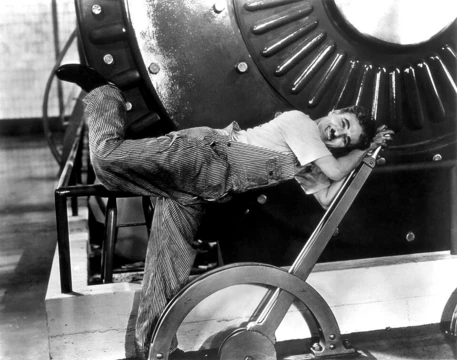
Charlie Chaplin
Last updated

via Wikipedia: Charlie Chaplin · see source
Charles Spencer Chaplin Jr. was born on 16 April 1889 in London, to music-hall entertainers Hannah Chaplin and Charles Chaplin Sr.[1][2] His childhood was marked by poverty and hardship, including stays in workhouses and asylums.[2][3]
Key facts and history
Chaplin's parents were estranged by around 1891, and his father provided no financial support.[4][2] At age seven, Chaplin was sent to Lambeth Workhouse and later to the Central London District School for paupers.[2][5] His mother was committed to Cane Hill mental asylum in September 1898 due to psychosis.[3] The Tramp character debuted to audiences in Kid Auto Races at Venice on 7 February 1914.[6]
Chaplin signed a $150-per-week contract with Keystone Studios in September 1913.[7] Chaplin joined forces with Douglas Fairbanks, Mary Pickford and D. W. Griffith to form United Artists.[2]
What the cited sources add
The Guardian article by Simon Louvish notes that American audiences first saw Chaplin in 1910 as a drunken "swell" in the sketch Mumming Birds.[8] Louvish states that Mumming Birds was the longest-running sketch the English music halls produced.[8] The BFI account of the First National period states that Chaplin signed a "million-dollar contract" on 17 June 1917.[9] The CharlieChaplin.com musical biography notes that Chaplin played both violin and piano by ear but could not transcribe notes on paper.[10]
The same source states that after City Lights, Chaplin composed the scores for all of his films.[10]
References
- Wikipedia, "Charlie Chaplin" (CC BY-SA 4.0), which cites: "Was Charlie Chaplin born in a Smethwick Gypsy camp?", www.bbc.com, 8 May 2026; Sweet, "Was Charlie Chaplin a Gypsy?", The Guardian, 17 February 2011; Brooks, "Unlocked: the little tramp's gypsy caravan secret is revealed", www.thetimes.com, 20 February 2011; Prempain, "European Roma: Lives Beyond Stereotypes", Liverpool University Press, 2022, p. 269; Robinson, p. 10 (we also read that source) en.wikipedia.org
- Wikipedia, "Charlie Chaplin" (CC BY-SA 4.0), which cites: Robinson, p. 10 (original not read by us) en.wikipedia.org
- Wikipedia, "Charlie Chaplin" (CC BY-SA 4.0), which cites: Weissman 2009, p. 10; Chaplin, p. 10; Robinson, p. 10; Robinson, p. 10 (original not read by us) en.wikipedia.org
- Wikipedia, "Charlie Chaplin" (CC BY-SA 4.0), which cites: Robinson, p. 10; Robinson, p. 10; Weissman 2009, p. 10; Robinson, p. 10; Robinson, p. 10 (original not read by us) en.wikipedia.org
- Wikipedia, "Charlie Chaplin" (CC BY-SA 4.0), which cites: Chaplin, p. 10 (original not read by us) en.wikipedia.org
- Wikipedia, "Charlie Chaplin" (CC BY-SA 4.0), which cites: Robinson, p. 10; Mostrom, "Unsuspecting extras go down in film history", Los Angeles Times, 19 June 2011; Murray, "The British Superhero", University Press of Mississippi, 2017, p. 22 (original not read by us) en.wikipedia.org
- Wikipedia, "Charlie Chaplin" (CC BY-SA 4.0), which cites: Robinson, p. 10; Chaplin, p. 10 (original not read by us) en.wikipedia.org
- Louvish, "Tramps like us", The Guardian, 6 March 2009. theguardian.com
- "Independence Won: First National", Charlie Chaplin. chaplin.bfi.org.uk
- "Chaplin – A Musical Biography", CharlieChaplin.com. charliechaplin.com
Each numbered sentence above was checked against the source it cites before publication. Sentences citing Wikipedia adapt text from the English Wikipedia article Charlie Chaplin (contributors), used under CC BY-SA 4.0; this entry is available under the same licence. Other sources were used for facts only.
Also in the Codexery
More in Clowning & Physical Comedy
Sources
Compiled from Wikipedia and the sources listed below. Text from Wikipedia is available under CC BY-SA 4.0; this entry is adapted from it.
- Wikipedia: Charlie Chaplin (CC BY-SA 4.0).
Spotted an error? Know more?
Reader corrections go straight into our review queue. Suggest an edit · How this site is sourced