Velocity
A vector measure of speed with direction.

Velocity measures how fast something moves and the direction it moves in. It is a core idea in kinematics, the study of how physical objects move in classical mechanics. Because velocity is a vector, describing it fully requires both its magnitude and its direction. The magnitude alone is called speed, which is a scalar quantity measured in metres per second (m/s) in the SI system. For instance, "5 metres per second" is a scalar, while "5 metres per second east" is a vector. An object accelerates if its speed changes, its direction changes, or both.
Average velocity over a time period is the change in position divided by the length of that period. Instantaneous velocity is the limit of average velocity as the time interval shrinks to zero; at any given moment, it is the derivative of position with respect to time. In one dimension, the area under a velocity-versus-time graph equals the displacement, and the integral of the velocity function gives the displacement function.
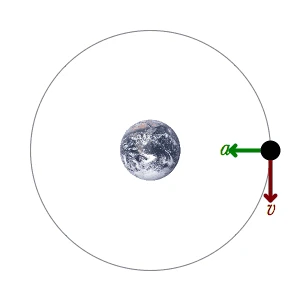
Although people often use "speed" and "velocity" interchangeably in everyday language, they differ scientifically. Speed tells only how fast an object moves, while velocity also tells its direction. For an object to have constant velocity, it must have constant speed and move in a constant direction—meaning a straight line at a steady speed. A car moving at a constant 20 kilometres per hour on a circular path has constant speed but not constant velocity, because its direction keeps changing; thus, it is accelerating.
Velocity is measured in metres per second (m/s), since it is the change in position (in metres) divided by the change in time (in seconds). Average velocity can also be found by taking the integral of the velocity function over a time interval and dividing by the interval's length.
- field
- Kinematics, classical mechanics
- known_for
- Definition as a vector quantity; distinction between speed and velocity; average and instantaneous velocity; relation to acceleration and displacement
Lore & Background
Velocity is a fundamental vector quantity in kinematics, the branch of classical mechanics that describes motion. It measures both how fast an object is moving and in which direction, distinguishing it from speed, which is only the scalar magnitude of the velocity vector. For example, "5 metres per second" is a speed, while "5 metres per second east" is a velocity. In the International System of Units, velocity is expressed in metres per second (m/s or m·s⁻¹). An object experiences acceleration whenever its speed changes, its direction changes, or both. Constant velocity requires both constant speed and constant direction, meaning motion in a straight line; a car moving at a constant speed on a circular path does not have constant velocity because its direction continually changes, so it is accelerating. The average velocity over a time interval is the change in position divided by that interval’s duration. Instantaneous velocity is the limit of average velocity as the time interval approaches zero, calculated as the derivative of position with respect to time. On a velocity versus time graph, the slope of a tangent line at any point gives instantaneous acceleration, while the area under the curve represents displacement. For constant acceleration, velocity can be studied using the suvat equations, relating initial and final velocities, displacement, and time. The Torricelli equation provides an expression for velocity independent of time. These relationships hold in both Newtonian mechanics and special relativity, though the two frameworks differ in how observers perceive the same motion.
Reader's Guide
Velocity is a cornerstone of kinematics, describing not just how fast an object moves but also its direction. Its vector nature distinguishes it from speed, which is only the scalar magnitude. A change in speed, direction, or both constitutes acceleration. The concept of instantaneous velocity, though initially counter-intuitive, can be thought of as the velocity an object would maintain if it stopped accelerating at that moment. Average velocity, always less than or equal to average speed, is calculated as the total displacement divided by total time. In a displacement-time graph, instantaneous velocity is the slope of the tangent line, while average velocity is the slope of the secant line between two points. The SI unit for velocity is metres per second (m/s).
Did You Know?
- Velocity is a vector quantity, requiring both magnitude and direction for its definition.
- The scalar absolute value of velocity is called speed, measured in metres per second.
- A constant velocity requires both constant speed and constant direction, meaning motion in a straight line.
- The area under a velocity vs. time graph corresponds to the displacement of the object.
More in Classical Mechanics 1-21
Spotted an error? Know more?
This is a living reference — every entry is fact-audited, and reader corrections feed straight into our audit queue. Suggest an edit · See this site's audit record