Friction
Force resisting relative motion of surfaces and fluid layers.

ترتيل سيد احمد · CC BY-SA 4.0
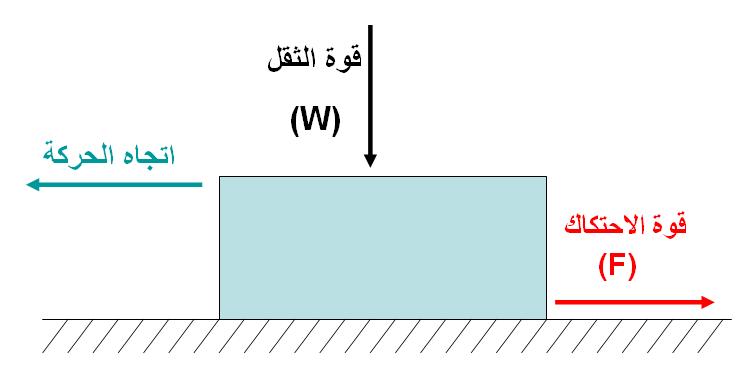
Friction is the force that opposes the relative motion of solid surfaces, fluid layers, or material elements when they slide or grind against each other. It accounts for roughly 20% of the world's total energy expenditure and can cause wear, which degrades performance or damages components. The study of friction and related processes is called tribology, a field with a history spanning over 2,000 years.
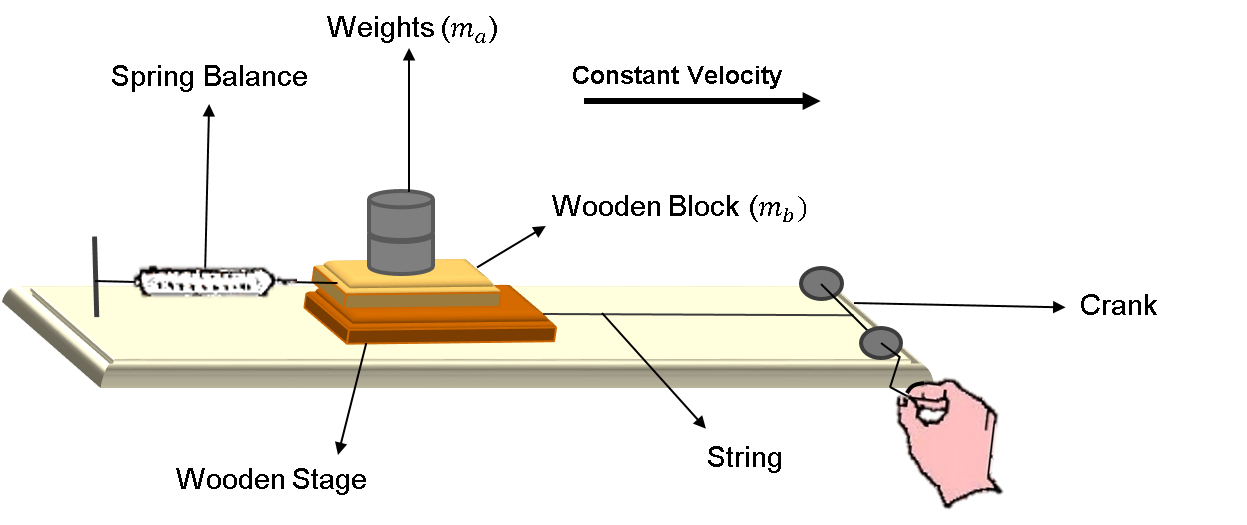
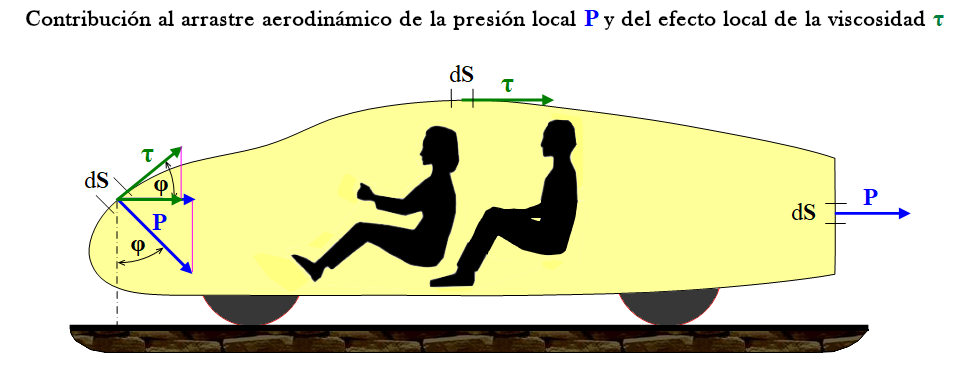
There are several types of friction. Dry friction opposes the lateral motion of two solid surfaces in contact; it is divided into static friction (between non-moving surfaces) and kinetic friction (between moving surfaces). Except at the atomic or molecular scale, dry friction generally comes from the interaction of surface features called asperities. Fluid friction occurs between layers of a viscous fluid moving relative to each other. Lubricated friction is a subtype of fluid friction where a lubricant separates two solid surfaces. Skin friction is a component of drag that resists the motion of a fluid across a body's surface. Internal friction resists motion between the elements of a solid material as it deforms.
The retarding force in friction has many contributors, from the deformation of asperities to the generation of electric charges and changes in local structure. When two bodies in contact move relative to each other, mechanical energy is transformed into heat, the free energy of structural changes, and other forms of dissipation. The total energy dissipated per unit distance moved equals the retarding frictional force (F = E/d). Because the interactions are so complex, calculating friction from first principles is difficult; empirical methods are often easier for analysis and theory development.
Ancient authors such as Aristotle, Vitruvius, and Pliny the Elder studied the causes and reduction of friction. They recognized differences between static and kinetic friction; Themistius noted in 350 A.D. that it is easier to keep a moving body in motion than to start a stationary one. Leonardo da Vinci discovered the classic laws of sliding friction in 1493, but his notebooks were unpublished. Guillaume Amontons rediscovered these laws in 1699, now known as Amonton's three laws of dry friction. He explained friction in terms of surface irregularities and the force needed to lift the weight pressing the surfaces together. Bernard Forest de Bélidor and Leonhard Euler later refined this view, deriving the angle of repose and distinguishing static from kinetic friction. John Theophilus Desaguliers first recognized adhesion's role in friction in 1734, proposing that microscopic forces cause surfaces to stick and that friction is the force needed to tear them apart. Charles-Augustin de Coulomb investigated four main factors in 1785: the materials and their coatings, surface area, normal pressure, and the time surfaces remained in contact. He also considered sliding velocity, temperature, and humidity to evaluate competing theories. Coulomb's friction law distinguishes static and dynamic friction, though Johann Andreas von Segner had already made this distinction in 1758. Pieter van Musschenbroek explained the effect of time of repose in 1762 by noting that fibers in surfaces mesh together over time, increasing friction. John Leslie criticized Amontons and Coulomb's views, arguing that if friction came from weight being drawn up inclined asperities, it should be balanced by descending the opposite slope. He also doubted Desaguliers' adhesion theory, which should equally accelerate and retard motion. Leslie saw friction as a time-dependent process of flattening and pressing down asperities, creating new obstacles in former cavities.
As the law of conservation of energy and the first law of thermodynamics developed, friction was recognized as converting mechanical work into heat. Benjamin Thompson reported on cannon boring experiments in 1798. Arthur Jules Morin developed the concept of sliding versus rolling friction in 1833. In 1842, Julius Robert Mayer generated heat through friction in paper pulp and measured the temperature rise. In 1845, James Joule published "The Mechanical Equivalent of Heat," specifying the amount of mechanical work needed to produce a unit of heat, based on friction from an electric current in a resistor and from a paddle wheel in water. Osborne Reynolds derived the equation of viscous flow in 1866, completing the classic empirical model of friction (static, kinetic, and fluid).
- field
- Physics, Engineering
- known_for
- Force resisting relative motion; types include dry, fluid, lubricated, skin, and internal friction
- energy_impact
- Frictional energy losses account for about 20% of total world energy expenditure
- study_name
- Tribology
Lore & Background
Friction is the force that opposes the relative motion of solid surfaces, fluid layers, or material elements sliding or grinding against each other. Its appearance is not visible itself, but its effects are observed, such as when a blue plate on a sloped surface slides down more slowly than a green one due to greater friction. The range of friction is universal in interactions between contacting materials, from the atomic scale to macroscopic objects. Its habitat includes any interface where surfaces meet, whether solid, fluid, or lubricated. Defining characteristics include several types: dry friction opposes lateral motion of solid surfaces and is subdivided into static friction between non-moving surfaces and kinetic friction between moving surfaces; fluid friction occurs between layers of a viscous fluid moving relative to each other; lubricated friction involves a fluid lubricant separating two solids; skin friction is a component of drag resisting fluid motion across a body’s surface; and internal friction resists motion between elements of a solid material undergoing deformation. Friction arises from complex contributors such as asperity deformation, generation of charges, and changes in local structure, transforming mechanical energy into heat or other dissipation. The total dissipated energy per unit distance moved is the retarding frictional force. Friction can have dramatic consequences, like starting a fire by rubbing wood, and causes wear that degrades performance or damages components. Frictional energy losses account for about 20% of the world’s total energy expenditure.
Reader's Guide
Friction is a fundamental force with profound practical and theoretical significance. The classic empirical laws—Amontons' first law (friction proportional to load), second law (friction independent of apparent contact area), and Coulomb's law (kinetic friction independent of sliding velocity)—remain foundational in engineering. In the 20th century, Frank Philip Bowden and David Tabor showed that actual contact area between surfaces is a tiny fraction of apparent area, explaining Amontons' first law. The atomic force microscope (ca. Frictional energy losses account for about 20% of the world's total energy expenditure, making friction a critical factor in efficiency, wear, and design across all mechanical systems.
Did You Know?
- Frictional energy losses account for about 20% of the total energy expenditure of the world.
A Science Spanning Scales
Frictional contact mechanics is not confined to a single level of observation. At the macroscopic level, it governs how entire bodies move when they touch—think of a rubber ball bouncing off a floor, where the total force against indentation and lateral displacement tells the story. Step down to the intermediate scale and the focus shifts to local stresses, strains, and deformations right in and around the contact zone. This is the realm of tire-pavement interaction, railway wheel-rail contact, and roller bearing analysis, where engineers need to understand wear and damage at the surface. At the microscopic and nano-scales, the same principles help researchers probe the very origin of friction in tribological systems and design precision instruments such as atomic force microscopes and micro-electro-mechanical systems. The Wikipedia page itself concentrates on that middle ground: extracting fundamental insight into stresses and deformations within the contact patch without getting bogged down in the detailed mechanisms that produce them.
A Long Line of Thinkers
The intellectual history of friction stretches back to Leonardo da Vinci and continues through Guillaume Amontons, John Theophilus Desaguliers, Leonhard Euler, and Charles-Augustin de Coulomb, who collectively built the early framework of frictional behavior. Nikolai Pavlovich Petrov, Osborne Reynolds, and Richard Stribeck later layered lubrication theory on top. On the deformation side, Robert Hooke and Joseph Louis Lagrange worked in the 17th and 18th centuries, while d'Alembert and Timoshenko carried the thread into the 19th and 20th. Heinrich Hertz's classical contribution to contact mechanics stands out, and Boussinesq and Cerruti provided fundamental solutions for the linearly elastic regime. The first true frictional contact solutions came from F.W. Fromm (1927), who independently derived the creep-versus-creep-force relation for rolling cylinders using Coulomb's dry friction law—results directly applicable to railway locomotive traction and hunting oscillation. C.
The Stick-Slip Puzzle
At the heart of every frictional contact problem lies a deceptively simple observation: the stresses at the surface of each body are not uniform. They vary from point to point, and so do the resulting strains, deformations, and even the motion of individual particles. In one part of the contact patch, the two surfaces adhere and move together; in another, they slide past each other. That local relative sliding is called micro-slip, and it is the engine behind fretting wear—because wear only occurs where power is actually dissipated, which demands both stress and local relative displacement. Complicating matters further, the size and shape of the contact patch itself, along with the boundaries between its adhesion and slip regions, are generally unknown before the analysis begins. This means the geometry of the problem is part of what must be solved, not something given upfront.
From Theory to Computation
Johnson offered an approximate approach for three-dimensional frictional problems with Hertzian geometry, revealing that spin creepage—symmetric about the contact center—produces a net lateral force because of fore-aft differences in traction distribution. Hans Pacejka contributed the influential magic tire formula for road-tire interaction. By the 1970s, numerical methods proliferated: variational approaches rooted in Duvaut and Lion's existence and uniqueness theories evolved into finite element methods for general geometries (Laursen, Wriggers) and into half-space-based models like Kalker's CONTACT for smooth-edged, linearly elastic contacts. Because these rigorous methods demand heavy computation, approximate alternatives such as Kalker's FASTSIM, the Shen-Hedrick-Elkins formula, and Polach's approach were developed for practical rolling contact analysis.
Gallery

Frequently Asked Questions
Who is Friction?
Friction is the resistive force that opposes relative sliding, grinding, or rolling between solid surfaces, fluid layers, and internal material elements. It acts whenever two bodies are pressed together and attempt to move past one another.
What are Friction's known types and abilities?
Friction appears in several distinct forms—dry, fluid, lubricated, skin, and internal—each governing a different contact regime. Collectively, these modes are responsible for roughly 20% of all energy expended in the world.
How does Friction's story end?
Friction has no narrative arc because it is a persistent physical interaction rather than a character with a plot. Its long-term consequence, however, is progressive wear, performance degradation, and eventual structural damage to moving components.
Why is Friction important to the canon?
Without Friction, everyday actions like walking, gripping, or braking would be impossible, and the roughly one-fifth of global energy lost to resistive forces would vanish. It anchors both practical engineering design and foundational classical-mechanics theory.
What is Friction's dedicated field of study?
The discipline devoted to understanding Friction is called Tribology, which spans physics and engineering. It examines contact mechanics, lubrication behavior, and wear processes in moving systems.
More in Classical Mechanics 1-21
Spotted an error? Know more?
This is a living reference — every entry is fact-audited, and reader corrections feed straight into our audit queue. Suggest an edit · See this site's audit record