Bernoulli's principle
Relates pressure, speed, and height in fluid flow.

Wikimedia Commons · CC BY-SA 2.5
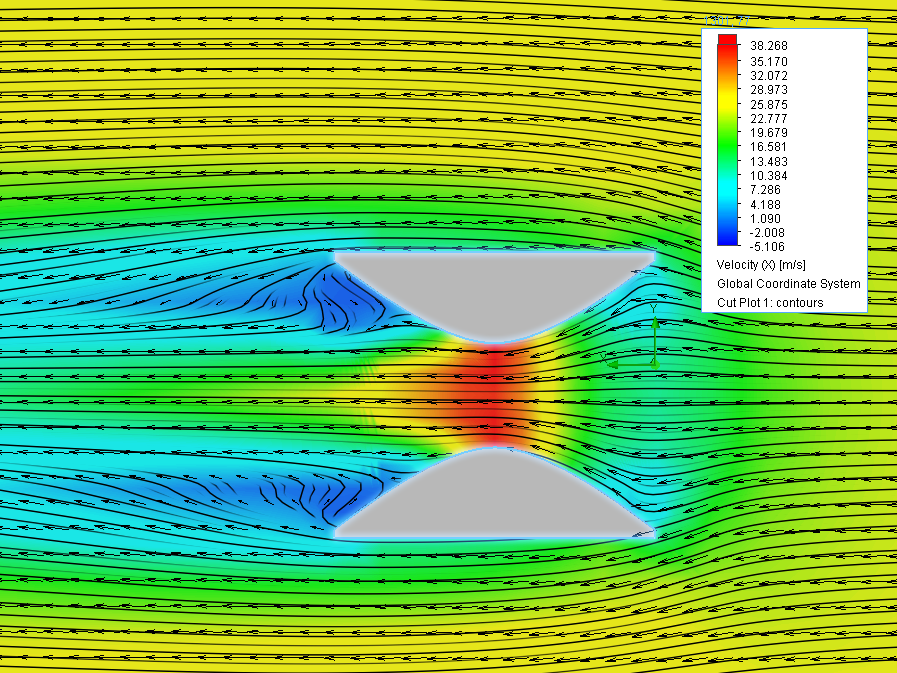
Bernoulli's principle describes how pressure, speed, and height are related in a moving fluid. In horizontal flow, for instance, the principle says that when the fluid speeds up, its pressure drops at the same time. The principle is named after Daniel Bernoulli, a Swiss mathematician and physicist who published it in his 1738 book *Hydrodynamica*. While Bernoulli figured out that higher speed means lower pressure, it was Leonhard Euler who, in 1752, wrote down the equation that now commonly represents the principle. The principle can be derived from Newton’s second law of motion. Picture a small volume of fluid moving horizontally from an area of high pressure to one of low pressure. Because there is more pressure behind it than ahead, the volume experiences a net force that accelerates it along its path. So, if pressure is dropping along the streamline, the fluid speeds up—the decrease in pressure is what causes the higher speed. Conversely, if pressure is rising, the fluid slows down. Bernoulli’s principle also follows from the conservation of energy. In a steady flow, the total of all energy forms stays constant. This means the sum of kinetic energy, potential energy, and internal energy does not change. Therefore, when the fluid’s kinetic energy increases, its potential and internal energies must decrease by the same amount. In a flow where energy is constant, Bernoulli’s principle tells us that fluid speeds up when it enters a region of lower pressure and slows down when it enters a region of higher pressure. This quantifies how speed and pressure change within a flow field. The equation is derived by looking at forces or energy along a single streamline, but it can also apply to a whole flow field if all streamlines come from a region with uniform velocity and pressure. However, it cannot be used to compare different flow fields—for example, you cannot use it to compare a jet of air with the still air around it. Fluid particles are affected only by pressure and their own weight. In horizontal flow, a speed increase can only happen because the fluid moved from higher to lower pressure; a speed decrease means it moved from lower to higher pressure. As a result, in horizontal flow, the fastest speed is where pressure is lowest, and the slowest speed is where pressure is highest. Bernoulli’s principle works only for isentropic flows—where effects like turbulence or heat radiation are small enough to ignore. The simple form of the equation is valid for incompressible flows, such as most liquids and gases moving at low Mach numbers. More advanced versions can handle compressible flows at higher Mach numbers. For most liquids and low-speed gases, the density of a fluid parcel stays nearly constant even when pressure changes. These are called incompressible flows, and Bernoulli’s original equation (based on his experiments with liquids) applies only to them. A common form of the equation is:
v²/2 + gz + p/ρ = constant
Here, v is the fluid speed at a point, g is gravity, z is the height above a reference plane (with positive z upward), p is the static pressure, and ρ is the fluid density (constant everywhere). This equation and the Bernoulli constant apply wherever the energy per unit mass is uniform—for example, in a well-mixed reservoir. It can then be used to analyze flow in pipes or other regions fed by that reservoir, as long as viscous forces are not dominant. For this equation to hold, three conditions must be met: the flow must be steady (parameters at any point don’t change with time), the flow must be incompressible (density stays constant along a streamline despite pressure changes), and friction from viscous forces must be negligible. For conservative force fields beyond just gravity, Bernoulli’s equation can be generalized as:
v²/2 + Ψ + p/ρ = constant
where Ψ is the force potential at the point (for Earth’s gravity, Ψ = gz).
- field
- Fluid dynamics
- known_for
- Bernoulli's principle
- named_after
- Daniel Bernoulli
- publication
- Hydrodynamica
Lore & Background
Bernoulli's principle is a concept in fluid dynamics that describes the relationship between pressure, speed, and height within a flow. For a fluid moving horizontally, the principle states that an increase in speed occurs simultaneously with a decrease in pressure. The principle is named after the Swiss mathematician and physicist Daniel Bernoulli, who published it in his 1738 book *Hydrodynamica*. Although Bernoulli deduced that pressure decreases when flow speed increases, it was Leonhard Euler who derived the equation in its usual form in 1752. The principle can be derived from Isaac Newton's second law of motion: when a small volume of fluid flows horizontally from a region of high pressure to low pressure, there is more pressure behind than in front, creating a net force that accelerates the fluid along the streamline. Thus, a decrease in pressure causes a higher speed, while an increase in pressure causes a decrease in speed. Bernoulli's principle can also be derived from the conservation of energy, as in a steady flow the sum of kinetic energy, potential energy, and internal energy remains constant. The principle is only applicable for isentropic flows, where effects like turbulence and thermal radiation are negligible. The simple form of Bernoulli's equation is valid for incompressible flows, such as most liquid flows and gases moving at low Mach number. Bernoulli performed his experiments on liquids, so his original equation applies only to incompressible flow. The equation assumes steady flow, constant density along a streamline, and negligible viscous friction. For a fluid flowing horizontally, the highest speed occurs where the pressure is lowest, and the lowest speed occurs where the pressure is highest.
Reader's Guide
Bernoulli's principle is significant because it quantifies changes in speed and pressure within a flow field of constant energy. It is applicable for isentropic flows where irreversible processes like turbulence and non-adiabatic effects are negligible. The simple form of Bernoulli's equation is valid for incompressible flows, such as most liquid flows and gases at low Mach number. The principle is used to analyze fluid flow in reservoirs and pipes, except where viscous forces dominate. It cannot be used to compare different flow fields, such as a jet of air with surrounding stationary air. The equation suggests a flow speed at which pressure becomes zero, but gases and liquids are not capable of negative absolute pressure, and in liquids, cavitation occurs when pressure becomes too low.
Did You Know?
- Bernoulli's principle is derived from the conservation of energy (work-energy theorem) for inviscid, incompressible, steady flow.
- For incompressible, inviscid, steady flow, the principle does not require isentropic conditions; isentropic flow is a specific case for compressible flows.
Origins & Historical Development
In that work, Bernoulli established the core insight that within a flowing fluid, a rise in velocity coincides with a drop in pressure. This seventeen-year gap between the conceptual breakthrough and its formal equation underscores how scientific ideas often mature over time, with one mind planting the seed and another building the structure. Bernoulli's original experiments focused on liquids, which is why the equation in its simplest guise applies to incompressible flow. The principle thus stands as a collaborative monument to eighteenth-century European physics, linking the empirical observations of one scholar with the analytical rigor of another.
Physical Mechanism & Two Derivations
The principle can be understood through two complementary lenses. From a force-based perspective rooted in Newton's second law, consider a small parcel of fluid moving horizontally. If the pressure behind the parcel exceeds the pressure ahead of it, a net force pushes the parcel forward, accelerating it along its path. In this reading, the pressure gradient is the cause and the change in speed is the effect. Conversely, if pressure rises along the streamline, the net force opposes the motion and the fluid decelerates. From an energy perspective, the principle follows directly from conservation of energy in steady flow. The total energy per unit mass—comprising kinetic energy, gravitational potential energy, and internal pressure energy—must remain constant. When a fluid speeds up, its kinetic energy grows, and that gain is paid for by a simultaneous reduction in potential and internal energy. Both derivations arrive at the same conclusion: within a horizontal flow, maximum speeds correspond to minimum pressure, and minimum speeds to maximum pressure.
Scope, Assumptions & Limitations
Despite its elegance, Bernoulli's principle operates under strict conditions. It applies only to isentropic flows, meaning that irreversible effects such as turbulence and non-adiabatic processes like thermal radiation must be negligible. The simple, widely taught form of the equation is valid exclusively for incompressible flows—situations where the fluid's density remains essentially constant despite pressure variations. This covers most liquid flows and gases traveling at low Mach numbers. For compressible flows at higher speeds, more advanced formulations are required. Additionally, the flow must be steady, so that velocity, density, and other parameters at any given point do not fluctuate with time, and viscous friction must be small enough to ignore. A critical practical limitation is that the equation cannot be used to compare two entirely different flow fields, such as a jet of air against the still air surrounding it. It is designed to track changes within a single, coherent flow where all streamlines originate from a region of uniform velocity and pressure.
The Equation & Its Physical Terms
The incompressible form of Bernoulli's equation expresses a constant sum of three terms along any streamline: the kinetic energy per unit mass (v²/2), the gravitational potential energy per unit mass (gz), and the pressure energy per unit mass (p/ρ). Here v denotes the local flow speed, g is gravitational acceleration, z is the elevation above a chosen reference plane measured in the direction opposite to gravity, p is the static pressure, and ρ is the fluid density, assumed uniform throughout. Multiplying through by density recasts the relationship into a form involving dynamic pressure (½ρv²), hydrostatic pressure (ρgz), and static pressure (p), all summing to a constant. The equation is applicable throughout any region where energy per unit mass is uniform, such as a well-mixed reservoir and the pipes or flow fields it feeds, provided viscous forces do not erode that energy. For conservative force fields beyond gravity, the gravitational term can be replaced by a general force potential Ψ, broadening the equation's reach to other physical contexts.
Gallery

Frequently Asked Questions
Who is Bernoulli's principle?
It is a foundational relationship in fluid dynamics named after Daniel Bernoulli, who first laid it out in his 1738 treatise Hydrodynamica. In the mechanics canon, it plays the role of the rule that links pressure, flow speed, and elevation in a moving fluid.
What are Bernoulli's principle's powers or role?
For a fluid moving horizontally, it enforces an inverse coupling: wherever the flow speeds up, the static pressure must drop at the same time. This single trade-off is the core 'ability' that lets engineers predict pressure differences across a streamline.
How does Bernoulli's principle's story end?
Its applicability is bounded to steady, incompressible, and non-viscous flow, so it steps aside the instant a fluid goes turbulent or compressible. In practice, practitioners add correction terms or switch to the full Navier-Stokes equations to cover those regimes.
Why is Bernoulli's principle important?
It provides the simplest quantitative explanation for why airplane wings generate lift, why a Venturi tube can measure flow rate, and how carburetors atomize fuel. Without that pressure–speed trade-off, a large portion of everyday fluid-machinery design would lack a clean theoretical anchor.
What is Bernoulli's principle's backstory?
Daniel Bernoulli published the underlying ideas in Hydrodynamica in 1738, building on earlier hydrodynamic work by his father Johann and by Newton. The relationship was later recast into the familiar energy-per-unit-volume form that ties together static pressure, kinetic energy, and gravitational potential along a streamline.
More in Classical Mechanics 1-21
Spotted an error? Know more?
This is a living reference — every entry is fact-audited, and reader corrections feed straight into our audit queue. Suggest an edit · See this site's audit record