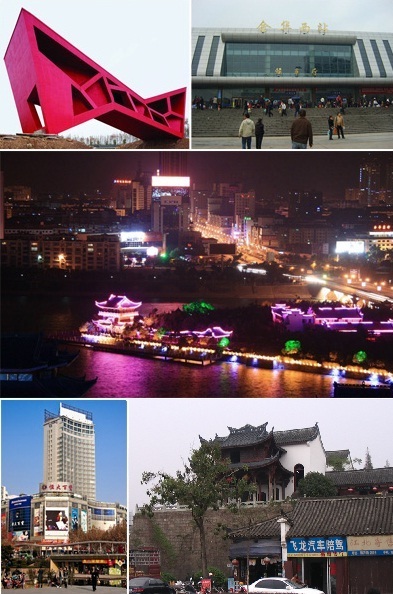
Jinhua
Prefecture-level city in Zhejiang, known for Jinhua ham.

song songroov · CC BY 3.0
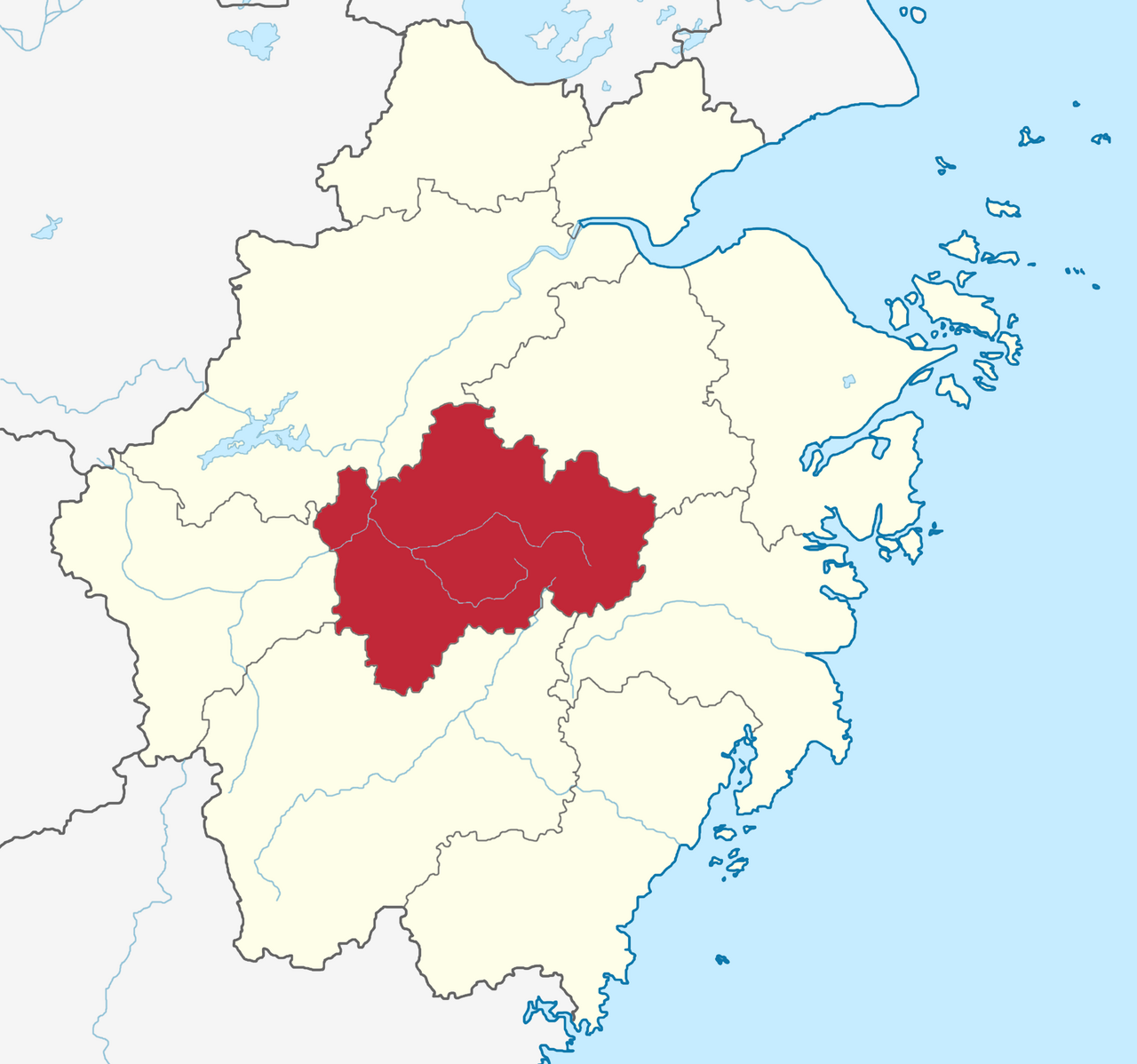
Jinhua is a prefecture-level city located in the central-western part of Zhejiang province, in eastern China. To its northwest lies the provincial capital, Hangzhou; Quzhou is to the southwest, Lishui to the south, Taizhou to the east, and Shaoxing to the northeast. According to the 2020 census, the city’s total population was 7,050,683, with 1,463,990 people living in the built-up metropolitan area formed by two urban districts. The nearby satellite city of Lanxi has essentially become a suburban extension of Jinhua’s main urban zone. The area is known for its abundant red soil and forest resources. The Jinhua, or Wu, River flows through the Lan and Fuchun rivers into the Qiantang River near Hangzhou, which empties into Hangzhou Bay and the East China Sea. During medieval China, this river system was part of the water network that supplied the southern end of the Grand Canal. Jinhua is most famous for its dry-cured ham.
The city’s history stretches back to the 2nd century BC, when it was a county under the jurisdiction of Shaoxing. It received the name Jinhua in AD 598 during the Sui dynasty and later became the seat of a prefecture. The current city and its walls were built in 1352, under the Yuan dynasty. Jinhua’s most notable historical figure is Huang Chuping, a 4th-century Daoist holy man and reputed immortal, whose descendants still live in the area. According to local legend, Wuyang Shan, or Reclining Sheep Mountain, is a sheep that Huang turned to stone using skills he acquired through years of dedicated Daoist study.
Economically, Jinhua has long prospered as a regional hub for collecting and processing agricultural and forestry products, especially rice and bamboo. It is now the second most important grain-producing area in Zhejiang. In 1985, Jinhua was promoted to city status and now administers four cities, three counties, and two districts. Local livestock includes dairy cattle, meat hogs (used for Jinhua ham, a product with a 900-year history), and honeybees. The industrial sector has grown more recently, encompassing machinery, metallurgy, pharmaceuticals, building supplies, and electrical and electronic equipment. The Tang dynasty painter Guan Xiu, known for his depictions of Buddhist holy men, was born in Jinhua. The region contains numerous scenic and historical sites, including many linked to the Immortal Huang and a palace of the Dukes of the Taiping Heavenly Kingdom.
Geographically, Jinhua lies between latitudes 28° 32' and 29° 41' N and longitudes 119° 14' and 120° 46' E, in central Zhejiang. It shares borders with Hangzhou, Quzhou, Lishui, Taizhou, and Shaoxing. The climate is humid subtropical (Köppen Cfa), with four distinct seasons: hot, humid summers and chilly, cloudy, drier winters with occasional snow. The mean annual temperature is 17.33 °C (63.2 °F), ranging from a daily average of 5.2 °C (41.4 °F) in January to 29.0 °C (84.2 °F) in July. Average annual rainfall is 1,450 mm (57.1 in), with the plum rains of the Asian monsoon affecting the city in June, when relative humidity also peaks.
The prefecture-level city of Jinhua oversees nine county-level divisions: two districts, four county-level cities, and three counties. These are further split into 191 township-level divisions, including 107 towns, 73 townships, and 11 subdistricts.
Jinhua architecture, also called Wu-school architecture, is a traditional Chinese style marked by large apartments, spacious courtyards, open halls, and horse-head walls. This differs from Beijing’s courtyard houses and Fujian’s earth buildings. Representative of Ming and Qing dynasty residences, these buildings typically have a clear central axis and symmetrical layout. They were often built by the royal family or descendants of Confucianism, serving as both homes and cultural artifacts that reflect Confucian values. A common Confucian emphasis on respecting teachers, education, law, and rules is evident in the spatial design and construction, which aims for a harmonious balance between Yin and Yang and embodies symmetry.
The economy is flexible, with distinct characteristics across different areas. About 90% of enterprises are privately owned, and the private sector contributes roughly 88% of the city’s GDP. Industry is mainly based on processing and manufacturing, with leading sectors including clothing and textiles, mechanics and electronics, pharmaceuticals and chemicals, crafts, metalwork, construction materials, automobile and motorcycle parts, food processing, and plastic products. Industrial distribution varies by county: Yiwu focuses on light-industry commodities; Yongkang on auto parts and mechanical tools; Dongyang on clothing, construction, and magnetic materials; Jinhua Proper on pharmaceuticals, building materials, and industrial measures; Lanxi on non-ferrous metals, cement, towels, and daily chemicals; and Pujiang on textiles, lockmaking, and crystal lantern ornaments.
Traditional handicrafts are also thriving. Dongyang is known for wood carving and bamboo weaving; Pujiang for straw plaiting, lace, and crystal carving; and Yongkang for hardware crafts. These products have a long history and are sold both domestically and abroad.
- area_type
- Prefecture-level city
- province
- Zhejiang
- country
- China
- known_for
- Jinhua ham, Wu-school architecture, Huang Chuping
Lore & Background
The history of Jinhua dates back to the 2nd century BC, when it was a county subordinate to Shaoxing. The most famous native of Jinhua is Huang Chuping, a Daoist holy man of the 4th century and reputed immortal whose descendants still live in the area. Wuyang Shan ('Reclining Sheep Mountain') is said to be a sheep which was turned to stone by Huang, a trick which he learned through his years of diligently studying Daoism. Economically Jinhua has always prospered from its position as the regional collecting and processing center for agricultural and forestry products, chiefly rice and bamboo. It is currently the second most important grain producing area in Zhejiang. The Tang dynasty painter Guan Xiu was born in Jinhua, known for his paintings of Buddhist holy men. Jinhua architecture, also known as Wu-school architecture, is a style of traditional Chinese architecture characterized by large apartments, large courtyards, large open halls, and horse-head walls.
Reader's Guide
Jinhua's significance lies in its long history as a regional administrative and economic hub in central Zhejiang. Its position along the Wu River, which flows to the Qiantang River and historically fed the southern end of the Grand Canal, made it a key node in medieval China's water transport network. Jinhua is also notable for its distinctive Wu-school architecture, exemplified by Ming and Qing Dynasty residences featuring symmetrical layouts and horse-head walls, reflecting Confucian values of balance and order. The city's economy is heavily private-sector driven, with 88% of GDP from private enterprises, and its industries are diversified across counties: Yiwu specializes in light-industry commodities, Yongkang in automobile accessories and tools, and Dongyang in clothing and magnetic materials. Jinhua has been a leader in China-Africa education cooperation since the 1980s, primarily through Zhejiang Normal University, which has trained over 8,000 African students. The city's scenic and historical sites include places associated with the Daoist immortal Huang Chuping and a palace of the Dukes of the Taiping Heavenly Kingdom.
Did You Know?
- The most famous native of Jinhua is Huang Chuping, a 4th-century Daoist holy man and reputed immortal.
- Jinhua architecture, or Wu-school architecture, features horse-head walls and symmetrical layouts reflecting Confucian values.
- Zhejiang Normal University in Jinhua has trained more than 8,000 African students since the 1980s.
The Art of Slow Curing
Jinhua ham is crafted exclusively from the hind legs of the "two ends black" pig, a Chinese native breed distinguished by dark hair on the head and rump, a pale midsection, thin skin, and notably fine meat. Production is strictly seasonal, commencing only when ambient temperatures fall below 10 °C, and the full traditional process spans roughly eight to ten months from winter through the following autumn. The work is divided into six distinct phases: initial trimming and blood-removal; repeated salting at 5–10 °C over about a month, sometimes five to seven rounds guided by a traditional mnemonic dictating order and placement; soaking and scrubbing in water; sun-drying until the legs release liquefied fat, typically a week's exposure; a lengthy ripening period of six to eight months in a cool, humidity-controlled room where endogenous enzymes hydrolyze proteins and fats into free amino acids; and a final post-ripening stage of two to three months in which the hams are stacked, brushed clean of mold, coated in a thin film of vegetable oil, and allowed to settle. Modern adjustments to temperature and humidity can compress the timeline to one or two months, but the traditional pace remains the benchmark for quality.
A Thousand Years on the Table
The technique behind Jinhua ham traces back to written records from the Tang dynasty (618–907 AD), making it one of the oldest documented dry-curing methods in the world. Some accounts credit Marco Polo with carrying the concept westward, seeding European ham traditions. The name "Jinhua" itself was bestowed by the first emperor of the Southern Song dynasty, binding the city's identity to the product. Over the centuries the ham became inseparable from elite Chinese dining: it features as a key ingredient in the celebrated dish "Buddha jumps over the wall," and it was given a prominent role in the Qing-dynasty novel Dream of the Red Chamber when the author painted a picture of aristocratic cuisine. Today it remains a cornerstone of Zhejiang and broader Chinese cooking, prized for its deep umami in soups, stews, and braised dishes, or served simply as a cold-cut. Its first-prize win at the 1915 Panama International Merchandise Exhibition brought it international recognition, and it continues to be compared favorably with Iberian and Italian dry-cured hams.
The Chemistry of Umami
What makes Jinhua ham taste the way it does is not a secret ingredient but time and biology. Chemical analysis shows that the total amino-acid content of a cured Jinhua ham is essentially the same as an uncured one; the difference lies in the proportion of free amino acids and nucleotides—especially glutamic acid and 5'-inosinic acid—released as endogenous enzymes hydrolyze proteins and fats during months of ripening. Molds and yeasts colonizing the surface drive additional fermentation, generating the characteristic aroma. Those aroma compounds, which include aldehydes, sulfur molecules such as methanethiol and dimethyl disulfide, and branched alkenes, arise from the auto-oxidation and rearrangement of amino acids and fatty acids. The resulting fragrance profile closely resembles that of dry-cured Iberian jamón and diverges from lighter Italian hams such as Parma, a difference attributed to the longer aging and greater environmental exposure shared by Jinhua and Iberian products. A properly made ham should display a glossy yellow rind, a bamboo-leaf silhouette, a thin bone, abundant fat encasing deep-red meat, a pronounced yet pleasant aroma, and a taste balancing salt, sweetness, and intense umami.
The 2003 Pesticide Scandal
In 2003, the reputation of Jinhua ham was severely damaged by a food-safety controversy that struck at the heart of consumer trust. A number of small-scale producers, operating outside the traditional winter-to-autumn production window, attempted to manufacture hams during warmer months when natural curing conditions were absent. To prevent spoilage and insect infestation in the absence of cold temperatures, these operators soaked their product in dichlorvos, a volatile organophosphate insecticide normally used for fumigation. The revelation triggered a sharp and immediate drop in market demand, as consumers and restaurants alike distanced themselves from the category. Legitimate producers, who adhered to the seasonal calendar and the traditional six-stage process, found themselves caught in the fallout, their sales and brand equity undermined by the actions of a minority of bad actors. The incident underscored the vulnerability of a centuries-old artisanal product when industrial shortcuts and out-of-season production collide with public expectations of safety and authenticity, and it remains a cautionary reference point in Chinese food-safety discourse.
Gallery
Frequently Asked Questions
What is Jinhua?
Jinhua is a prefecture-level city located in the central-western part of Zhejiang province in eastern China. It functions as a regional hub for gathering and processing agricultural and forestry goods.
What is Jinhua most famous for?
The city is internationally recognized for its dry-cured Jinhua ham, a traditional preserved meat product. It is also noted for its distinctive Wu-school architectural style and the historic Huang Chuping site.
Where exactly is Jinhua located?
Jinhua sits in central-western Zhejiang, sharing borders with Hangzhou to the northwest, Quzhou to the southwest, Lishui to the south, Taizhou to the east, and Shaoxing to the northeast.
What economic role does Jinhua play in the region?
The city serves as a key collecting and processing center for agricultural and forestry products from the surrounding area. Its ham industry is a particularly well-known contributor to the local economy.
What cultural or architectural features distinguish Jinhua?
The city is associated with the Wu-school of traditional Chinese architecture, recognizable by its ornate wooden carvings and layered rooflines. The Huang Chuping site is another notable landmark tied to the region's heritage.
More in Cities Starting With J 1-18
Spotted an error? Know more?
This is a living reference — every entry is fact-audited, and reader corrections feed straight into our audit queue. Suggest an edit · See this site's audit record