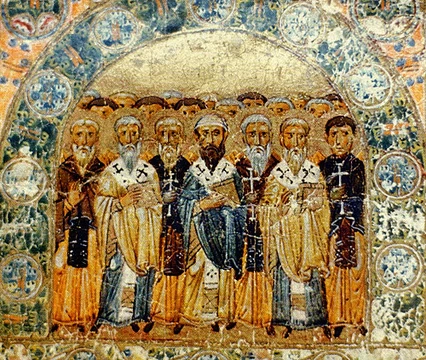
Mark the Evangelist
Traditional author of the Gospel of Mark.

Mark the Evangelist, also known as John Mark or Saint Mark, is the traditional author of the Gospel of Mark, though most modern scholars consider that gospel to be anonymous. Church tradition, particularly within the Coptic Orthodox, Greek Orthodox of Alexandria, and Coptic Catholic churches, holds that he founded the episcopal see of Alexandria, making him the first bishop there and a foundational figure for Christianity in Africa. His feast day is April 25, and his symbol is the winged lion. The identity of Mark is complex. An unbroken tradition identifies him with John Mark, the cousin of Barnabas, but the early writer Hippolytus of Rome distinguished between Mark the Evangelist, John Mark, and Mark the cousin of Barnabas, considering them three separate members of the Seventy Disciples sent out by Jesus. According to Eusebius, Mark traveled with Peter as his interpreter and wrote down Peter’s sermons, composing the Gospel before leaving for Alexandria in the third year of Emperor Claudius (AD 43). After the Council of Jerusalem, he went to Cyprus with Barnabas. Coptic tradition adds that he hosted the disciples after Jesus’s death, that the resurrected Jesus appeared in his house, and that the Holy Spirit descended there at Pentecost; it also links him to the servants at the Marriage at Cana. Scholarship on authorship remains inconclusive: some reject any Markan attribution, others debate which Mark might be the author, and some concede the author was named Mark but that his identity is unknown. Most critical scholars agree the gospel was not written by an eyewitness, though it may be based on Peter’s testimony. Eusebius records that Anianus succeeded Mark as bishop of Alexandria in the eighth year of Nero (62/63), and later Coptic tradition holds that Mark was martyred in 68.
- also_known_as
- John Mark, Saint Mark
- feast_day
- April 25
- symbol
- Winged lion
- traditionally_ascribed_work
- Gospel of Mark
- tradition_founded
- Episcopal see of Alexandria
Lore & Background
Mark the Evangelist, also known as John Mark, is traditionally depicted in art as a mature man with a beard, often holding a book or a scroll, and accompanied by his defining symbol: a winged lion. According to Coptic Christian tradition—though not universally accepted—he was a Roman African from Ancient Libya. His range of activity, as recorded in church tradition and biblical accounts, extended from Judea and Jerusalem, where he is said to have hosted the disciples in his house after Jesus’s death and witnessed the descent of the Holy Spirit at Pentecost, to Cyprus with Barnabas after the Council of Jerusalem, and ultimately to Alexandria, Egypt. He is credited with founding the episcopal see of Alexandria, one of the five most important early Christian sees, and is honored as the founder of Christianity in Africa. His defining characteristics include his role as the traditional author of the Gospel of Mark, which is believed to have been composed from the sermons of Peter, whom he accompanied as a travel companion and interpreter. Modern scholarship, however, is inconclusive on authorship, with many critical scholars viewing the gospel as anonymous and debating whether its author was John Mark, another Mark, or an unknown figure. His feast day is April 25, and his enduring symbol is the winged lion, also known as the Lion of Saint Mark.
Reader's Guide
Mark the Evangelist is significant primarily as the traditional author of the Gospel of Mark, one of the four canonical gospels. However, most modern scholars agree that the Gospel of Mark is anonymous, and scholarship is inconclusive on authorship. Some reject the attribution to Mark, while others debate the identity of Mark. The four canonical gospels do not name their authors, which was common for other ancient works. Most academic researchers agree that none of them were written by eyewitnesses, though that would not preclude the theory that Mark's gospel was based on Peter's eyewitness testimony. Evidence for Mark's authorship originates with Papias (c. 60 – c. Despite these scholarly disputes, Mark's legacy endures through the Coptic Orthodox Church, the Greek Orthodox Church of Alexandria, and the Coptic Catholic Church, all of which trace their origins to the community he founded in Alexandria. Aspects of the Coptic liturgy can be traced back to Mark himself, and he is honored as the founder of Christianity in Africa.
Did You Know?
- According to Coptic Christian tradition, Mark was born in Cyrene, a city in the Pentapolis of North Africa (now Libya).
- Hippolytus of Rome distinguished Mark the Evangelist from John Mark and Mark the cousin of Barnabas, all belonging to the Seventy Disciples.
- Mark's symbol is a winged lion, and his feast day is April 25.
- Most modern scholars agree that the Gospel of Mark is anonymous, though the topic remains contentious among experts.
Frequently Asked Questions
Who is Mark the Evangelist?
Mark the Evangelist, also called John Mark or Saint Mark, is a first-century figure traditionally credited with authoring one of the four Gospels. He is venerated as a saint across a wide range of Christian denominations.
What is the traditional symbol of Mark the Evangelist?
The winged lion is the emblem most commonly associated with Mark in Christian art and iconography. This pairing traces back to early church tradition that linked each Gospel writer to one of the four living creatures described in Ezekiel and Revelation.
What work is Mark the Evangelist traditionally ascribed with?
The Gospel of Mark is the text attributed to him, placing him among the four canonical Gospel authors. His narrative is the shortest of the four and is noted for its fast-paced emphasis on Jesus' deeds rather than extended sermons.
What role did Mark the Evangelist play in the early Church?
Church tradition holds that he established the episcopal see of Alexandria, which went on to become one of the five most significant sees in early Christianity. His legacy is especially prominent in the Coptic and broader Alexandrian Christian heritage.
When is the feast day of Mark the Evangelist?
April 25 is observed as his feast day in the liturgical calendars of many Western and Eastern Christian churches. The date commemorates the anniversary of his death, which tradition places in Alexandria.
More in Christian Saints & Early Church Fathers 1-24
Spotted an error? Know more?
This is a living reference — every entry is fact-audited, and reader corrections feed straight into our audit queue. Suggest an edit · See this site's audit record