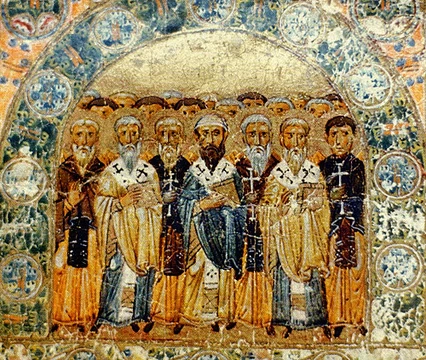
Hosius of Corduba
Bishop of Corduba and key figure in the Arian controversy.

Hosius of Corduba (c. 256–359), also called Hosius the Confessor, Osius, or Ossius, served as bishop of Corduba (modern Córdoba, Spain) and became a leading figure in the homoousion branch of Christianity during the Arian controversy. He likely presided over the First Council of Nicaea and later chaired the Council of Serdica. Following Lactantius, he was Emperor Constantine the Great’s most trusted Christian advisor, helping shape public statements like Constantine’s *Oration to the Saints*, which was delivered to assembled bishops. He is honored as a saint in the Eastern Orthodox, Roman Catholic, and Oriental churches, bearing the title confessor of the faith, with a feast day on 27 August.
Born in Corduba in the Roman province of Hispania, Hosius was elected bishop of that see around 295 and narrowly avoided martyrdom during the persecution under Emperor Maximian. In 300 or 301, he attended the provincial Synod of Elvira, where his name appears second among those present, and supported its strict canons on clerical marriage and the treatment of Christians who had renounced their faith during recent persecutions. The synod leaned toward Novatianist views, refusing readmission to baptized Christians who had denied their faith or performed pagan sacrifices under duress.
In 313, Hosius appeared at Constantine’s court, mentioned by name in an imperial directive sent to Caecilianus of Carthage that year. He is not listed among attendees of the Synod of Arles in 314, though he may have accompanied the emperor during his first war with Licinius in Pannonia. Around 320 or 321, Alexander, bishop of Alexandria, convened a council in Alexandria where over one hundred bishops from Egypt and Libya condemned Arius and his deacon. In autumn 324, Hosius carried Constantine’s letter to Bishop Alexander and Arius, urging reconciliation. After that synod, Hosius led another in Antioch, likely during the election of Eustathius following Philogonius’s death in November 324. There, bishops supporting Arius were suspended, and a general synod was announced for Ancyra. Constantine moved this gathering to the First Council of Nicaea, which opened on 20 May 325. Hosius probably presided, as his name appears first on the list of participants, and he backed Alexander against Arius. After the council, he returned to his diocese in Spain.
For nearly fifty years, Hosius ranked among the foremost bishops of his era, widely respected and influential. After Constantine’s death in 337, Eusebius of Nicomedia, an Arian with ties to the imperial family, became patriarch of Constantinople. He and his supporters pressured Emperor Constantius II to expel Athanasius of Alexandria, a staunch anti-Arian, from his diocese for a second time. Eusebius urged the emperor to summon Hosius, a supporter of Athanasius, to Milan, where the bishop of Corduba refused to condemn Athanasius. Hosius so impressed Constantius that he was allowed to return home. He played a key role at the Council of Serdica, which began in summer or autumn 343, as shown by his being the first to sign its acts.
Continued pressure from Eusebius led Constantius to write, asking whether Hosius alone would remain stubborn in backing Athanasius. In reply, Hosius sent a courageous letter of protest against imperial interference in church affairs (353), preserved by Athanasius. This led to Hosius’s exile in 355 to Sirmium, an imperial center in Pannonia (modern Serbia). From exile, he wrote his only surviving composition to Constantius II: “God gives you the empire; He entrusts ecclesiastical power to us.” The French historian Louis-Sébastien Le Nain de Tillemont characterized this letter as displaying gravity, dignity, gentleness, wisdom, generosity, and all the qualities of a great soul and bishop. Under relentless pressure from the Eusebian party, Hosius signed the homoean formula adopted by the Third Council of Sirmium in 357, which allowed communion with the homoeans (Acacians) but did not require condemning Athanasius. He was then permitted to return to his Hispanic diocese, where he died in 359. Later accounts—such as those by Faustinus and Athanasius—claiming that Hosius persecuted Nicene Christians or anathematized Arianism on his deathbed are likely fictional. His lapse can be explained by his frail health and old age, without assuming he consciously abandoned the faith he held for ninety years. A letter from Pope Liberius to him, dating from around 353, discusses the lapse of Vincentius of Capua at the Council of Arles.
- field
- Bishop, theologian, imperial advisor
- nationality
- Roman (Hispania)
- known_for
- Advocacy for homoousion Christianity; probable presidency at First Council of Nicaea; advisor to Constantine the Great
Lore & Background
Hosius of Corduba, a bishop of Corduba in the Roman province of Hispania, was a central figure in early Christianity, particularly during the Arian controversy. He was a prominent advocate for the homoousion doctrine, which affirmed the consubstantiality of the Father and the Son. He is venerated as a saint in the Eastern Orthodox, Roman Catholic, and Oriental churches, with a feast day on 27 August. Born in Corduba, he was elected to its see around 295 and narrowly avoided martyrdom during the persecution under Emperor Maximian. He attended the provincial Synod of Elvira in 300 or 301, where his name appears second among participants, and he upheld its strict canons on clerical marriage and the treatment of those who had renounced their faith under persecution. After Lactantius, he was the closest Christian advisor to Emperor Constantine the Great, guiding the content of public utterances such as Constantine's Oration to the Saints. In autumn 324, Hosius delivered Constantine’s letter to Bishop Alexander and Arius urging reconciliation. He likely presided over the First Council of Nicaea in 325, his name appearing first on the participant list, and later presided at the Council of Serdica in 343. For nearly 50 years, he was a foremost bishop, held in universal esteem. Exiled in 355 to Sirmium for refusing to condemn Athanasius, he wrote a famous letter to Constantius II asserting that God grants the empire while entrusting ecclesiastical power to the Church. Under continual pressure, he signed the homoean formula of the Third Council of Sirmium in 357, allowing his return to Spain, where he died in 359.
Reader's Guide
Hosius of Corduba was a central figure in early Christian history, particularly during the Arian controversy. For nearly 50 years he was one of the foremost bishops of his time, held in universal esteem and exercising great influence. As the closest Christian advisor to Emperor Constantine the Great, he guided the content of public utterances such as Constantine's Oration to the Saints. His probable presidency at the First Council of Nicaea and his presidency at the Council of Serdica underscore his leadership in shaping orthodox doctrine. Later accounts suggesting he persecuted Nicene Christians or anathemized Arianism on his deathbed are most likely fictious. His lapse is explainable by his frail health and old age without positing a conscious change of faith. His legacy as a confessor of the faith is commemorated on 27 August.
Did You Know?
- Hosius narrowly escaped martyrdom during the persecution of Maximian.
- He was the bearer of Constantine's letter to Bishop Alexander and Arius in autumn 324 urging reconciliation.
- His name appears first on the list of participants at the First Council of Nicaea, suggesting he probably presided.
- From exile in Sirmium, he wrote to Constantius II: 'God gives you the empire; He entrusts ecclesiastical power to us.'
Gallery
Frequently Asked Questions
What role did Hosius of Corduba play at the First Council of Nicaea?
He is widely believed to have chaired the 325 council, presiding over the assembly that produced the Nicene Creed. He later held the same presiding role at the Council of Serdica, underscoring his standing as a leading ecumenical authority.
How did Hosius of Corduba connect to Emperor Constantine?
After Lactantius, Hosius became Constantine's closest Christian counselor, helping to shape the theological language of imperial texts such as the Oration to the Saints. That proximity to the throne amplified the political force behind his homoousion advocacy during the Arian dispute.
Why is Hosius of Corduba important in the Arian controversy?
He staked his episcopal authority on the doctrine that the Son shares the same divine substance as the Father, directly opposing the Arian position at a moment when it enjoyed considerable imperial support. His leadership at Nicaea and Serdica helped lock the Nicene formula in as the orthodox benchmark.
How is Hosius of Corduba venerated today?
He is honored as a saint in the Eastern Orthodox Church, where his memory is kept in the liturgical calendar. The epithet 'the Confessor' highlights his reputation for holding fast to his convictions under pressure.
More in Christian Saints & Early Church Fathers 1-24
Spotted an error? Know more?
This is a living reference — every entry is fact-audited, and reader corrections feed straight into our audit queue. Suggest an edit · See this site's audit record