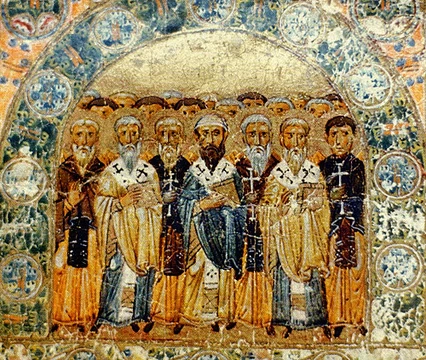
James the Great
First apostle martyred; patron saint of Spain.

James the Great (died around 44 CE) was one of the Twelve Apostles of Jesus. He was the second apostle to die, after Judas Iscariot, and the first to be killed for his faith. He is the patron saint of Spain, and tradition holds that his remains are kept in Santiago de Compostela in Galicia, Spain.
He is also known by several other names: James, son of Zebedee; James, brother of John; Saint James the Greater; Saint James the Major; Saint James the Elder; Saint Jacob; James the Apostle; Santiago; and, with his brother John, one of the "Sons of Thunder" (Boanerges). He was born into a Jewish fishing family on the Sea of Galilee, the son of Zebedee and Salome. Salome was a sister of Mary, the mother of Jesus, making James a cousin of Jesus. He is called "the Greater" to distinguish him from the other apostle James "the Lesser," with "greater" meaning older or taller, not more important.
James was one of the first disciples to follow Jesus. The Synoptic Gospels say he and his brother John were preparing to fish with their father when Jesus called them. Along with Peter and John, James formed an inner circle among the Twelve. Jesus allowed only these three to witness the raising of Jairus' daughter, the Transfiguration, and his agony in the Garden of Gethsemane. James and John (or, in another version, their mother) asked Jesus to grant them seats at his right and left in his glory. Jesus rebuked them, asking if they could drink the cup he would drink, and said the honor was not his to give. The other apostles were annoyed. James and John also wanted to call down fire on a Samaritan town, but Jesus rebuked them.
The Acts of the Apostles records that "Herod the king" (usually identified as Herod Agrippa) had James executed "by the sword." Henry Alford suggests he was probably beheaded. Nixon suggests his death may have been triggered by his fiery temper. F. F. Bruce contrasts this with the liberation of Peter, calling the difference a "mystery of divine providence."
In Catholic tradition, Saint James is Spain's patron saint. According to legend, his remains are in Santiago de Compostela in Galicia. The name "Santiago" comes from the Latin *Sancti Iacobi* ("of Saint James"), which also evolved into the Spanish name Diego and Portuguese Tiago/Thiago. The pilgrimage to his grave, the "Way of St. James," has been popular since the Early Middle Ages, though its modern revival stems from Walter Starkie's 1957 book *The Road to Santiago*. In 2018, 327,378 pilgrims registered as having completed the final 100 km (or 200 km by bicycle) to qualify for a Compostela. When July 25 falls on a Sunday, it is a Jacobean Holy Year, and a special east door opens at Santiago Cathedral. Jubilee years follow a 6-5-6-11 pattern (with occasional gaps of 7 or 12 years). In the 2004 Holy Year, 179,944 pilgrims were received; in 2010, 272,412. The most recent Holy Year was 2021; the next will be 2027.
His feast day is July 25 on the liturgical calendars of the Catholic, Eastern Orthodox, True Orthodox, Anglican, Lutheran, and some other Protestant churches. This date is traditionally believed to be the day of his martyrdom in 44 CE, though some historians argue it was chosen to coincide with the feast of Saint Christopher. He is also commemorated on April 30 (or May 13 on the Gregorian calendar for churches using the Julian Calendar) and on June 30 (Synaxis of the Apostles). July 25 is also the National Day of Galicia, as James is its patron saint.
The site of his martyrdom is within the Armenian Apostolic Cathedral of St. James in the Armenian Quarter of Jerusalem. The Chapel of Saint James the Great, to the left of the sanctuary, is the traditional place where King Agrippa ordered his beheading (Acts 12:1–2). His head is believed to be buried under the altar, marked by a piece of red marble and surrounded by six votive lamps.
The 12th-century *Historia Compostelana* summarizes the legend: first, that James preached the gospel in Hispania as well as the Holy Land; second, that after his martyrdom, his followers carried his body by sea to Hispania, landing at Padrón on the coast of Galicia, then carried it overland for burial at Santiago de Compostela. After first going to Sardinia, James embarked at Cartagena and began preaching in Hispania.
- born
- Unknown (family of Jewish fishermen on the Sea of Galilee)
- died
- c. 44
- field
- Apostle, missionary
- nationality
- Jewish (Galilee)
- known_for
- One of the Twelve Apostles; first apostle martyred; patron saint of Spain; associated with the Way of St. James pilgrimage
Quick Facts
- Honorific Prefix
- Saint
- Death Date
- AD 44
- Feast Day
- 25 July (Western Christianity) / 30 April (Eastern Christianity) / 30 December (Mozarabic Rite)
- Birth Place
- Bethsaida, Galilee, Roman Empire
- Death Place
- Jerusalem, Judea, Roman Empire
- Titles
- Apostle and Martyr
- Honored In
- All Christian denominations that venerate saints
- Canonized Date
- Pre-Congregation
- Attributes
- Red Martyr, Scallop, Pilgrim's hat
Facts from the source article.
Lore & Background
James was born into a family of Jewish fishermen on the Sea of Galilee, the son of Zebedee and Salome. Salome was a sister of Mary, mother of Jesus, making James a cousin of Jesus. He was styled 'the Greater' to distinguish him from James the Lesser, with 'greater' meaning older or taller. He was the brother of John the Apostle and, along with John and Peter, formed an informal triumvirate among the Twelve Apostles. Jesus allowed them to be present at the raising of Jairus' daughter, the transfiguration, and Jesus' agony in the Garden of Gethsemane. James and John asked Jesus for seats on his right and left in his glory, which Jesus rebuked. They also wanted to call down fire on a Samaritan town but were rebuked. The Acts of the Apostles records that 'Herod the king' (usually identified with Herod Agrippa) had James executed 'by the sword.' Henry Alford suggests he was probably beheaded. Nixon suggests his death may have been triggered by his fiery temper, from which he and his brother earned the nickname Boanerges or 'Sons of Thunder.' The site of martyrdom is located within the Armenian Apostolic Cathedral of St. James in the Armenian Quarter of Jerusalem, where his head is believed to be buried under the altar.
Reader's Guide
James the Great holds a significant place in Christian tradition as the first apostle to be martyred, setting a precedent for apostolic witness. His association with Spain, though based on later legends rather than contemporary records, has had a profound impact on European history and culture. The tradition that he preached in Hispania and that his relics were translated to Santiago de Compostela gave rise to the Way of St. James, one of the most important Christian pilgrimages from the Early Middle Ages onward. The scallop shell became his emblem, and the battle cry 'Santiago, y cierra, España!' linked him to medieval Spanish identity. His feast day on 25 July is also the National Day of Galicia. The legend of Santiago Matamoros, though a later addition, further cemented his role as a protector of Spain. The mystery of why James died while Peter escaped, as noted by F. F. Bruce, remains a point of theological reflection.
Did You Know?
- James was the second apostle to die after Judas Iscariot and the first to be martyred.
- His mother Salome was a sister of Mary, mother of Jesus, making James a cousin of Jesus.
- His feast day on 25 July is also the National Day of Galicia.
Frequently Asked Questions
Who is James the Great?
He was one of the Twelve Apostles called by Jesus, a Jewish fisherman from the Sea of Galilee. He is traditionally identified as the son of Zebedee and the brother of John the Evangelist.
How did James the Great die?
The Acts of the Apostles records that King Herod Agrippa I had him beheaded around 44 CE. This made him the first of the original Twelve to suffer martyrdom.
Why is he called 'the Great' or 'the Elder'?
The epithet simply distinguishes him from the other apostle named James, the son of Alphaeus, who is often called 'James the Less.' It is a traditional naming convention and does not imply a hierarchy of importance between the two.
What is James the Great's connection to Spain?
His remains are venerated in the cathedral at Santiago de Compostela in Galicia, which made him the patron saint of Spain. The city's name itself references him, roughly meaning 'Saint James of the Old Field.'
What is the Way of St. James pilgrimage?
It is a network of walking routes across Europe that historically lead pilgrims to the shrine of James the Great in Santiago de Compostela. The tradition dates back to the Middle Ages and continues to draw hundreds of thousands of walkers each year.
More in Christian Saints & Early Church Fathers 1-24
Spotted an error? Know more?
This is a living reference — every entry is fact-audited, and reader corrections feed straight into our audit queue. Suggest an edit · See this site's audit record