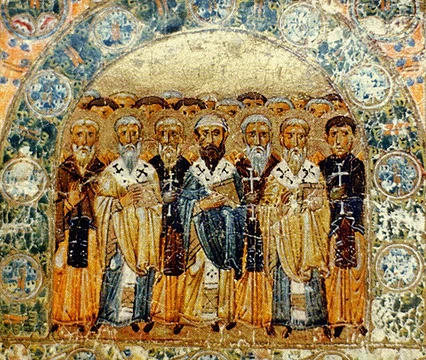
Hosius of Corduba
Last updated
With the title of confessor of the faith and a feast day on 27 August, Hosius is venerated as a saint in the Eastern Orthodox Church, Roman Catholic Church, and Oriental churches.[1]
Life and work
In 300 or 301 he attended the provincial Synod of Elvira, his name appearing second in the list of those present.[2] He appeared at the court of Constantine the Great in 313, being mentioned by name in a constitution directed to Caecilianus of Carthage.[3] After the council, Hosius returned to his diocese in Spain.[4] Constantine's letter urging reconciliation between Bishop Alexander and Arius was carried by Hosius in autumn 324.[5]
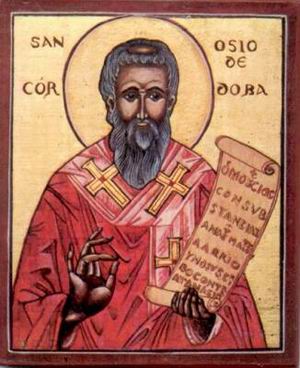
For nearly five decades Hosius ranked among the most prominent bishops of his era, enjoying universal respect and wielding significant influence.[6] Under ongoing pressure from the Eusebian faction, Hosius signed the homoean formula that the Third Council of Sirmium adopted in 357.[7]
What the cited sources add
The Dictionary of Christian Biography states that Athanasius called Hosius "of all men the most illustrious" and was never weary of repeating his praises.[8] Hosius was more than 100 years old and had been more than 60 years a bishop when he was summoned by Constantius from Spain to Sirmium.[8] That same account credits Hosius and Athanasius with having a dominant role in shaping the symbol of the First Ecumenical Council.[9]
References
- Wikipedia, "Hosius of Corduba" (CC BY-SA 4.0), which cites: "Saint Hosius the Confessor, Bishop of Córdoba", www.oca.org (we also read that source) en.wikipedia.org
- Wikipedia, "Hosius of Corduba" (CC BY-SA 4.0), which cites: Myers, "Hosius of Cordova", www.newadvent.org; ; "Henry Wace: Dictionary of Christian Biography and Literature to the End of the Sixth Century A.D., with an Account of the Principal Sects and Heresies. - Christian Classics Ethereal Library", www.ccel.org (we also read that source) en.wikipedia.org
- Wikipedia, "Hosius of Corduba" (CC BY-SA 4.0) en.wikipedia.org
- Wikipedia, "Hosius of Corduba" (CC BY-SA 4.0), which cites: Myers, "Hosius of Cordova", www.newadvent.org (we also read that source) en.wikipedia.org
- Wikipedia, "Hosius of Corduba" (CC BY-SA 4.0), which cites: "Henry Wace: Dictionary of Christian Biography and Literature to the End of the Sixth Century A.D., with an Account of the Principal Sects and Heresies. - Christian Classics Ethereal Library", www.ccel.org; "First Council of Nicaea", www.newadvent.org (we also read that source) en.wikipedia.org
- Wikipedia, "Hosius of Corduba" (CC BY-SA 4.0), which cites: "Henry Wace: Dictionary of Christian Biography and Literature to the End of the Sixth Century A.D., with an Account of the Principal Sects and Heresies. - Christian Classics Ethereal Library", www.ccel.org (we also read that source) en.wikipedia.org
- Wikipedia, "Hosius of Corduba" (CC BY-SA 4.0), which cites: Philostorgius, in Photius, Epitome of the Ecclesiastical History of Philostorgius, iv.3. (original not read by us) en.wikipedia.org
- "Henry Wace: Dictionary of Christian Biography and Literature to the End of the Sixth Century A.D., with an Account of the Principal Sects and Heresies. - Christian Classics Ethereal Library", www.ccel.org. ccel.org
- "First Council of Nicaea", www.newadvent.org. newadvent.org
Each numbered sentence above was checked against the source it cites before publication. Sentences citing Wikipedia adapt text from the English Wikipedia article Hosius of Corduba (contributors), used under CC BY-SA 4.0; this entry is available under the same licence. Other sources were used for facts only.
More in Christian Saints & Early Church Fathers
Sources
Compiled from Wikipedia and the sources listed below. Text from Wikipedia is available under CC BY-SA 4.0; this entry is adapted from it.
- Wikipedia: Hosius of Corduba (CC BY-SA 4.0).
Spotted an error? Know more?
Reader corrections go straight into our review queue. Suggest an edit · How this site is sourced