Tracheobronchial injury
Rare airway damage from blunt or penetrating trauma, often fatal before hospital arrival.
Last updated
Tracheobronchial injury (TBI) is damage to the trachea and bronchi, the major airways. It is a rare but serious condition that can cause life-threatening airway obstruction. Most deaths occur before emergency care is reached, and the mortality rate among those who reach a hospital may be as high as 30%.
Quick Facts
- Field
- Emergency medicine
Facts from the source article.
Mechanism
The tracheobronchial tree is well protected, so significant force is usually required to injure it. In blunt trauma, violent chest compression is a common cause; rapid neck hyperextension, often from vehicle crashes, can also damage the trachea. A crush injury of the larynx or cervical trachea may occur in head-on collisions when the hyperextended neck strikes the steering wheel or dashboard—termed a "dashboard injury"—or from a seat belt across the neck.
Three mechanisms are thought to contribute, though the process is not fully understood. The first, sometimes called "explosive rupture," happens when the chest is violently compressed, the glottis reflexively closes, and pressure within the airways rises until the tissues burst; the membranous part of the trachea is more vulnerable than cartilaginous portions. The second mechanism involves shearing: sudden deceleration, as in vehicle accidents, causes the mobile lungs to tear at fixed points near the cricoid cartilage and carina.
The third mechanism occurs when front-to-back chest compression widens the chest from side to side; the lungs adhere to the chest wall via negative pleural pressure and are pulled apart, creating tension at the carina that can tear the airway. Most TBIs likely result from a combination of these three mechanisms.
Diagnosis
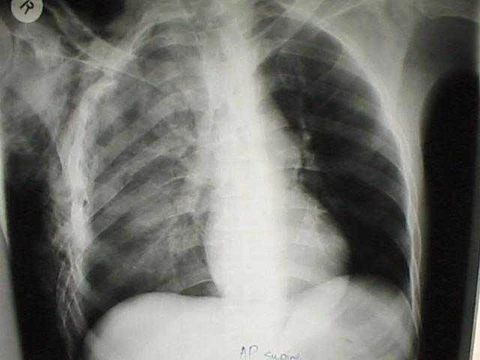
Rapid diagnosis is important to reduce complications. Bronchoscopy is the most effective method to diagnose, locate, and determine severity, and is usually the only method that allows a definitive diagnosis; flexible bronchoscopy provides direct visualization and is the fastest and most reliable technique. Chest x-ray is the initial imaging tool, though it may show no signs in an otherwise asymptomatic patient. Radiographic indications of TBI include tracheal deformity, a defect in the tracheal wall, cervical emphysema, subcutaneous emphysema, or a high-riding hyoid bone suggesting tracheal severance.
A displaced endotracheal tube or an overinflated cuff protruding through a tear also raises suspicion. If a bronchus is completely torn, the lung may collapse outward toward the chest wall—a rare sign called fallen lung sign, which is pathognomonic for TBI. However, up to one in five people with blunt trauma and TBI have no signs on chest x-ray. CT scanning detects over 90% of blunt TBI cases, but neither x-ray nor CT replaces bronchoscopy.
Treatment
Treatment depends on injury location, severity, and patient stability, but ensuring a patent airway is always paramount. Intubation may bypass a disruption; a tube can be placed into the uninjured bronchus to ventilate a single lung. If a penetrating neck wound allows air escape, the trachea may be intubated through the wound. Multiple failed direct laryngoscopy attempts can threaten the airway, so fiberoptic or video laryngoscopy may be used.
For upper tracheal injury, tracheotomy or cricothyrotomy can secure the airway, though cricothyrotomy is ineffective if the laceration is below the artificial airway; tracheotomy is used sparingly due to risks of infection and narrowing. When an adequate airway cannot be established or complicated surgery is needed, cardiopulmonary bypass may be employed. Pneumothorax is treated with a chest tube. Supplemental oxygen and mechanical ventilation are often required; positive end-expiratory pressure and higher ventilation pressures can help oxygenation but may increase air leakage through a tear or stress surgical sutures, so the lowest effective pressures are used.
High frequency ventilation has been reported. Pulmonary toilet, fluid management, and pneumonia treatment improve lung compliance.
Epidemiology
Rupture of the trachea or bronchus is the most common blunt airway injury. True incidence is difficult to determine: 30–80% of cases die before reaching a hospital and may be excluded from studies, while some small TBIs cause no symptoms and go unnoticed. Autopsy studies find TBI in 2.5–3.2% of trauma deaths. Among all neck and chest traumas, including immediate deaths, TBI is estimated at 0.5–2%.
An estimated 0.5% of polytrauma patients in trauma centers have TBI. Incidence is 2% in blunt chest and neck trauma and 1–2% in penetrating chest trauma. Laryngotracheal injuries occur in 8% of penetrating neck injuries, and TBI in 2.8% of blunt chest trauma deaths. Among blunt trauma patients reaching hospital alive, reported incidences range from 2.1% to 5.3%; one study found 0.3% but a 67% mortality rate.
Iatrogenic TBI is rising, with higher risk in women and the elderly; it occurs about once per 20,000 oral intubations, but up to 15% in emergent intubations. Mortality for those reaching hospital alive was estimated at 30% in 1966, with more recent estimates at 9%. Most deaths occur within two hours of arrival. Earlier diagnosis correlates with higher mortality, likely due to severe accompanying injuries.
Did You Know?
- Isolated TBI does not usually cause profuse bleeding; such bleeding suggests another injury such as a ruptured large blood vessel.
- Vehicle occupants who wear seat belts have a lower incidence of TBI after a motor vehicle accident, but a strap across the neck increases risk.
- Gunshot wounds are the commonest form of penetrating trauma causing TBI.
More in Chest Trauma
Sources
Compiled from Wikipedia and the sources listed below. Text from Wikipedia is available under CC BY-SA 4.0; this entry is adapted from it.
- Wikipedia: Tracheobronchial injury (CC BY-SA 4.0).
- Word definitions: the , each quoted from its Wikipedia article.
Spotted an error? Know more?
Reader corrections go straight into our review queue. Suggest an edit · How this site is sourced