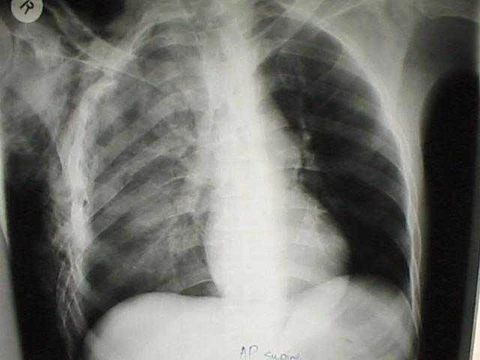
Flail chest
Flail chest: paradoxical breathing from multiple rib fractures.
Last updated
Flail chest is a life-threatening condition in which a segment of the rib cage becomes detached from the chest wall due to multiple adjacent rib fractures. It is notable for causing paradoxical breathing, where the flail segment moves opposite to the rest of the chest, and is often accompanied by a pulmonary contusion that can impair blood oxygenation.
Signs and symptoms
Chest pain and shortness of breath are two symptoms. The characteristic paradoxical motion occurs because the flail segment is pulled inward during inspiration when the rest of the chest expands, and pushed outward during expiration when the chest contracts. This motion is a late sign, so its absence does not rule out flail chest.
The constant movement of broken ribs at fracture sites is extremely painful, and untreated sharp edges may puncture the pleural sac or lung, causing pneumothorax. Pulmonary contusions are commonly associated and can lead to respiratory failure due to paradoxical motions that interrupt normal breathing, stiffen the lungs, and increase airway resistance. Respiratory failure from flail chest often requires mechanical ventilation and a longer intensive care unit stay; the lung damage from the flail segment is life-threatening.
Causes
Vehicle collisions cause 76% of flail chest injuries, and falls cause 14%, mainly in the elderly due to weak bones. The condition typically requires three or more adjacent ribs fractured in two or more places, or ribs fractured proximally with distal costal cartilage disarticulation. A significant force applied over a large thoracic surface is needed, as rollover and crushing injuries usually break ribs at only one point. In children, common blunt force traumas or metabolic bone diseases such as osteogenesis imperfecta are causes.
Treatment
Initial treatment follows advanced trauma life support principles. Good pain management includes early regional anesthesia like intercostal or erector spinae plane blocks, avoiding opioids to improve ventilation and oxygenation. Positive pressure ventilation is used with careful adjustment to prevent pulmonary barotrauma. Chest tubes are placed as needed, and the person is positioned for comfort.
Aggressive pulmonary toilet is performed. A double lumen tracheal tube may allow each lung to receive different ventilator pressures. Surgical fixation can reduce the duration of ventilatory support, conserve pulmonary function, reduce the need for tracheostomy, shorten intensive care unit stay, and lower pneumonia risk.
Prognosis
Death rates range from 10 to 25%, depending on severity. A systematic review found no statistically significant difference in deaths between surgical and non-surgical treatment. However, surgical intervention reduces the need for tracheostomy, shortens intensive care unit stay, and may lower pneumonia risk.
More in Chest Trauma
Sources
Compiled from Wikipedia and the sources listed below. Text from Wikipedia is available under CC BY-SA 4.0; this entry is adapted from it.
- Wikipedia: Flail chest (CC BY-SA 4.0).
- Word definitions: the Codexery glossary, each quoted from its Wikipedia article.
Spotted an error? Know more?
Reader corrections go straight into our review queue. Suggest an edit · How this site is sourced