Penetrating trauma
Open wound injury from object piercing skin and entering tissue.
Last updated
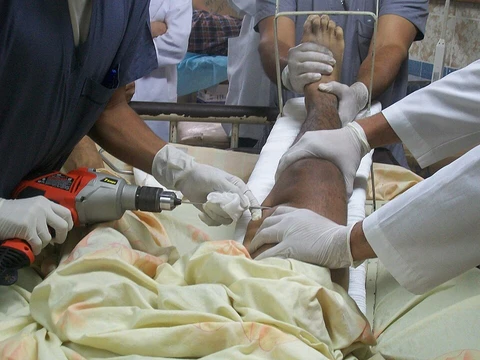
When an object breaks the skin and enters body tissue, the resulting open wound is called penetrating trauma, characterized by a deep but narrow entry point.[1]
Quick Facts
- Field
- Trauma surgery
- General surgery
- emergency medicine
Facts from the source article.
Key facts and history
High-velocity projectiles, such as bullets from assault rifles, create a temporary cavitation injury by forcing tissue outward.[2][3] Before the 17th century, hot oil was poured into wounds to cauterize blood vessels.[4] Penetrating injuries often happen during violent crimes or military combat, with gunshots and stabbings being frequent causes.[5] Knives are low-velocity items typically pushed by hand, and they usually harm only the tissue they directly touch.[6]
In 1545, French surgeon Ambroise Paré objected to pouring hot oil into wounds to stop bleeding and instead suggested using ligature to control hemorrhage.[4] During the American Civil War, surgeons used chloroform for operations, yet infection remained the main reason wounded soldiers died.[4] In World War I, medical personnel started giving salt solutions to replace lost fluids, and World War II brought blood banking and antibiotics into use.[7] Routinely restricting spinal motion after penetrating trauma leads to poorer outcomes and should be avoided.[8]
What the cited sources add
According to the Open Library record for ISBN 0723425957, "Cardiovascular/respiratory Physiotherapy" is a 284-page book published by Mosby on January 15, 1998.[9]
References
- Wikipedia, "Penetrating trauma" (CC BY-SA 4.0), which cites: Stewart MG, "Head, Face, and Neck Trauma: Comprehensive Management", Thieme, 2005, p. 188–94 (original not read by us) en.wikipedia.org
- Wikipedia, "Penetrating trauma" (CC BY-SA 4.0), which cites: Daniel Limmer and Michael F. O'Keefe. 2005. Emergency Care 10th ed. Edward T. Dickinson, Ed. Pearson, Prentice Hall. Upper Saddle River, New Jersey. Pages 189-1 (original not read by us) en.wikipedia.org
- Wikipedia, "Penetrating trauma" (CC BY-SA 4.0), which cites: "The Trauma Manual", Lippincott Williams & Wilkins, 2002; Maiden, "Ballistics reviews: mechanisms of bullet wound trauma", Forensic Science, Medicine, and Pathology, 2009, p. 204–9 (we also read that source) en.wikipedia.org
- Wikipedia, "Penetrating trauma" (CC BY-SA 4.0), which cites: Blank-Reid C, "A historical review of penetrating abdominal trauma", Crit Care Nurs Clin North Am, September 2006, p. 387–401; Blank-Reid C, "A historical review of penetrating abdominal trauma", Crit Care Nurs Clin North Am, September 2006, p. 387–401 (original not read by us) en.wikipedia.org
- Wikipedia, "Penetrating trauma" (CC BY-SA 4.0), which cites: "Head, Face, and Neck Trauma: Comprehensive Management", Thieme, 2005, p. 26; "Emergency Care and Transportation of the Sick and Injured", Jones and Bartlett, 2002, p. 562 (we also read that source) en.wikipedia.org
- Wikipedia, "Penetrating trauma" (CC BY-SA 4.0), which cites: Daniel Limmer and Michael F. O'Keefe. 2005. Emergency Care 10th ed. Edward T. Dickinson, Ed. Pearson, Prentice Hall. Upper Saddle River, New Jersey. Pages 189-1; "The Trauma Manual", Lippincott Williams & Wilkins, 2002 (we also read that source) en.wikipedia.org
- Wikipedia, "Penetrating trauma" (CC BY-SA 4.0), which cites: Blank-Reid C, "A historical review of penetrating abdominal trauma", Crit Care Nurs Clin North Am, September 2006, p. 387–401 (original not read by us) en.wikipedia.org
- Wikipedia, "Penetrating trauma" (CC BY-SA 4.0), which cites: Velopulos, "Prehospital Spine Immobilization/Spinal Motion Restriction in Penetrating Trauma: a Practice Management Guideline from the Eastern Association for the Surgery of Trauma (EAST).", The Journal of Trauma and Acu (original not read by us) en.wikipedia.org
- Open Library record, ISBN 0723425957 ("Cardiovascular/respiratory Physiotherapy"). CC0 (metadata); book content not read. openlibrary.org
Each numbered sentence above was checked against the source it cites before publication. Sentences citing Wikipedia adapt text from the English Wikipedia article Penetrating trauma (contributors), used under CC BY-SA 4.0; this entry is available under the same licence. Other sources were used for facts only; no text or images are copied from them.
More in Traumatology
Sources
Compiled from Wikipedia and the sources listed below. Text from Wikipedia is available under CC BY-SA 4.0; this entry is adapted from it.
- Wikipedia: Penetrating trauma (CC BY-SA 4.0).
Spotted an error? Know more?
Reader corrections go straight into our review queue. Suggest an edit · How this site is sourced