Nitroglycerin
A powerful explosive and lifesaving heart medication.

Unbekannte Autoren und Grafiker; Scan vom EDHAC e.V. · Public domain
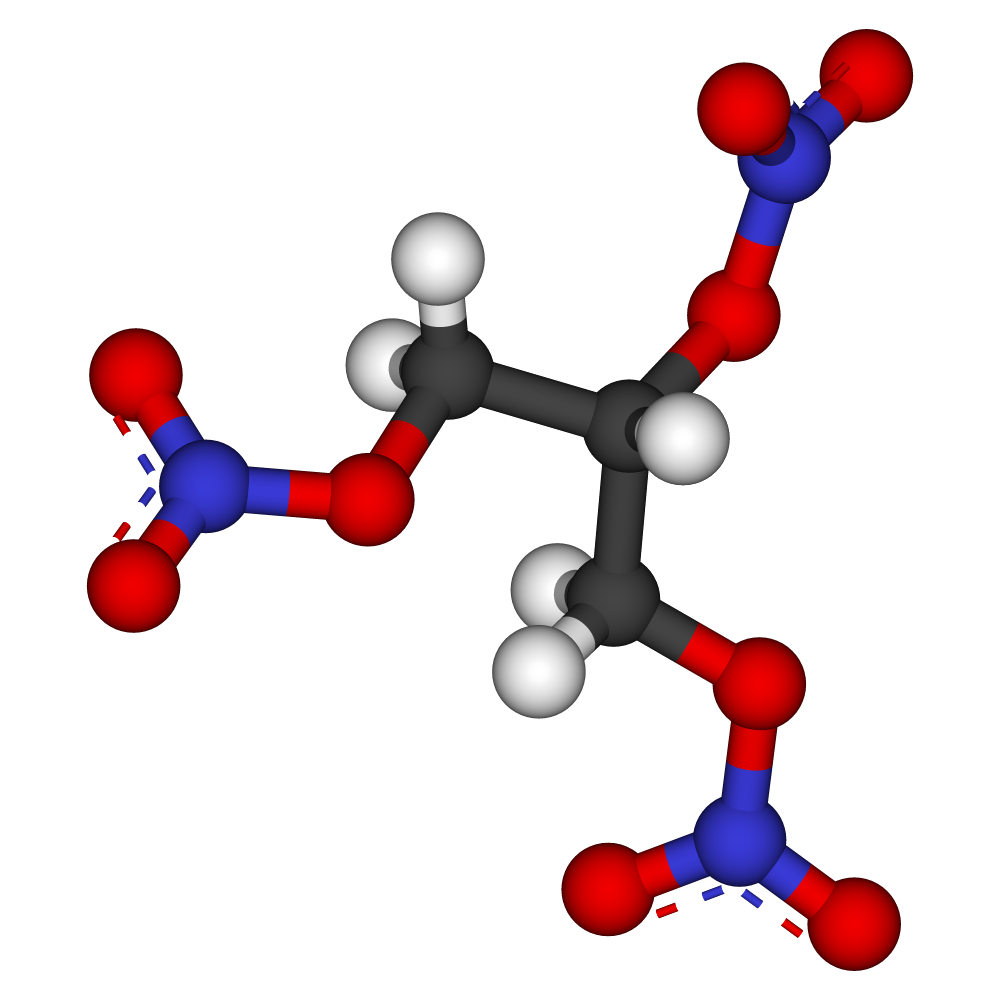
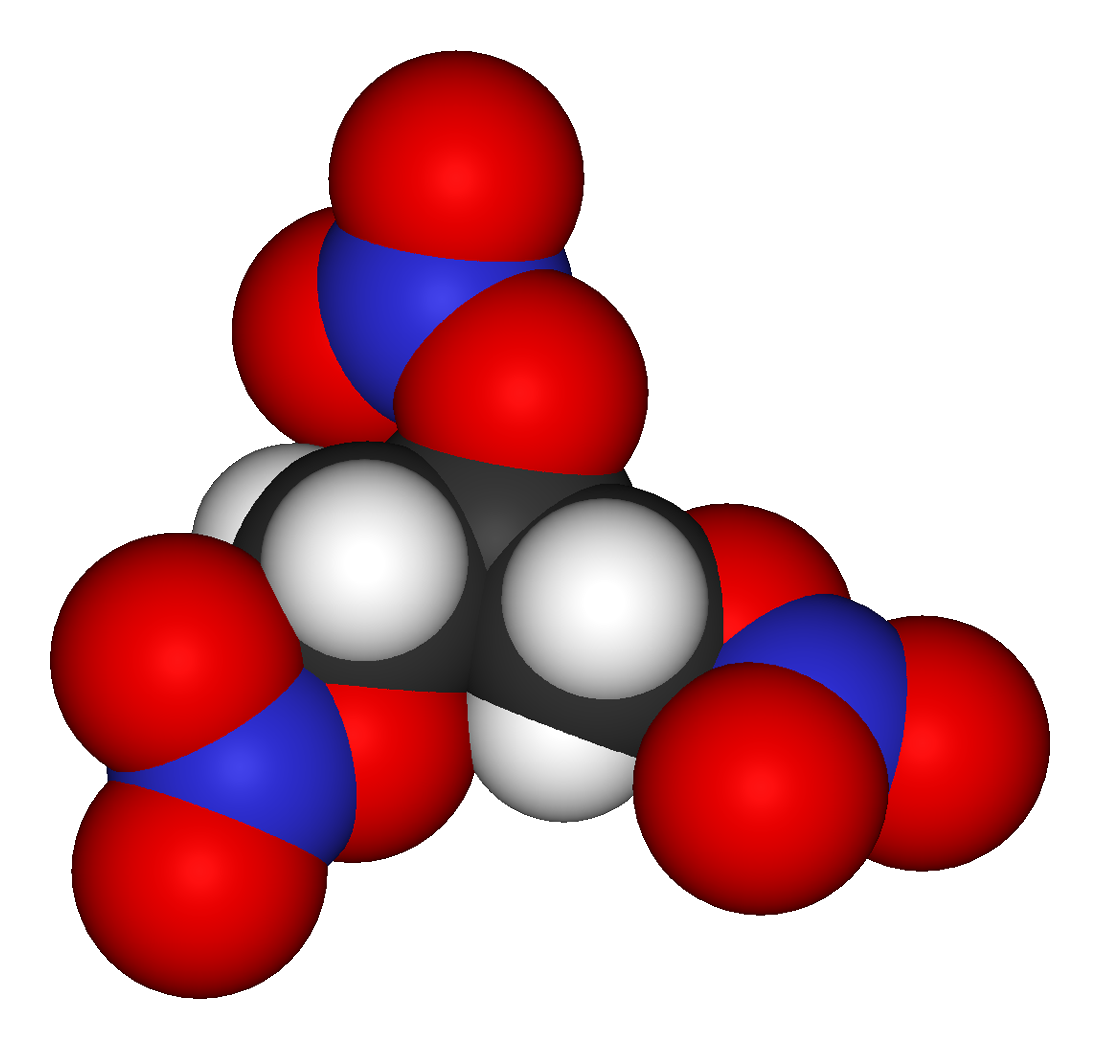
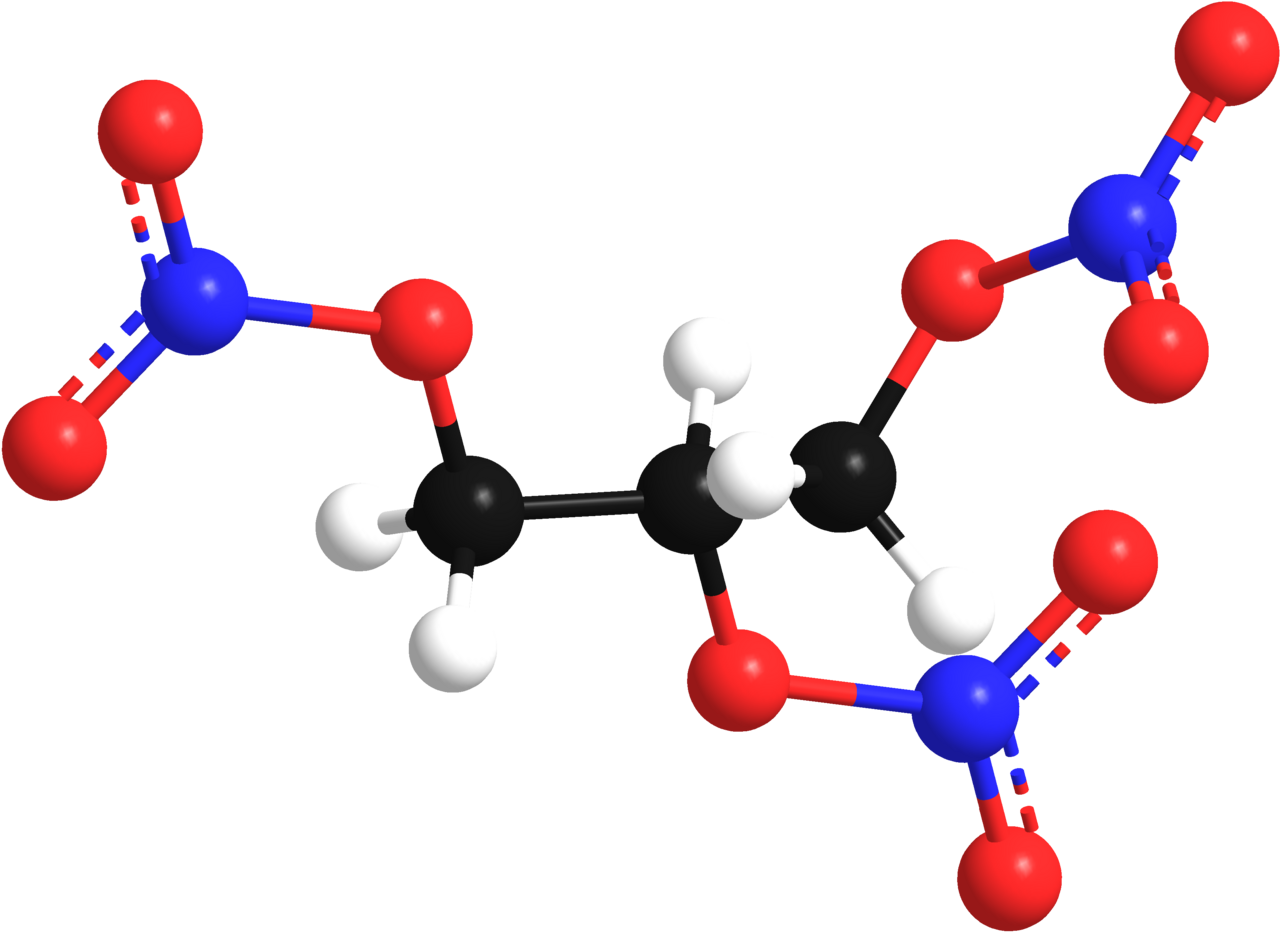
Nitroglycerin—also called trinitroglycerol, nitro, glyceryl trinitrate, or 1,2,3-trinitroxypropane—is a thick, oily liquid that is either colorless or pale yellow. It is made by treating glycerol with white fuming nitric acid under conditions that form a nitric acid ester. Despite its name, it is chemically a nitrate ester, not a nitro compound. The substance was first created in 1846 by Ascanio Sobrero. It serves as a key ingredient in explosives like dynamite, used in construction, demolition, and mining. When combined with nitrocellulose, it forms double-based smokeless powder, a propellant for firearms and artillery since the 1880s.
Like many explosives, nitroglycerin becomes more likely to explode on its own as temperature rises. At sea-level pressure, heating it above 218 °C makes it extremely unstable and prone to detonation. In a vacuum, its autoignition temperature is 270 °C. It melts at 12.8 °C, so it is usually encountered as a thick, viscous fluid; when frozen, it turns into a crystalline solid. Pure nitroglycerin is colorless, but leftover nitric oxide impurities from production often give it a slight yellow tint.
Because it has a high boiling point and a very low vapor pressure (0.00026 mmHg at 20 °C), pure nitroglycerin has almost no smell at room temperature. It tastes sweet and burning if ingested. It can accidentally detonate if dropped, shaken, lit on fire, heated quickly, exposed to sunlight or ozone, subjected to sparks or electrical discharges, or handled roughly. This sensitivity has caused many devastating industrial accidents over the years. Adding desensitizing agents makes it less likely to explode. Clay (diatomaceous earth) is one such agent; mixing it with nitroglycerin produces dynamite, which is much safer to handle. Other desensitizing agents yield different dynamite formulations.
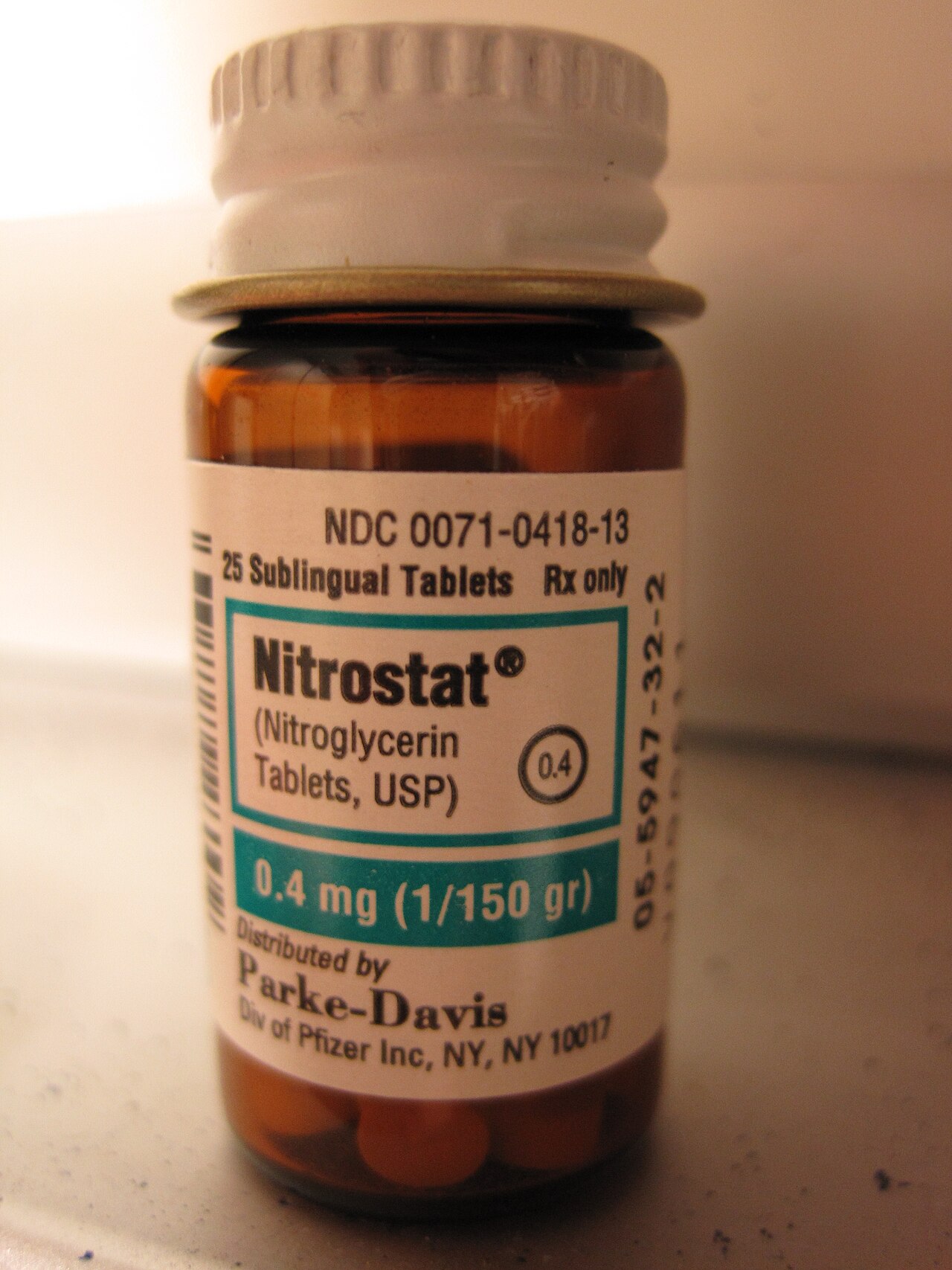
Since 1878, nitroglycerin has been used as a medication. It acts as a potent vasodilator, widening blood vessels to treat heart conditions like angina pectoris and chronic heart failure. It was known that these effects come from nitroglycerin being converted into nitric oxide, a strong vasodilator, but the enzyme responsible—mitochondrial aldehyde dehydrogenase (ALDH2)—was only identified in 2002. The drug is available as sublingual tablets, sprays, ointments, and patches.
**History**
Nitroglycerin was the first practical explosive stronger than black powder. Italian chemist Ascanio Sobrero synthesized it in 1846 while working under Théophile-Jules Pelouze at the University of Turin. Sobrero originally called it "pyroglycerin" and strongly warned against using it as an explosive.
Alfred Nobel turned nitroglycerin into a commercially useful explosive. He began experimenting with safer handling methods after his younger brother, Emil Oskar Nobel, and several factory workers died in an explosion at the Nobels' armaments factory in Heleneborg, Sweden, in 1864. The following year, Nobel founded Alfred Nobel and Company in Germany and built an isolated factory in the Krümmel hills near Hamburg. This business exported a liquid mixture of nitroglycerin and gunpowder called "Blasting Oil," but it was extremely unstable and hard to handle, leading to many disasters. The Krümmel factory buildings were destroyed twice.
In April 1866, several crates of nitroglycerin were shipped to California. Three were meant for the Central Pacific Railroad, which planned to use it as a blasting explosive to speed up construction of the 1,659-foot Summit Tunnel through the Sierra Nevada. One of the other crates exploded, destroying a Wells Fargo office in San Francisco and killing 15 people. This led to a complete ban on transporting liquid nitroglycerin in California. For the rest of the First transcontinental railroad’s construction, nitroglycerin had to be made on-site for hard-rock drilling and blasting.
On Christmas Day 1867, an attempt to dispose of nine canisters of Blasting Oil illegally stored at the White Swan Inn in Newcastle upon Tyne caused an explosion on the Town Moor that killed eight people. In June 1869, two one-ton wagons loaded with nitroglycerin—locally called Powder-Oil—exploded while passing through the village of Cwm-y-glo in North Wales. The blast killed six people, injured many, and caused extensive damage. Little trace of the two horses was found. The UK Government, alarmed by the damage and the risk to a city (the two tons were part of a larger shipment from Germany via Liverpool), soon passed the Nitro Glycerine Act 1869. Liquid nitroglycerin was widely banned elsewhere as well. These legal restrictions pushed Alfred Nobel and his company to develop dynamite in 1867, made by mixing nitroglycerin with diatomaceous earth (Kieselguhr) from the Krümmel hills. Other companies created similar mixtures—such as "dualine" (1867), "lithofracteur" (1869), and "gelignite" (1875)—by combining nitroglycerin with different inert absorbents, often trying to circumvent Nobel’s patents.
- discoverer
- Ascanio Sobrero
- field
- Chemistry, explosives, medicine
- known_for
- Powerful explosive, active ingredient in dynamite, vasodilator for angina and heart failure
Lore & Background
Nitroglycerin is a dense, oily liquid that is either colorless or pale yellow, the yellowish tint often resulting from nitric oxide impurities left over from its production. It has a melting point of 12.8 °C, so it is almost always encountered as a thick, viscous fluid, though it can form a crystalline solid when frozen. At room temperature, the pure compound has practically no odor due to its very low vapor pressure, but it possesses a sweet and burning taste if ingested. Its defining characteristic is extreme sensitivity to shock, heat, and friction; it can detonate when dropped, shaken, lit on fire, rapidly heated, exposed to sunlight or ozone, subjected to sparks or electrical discharges, or roughly handled. This instability increases with temperature, and above 218 °C at sea-level pressure it becomes prone to spontaneous explosion, with a higher autoignition temperature of 270 °C in a vacuum. To make it safer, desensitizing agents such as clay (diatomaceous earth) are added, producing dynamite. As a medication since 1878, it acts as a potent vasodilator for heart conditions, its effects resulting from conversion to nitric oxide by the enzyme mitochondrial aldehyde dehydrogenase, discovered in 2002. It is available in sublingual tablets, sprays, ointments, and patches. Historically, its dangerous nature led to numerous devastating accidents, including an 1866 explosion in San Francisco that killed 15 people and a ban on its transport in California, prompting Alfred Nobel to develop dynamite in 1867.
Reader's Guide
Nitroglycerin is a dense, oily liquid that is colorless or pale yellow, typically encountered as a viscous fluid due to its melting point of 12.8 °C, below which it freezes into a crystalline solid. Its behavior is defined by extreme sensitivity to shock, heat, and friction; it can detonate when dropped, shaken, lit on fire, rapidly heated, exposed to sunlight or ozone, or subjected to sparks and electrical discharges. This instability increases with temperature, becoming prone to spontaneous decomposition above 218 °C at sea level, or 270 °C in a vacuum. Its low vapor pressure at room temperature means it has practically no odor, though it has a sweet, burning taste. Historically, this reactivity caused numerous industrial accidents, such as the 1866 explosion of a crate in San Francisco that destroyed a Wells Fargo office and killed 15 people, leading to a ban on transporting liquid nitroglycerin in California. Another disaster in 1869 in Cwm-y-glo, Wales, killed six people and prompted the UK government to pass the Nitro-Glycerine Act. These dangers drove Alfred Nobel to mix nitroglycerin with diatomaceous earth to create dynamite in 1867, a more stable composition. Beyond explosives, nitroglycerin has been used since 1878 as a vasodilator for heart conditions like angina and chronic heart failure, acting through conversion to nitric oxide by the enzyme mitochondrial aldehyde dehydrogenase, discovered in 2002. It is also combined with nitrocellulose to form double-based smokeless powder, a propellant for artillery and firearms since the 1880s. Its significance thus spans enabling major engineering feats like the Summit Tunnel for the First transcontinental railroad, shaping modern explosives and propellants, and providing a critical cardiovascular therapy.
Gallery

Frequently Asked Questions
Who is Nitroglycerin?
Nitroglycerin is a heavy, nearly transparent oily liquid that sits at the crossroads of explosives and cardiology. Its formal chemical identity is 1,2,3-trinitroxypropane, though fans and professionals alike often just call it "nitro" or "NG."
What are Nitroglycerin's powers/role?
On one end of the spectrum, it serves as the shock-sensitive core ingredient that goes into dynamite and other blasting agents. On the other, it acts as a vasodilator that relaxes blood-vessel walls, making it a go-to treatment for angina and certain forms of heart failure.
How does Nitroglycerin's story end?
As a chemical compound, Nitroglycerin has no narrative arc, but its practical "story" is still unfolding. It remains a standard component in controlled demolition and mining while simultaneously being prescribed in sublingual tablet form to millions of cardiac patients worldwide.
Why is Nitroglycerin important?
It is one of the rare substances that is simultaneously a devastating explosive and a life-saving drug, giving it a uniquely dual role in both industry and medicine. Its discovery reshaped construction and mining in the nineteenth century, and its pharmacological use continues to manage chest pain and circulatory crises today.
More in Chemical Substances And Materials 1-22
Spotted an error? Know more?
This is a living reference — every entry is fact-audited, and reader corrections feed straight into our audit queue. Suggest an edit · See this site's audit record