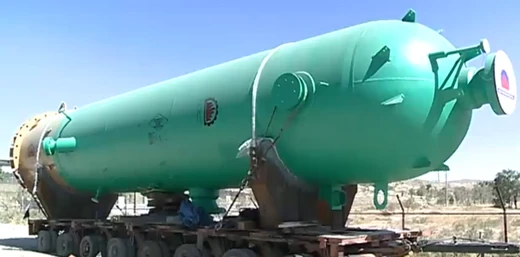
Direct process
Dominant industrial method for producing organosilicon compounds.

The direct process—also known as direct synthesis, the Rochow process, or the Müller-Rochow process—is the dominant industrial method for making organosilicon compounds. It was first described independently by Eugene G. Rochow and Richard Müller in the 1940s. In this process, alkyl halides react with elemental silicon in a fluidized bed reactor, with copper acting as a catalyst. While any alkyl halide can theoretically be used, chloromethane (CH₃Cl) gives the best balance of selectivity and yield. Typical operating conditions are 300 °C and 2–5 bar, achieving 90–98% conversion of silicon and 30–90% conversion of chloromethane. Around 1.4 million metric tons of dimethyldichlorosilane (Me₂SiCl₂) are produced each year this way.
Only a few companies operate the Rochow process, due to its complex technology and high capital costs. Because silicon is crushed before being fed into the fluidized bed, these firms are sometimes called silicon crushers.
The main reaction produces a mixture of methylchlorosilanes, including Me₃SiCl, Me₂SiCl₂, MeSiCl₃, and Me₄Si₂Cl₂. Dimethyldichlorosilane is especially valuable as a precursor to silicones, though trimethylsilyl chloride and methyltrichlorosilane also have important uses. Despite extensive research, the reaction mechanism remains poorly understood. Copper is essential and almost certainly forms an intermetallic compound near Cu₃Si. This intermediate helps form Si–Cl and Si–Me bonds. It is thought that a copper–chloromethane adduct brings the Si–Cl group close enough to create Me–SiCl units; a second chloromethane then releases Me₂SiCl₂. Copper is oxidized from its zero state and then reduced back to regenerate the catalyst. The chain reaction can end in various ways, producing the other observed products—for example, two Si–Cl groups can combine to form SiCl₂, which then reacts with MeCl to give MeSiCl₃. The catalyst also contains promoter metals; tin is necessary and works synergistically with zinc, while very tiny amounts of many other metals—including iron, aluminum, titanium, manganese, nickel, lead, phosphorus, antimony, magnesium, calcium, bismuth, arsenic, and cadmium—can influence the reaction.
Although dichlorodimethylsilane is the intended major product, many other methylchlorosilanes form. This mixture is actually desirable because each has specific and substantial applications. Me₂SiCl₂ is the most useful, serving as the precursor for most industrially produced silicon products. The other products are used in siloxane polymers and specialized applications. Typical yields are 70–90% for Me₂SiCl₂, 5–15% for MeSiCl₃, 2–4% for Me₃SiCl, 1–4% for MeHSiCl₂, and 0.1–0.5% for Me₂HSiCl. Purification is done by fractional distillation using columns with high separating capacities connected in series. The boiling points are close (Me₂SiCl₂: 70 °C, MeSiCl₃: 66 °C, Me₃SiCl: 57 °C, MeHSiCl₂: 41 °C, Me₂HSiCl: 35 °C), so product purity is critical—impurities cause unwanted chain branching in siloxane polymer production.
- field
- Industrial chemistry
- known_for
- Direct synthesis of organosilicon compounds
- annual_production
- Approximately 1.4 Mton of dimethyldichlorosilane
- typical_conditions
- 300 °C and 2–5 bar
- key_intermediate
- Cu₃Si
Lore & Background
The direct process, also known as the direct synthesis, Rochow process, or Müller-Rochow process, is the predominant industrial method for producing organosilicon compounds. First independently reported by Eugene G. Rochow and Richard Müller in the 1940s, the reaction takes place in a fluidized bed reactor, where crushed elemental silicon reacts with alkyl halides in the presence of a copper catalyst. While theoretically applicable to any alkyl halide, chloromethane (CH₃Cl) yields the best selectivity and efficiency. Typical operating conditions are 300 °C and 2–5 bar, achieving 90–98% conversion of silicon and 30–90% conversion of chloromethane. The defining characteristic of the process is its production of a mixture of methylchlorosilanes, with dimethyldichlorosilane (Me₂SiCl₂) being the most valuable product—approximately 1.4 million tons are made annually as a precursor to silicones. Other significant products include methyltrichlorosilane (MeSiCl₃) and trimethylsilyl chloride (Me₃SiCl). The reaction mechanism remains poorly understood, though copper forms an intermetallic phase (Cu₃Si) that facilitates bond formation. The catalyst also requires promoter metals, with tin being essential and zinc synergistic; many other metals, such as iron, aluminum, and titanium, may influence the reaction. Product isolation is achieved through fractional distillation, exploiting the distinct boiling points of the silanes. Due to the complex technology and high capital costs, few companies operate the process, and they are known as silicon crushers.
Reader's Guide
The direct process is the cornerstone of industrial organosilicon chemistry, producing approximately 1.4 million tons of dimethyldichlorosilane annually. This compound is the precursor for the majority of silicon products on an industrial scale, including silicones. The process yields a distribution of methylchlorosilanes, each with substantial applications: dimethyldichlorosilane (70–90%), methyltrichlorosilane (5–15%), trimethylsilyl chloride (2–4%), and others. Product isolation is efficient via fractional distillation, despite similar boiling points. The mechanism remains not well understood, though copper forms an intermetallic Cu₃Si intermediate, and promoter metals such as tin and zinc are necessary. The process's selectivity and yield make it indispensable, though its complexity limits the number of companies that can operate it.
Did You Know?
- The direct process is also called the Rochow process and Müller-Rochow process.
- Approximately 1.4 Mton of dimethyldichlorosilane is produced annually using this process.
- The mechanism is still not well understood, despite much research.
- Companies practicing this technology are referred to as silicon crushers.
Frequently Asked Questions
What is the Direct process in industrial chemistry?
The Direct process—also widely known as the Rochow process or Müller-Rochow process—is the dominant industrial route for synthesizing organosilicon compounds. It works by reacting alkyl halides with elemental silicon in a copper-catalyzed, fluidized-bed reactor, with chloromethane being the preferred halide for optimal selectivity and yield.
Who is credited with inventing the Direct process?
Eugene G. Rochow and Richard Müller independently reported the process in the 1940s, and it has carried both their names ever since. Their parallel discoveries established what would become the backbone of the global organosilicon industry.
What are the typical operating conditions for the Direct process?
The reaction generally runs at around 300 °C under a pressure of 2–5 bar. A key intermediate in the mechanism is copper-silicide (Cu₃Si), which forms during the catalytic cycle.
How much product does the Direct process yield on an industrial scale?
Roughly 1.4 million tonnes of dimethyldichlorosilane are produced annually via this route, making it by far the largest single source of organosilicon feedstocks worldwide.
Why is the Direct process considered so important in the field?
It remains the go-to method for manufacturing organosilicon compounds at scale, underpinning everything from silicone polymers to semiconductor-grade materials. No other industrial route matches its combination of selectivity, throughput, and economic viability.
More in Chemical Reactors And Processes 1-24
Spotted an error? Know more?
This is a living reference — every entry is fact-audited, and reader corrections feed straight into our audit queue. Suggest an edit · See this site's audit record