Terbium
A rare earth metal used in green phosphors and sonar systems.

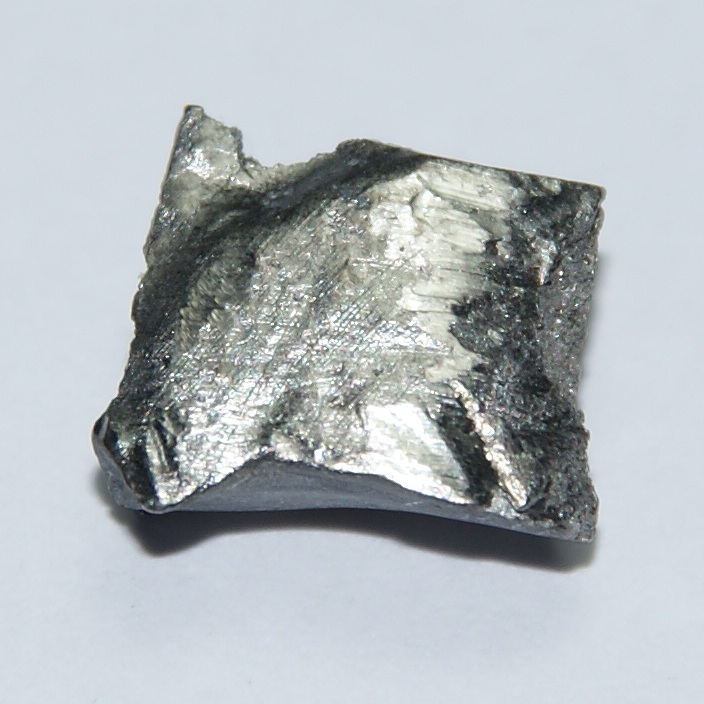
commons:User:Pumbaa (original work by commons:User:Greg Robson ) · CC BY-SA 2.0 uk
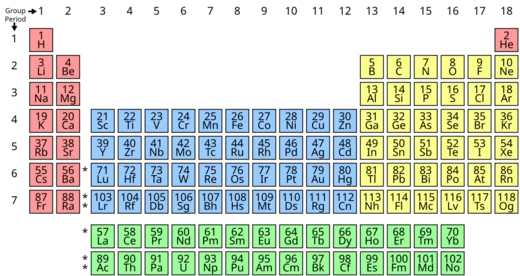
Terbium is a chemical element represented by the symbol Tb and atomic number 65. This silvery-white rare earth metal is both malleable and ductile, ranking as the ninth element in the lanthanide series. It is a fairly electropositive metal that reacts with water to release hydrogen gas. In nature, terbium never occurs as a free element; instead, it is found within various minerals such as cerite, gadolinite, monazite, xenotime, and euxenite.
Swedish chemist Carl Gustaf Mosander identified terbium as a distinct element in 1843, discovering it as an impurity in yttrium oxide (Y₂O₃). The names of yttrium, terbium, erbium, and ytterbium all derive from the Swedish village of Ytterby. Pure terbium was not obtained until ion exchange techniques were developed.
Terbium serves as a dopant for calcium fluoride, calcium tungstate, and strontium molybdate in solid-state devices, and it acts as a crystal stabilizer in fuel cells that operate at high temperatures. As a key component of Terfenol-D—an alloy that expands and contracts more than any other when exposed to magnetic fields—terbium is used in actuators, naval sonar systems, and sensors. Terbium is considered non-hazardous, though its biological role and toxicity remain largely unstudied.
The majority of the world's terbium supply goes into green phosphors. Terbium oxide is employed in fluorescent lamps and in cathode-ray tubes for televisions and monitors. These green phosphors are combined with divalent europium blue phosphors and trivalent europium red phosphors to create trichromatic lighting technology, a highly efficient white light used for indoor illumination.
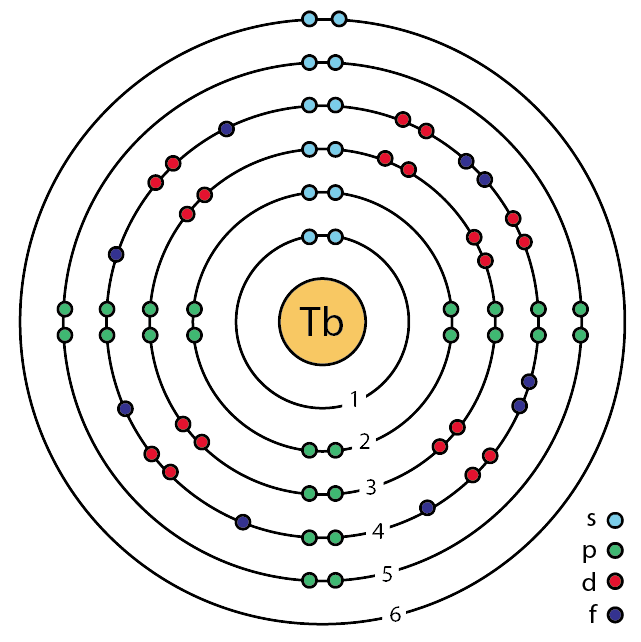
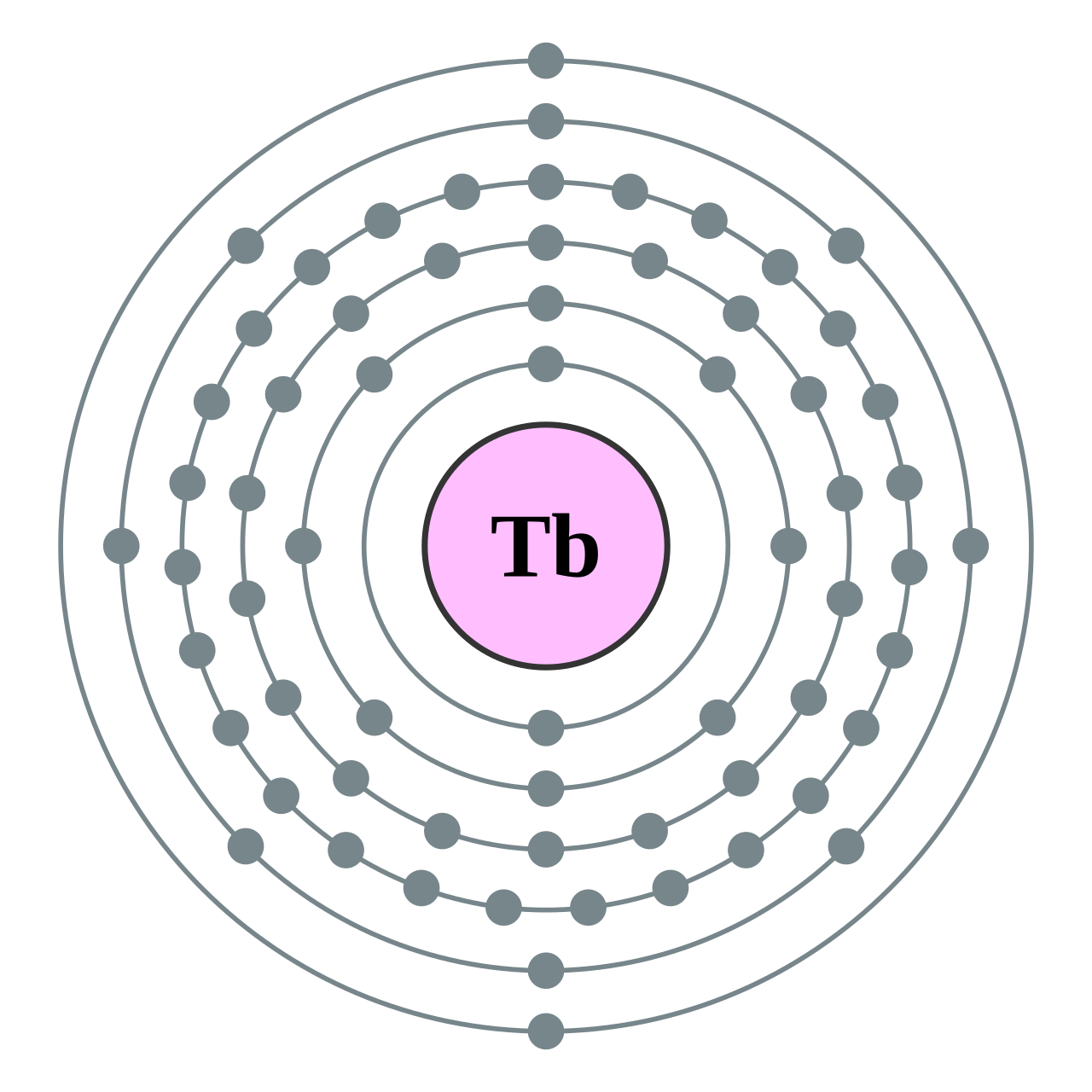
Terbium is a silvery-white rare earth metal that is soft enough to be cut with a knife, and it is relatively stable in air compared to more reactive lanthanides. It has two crystal allotropes, with a transformation temperature of 1289 °C. Its 65 electrons are arranged as [Xe]4f⁹6s², with the eleven 4f and 6s electrons being valence electrons. Only three electrons can typically be removed before the nuclear charge prevents further ionization, but the stability of the half-filled [Xe]4f⁷ configuration allows a fourth electron to be removed in the presence of very strong oxidizing agents like fluorine gas.
The terbium(III) cation (Tb³⁺) is brilliantly fluorescent, emitting a bright lemon-yellow color due to a strong green emission line combined with orange and red lines. The yttrofluorite variety of fluorite owes its creamy-yellow fluorescence partly to terbium. Terbium oxidizes easily, so its elemental form is used mainly for research. Single terbium atoms have been isolated by implanting them into fullerene molecules. Trivalent europium (Eu³⁺) and Tb³⁺ ions are among the most studied lanthanide ions for their strong luminosity and color purity. Terbium has a simple ferromagnetic ordering below 219 K, turns into a helical antiferromagnetic state between 219 K and 230 K, and becomes a disordered paramagnet above 230 K.
Chemically, terbium metal is electropositive and oxidizes in most acids (like sulfuric acid), all halogens, and water. It readily oxidizes in air to form a mixed terbium(III,IV) oxide (Tb₄O₇). The most common oxidation state is +3, as in TbCl₃. In the solid state, tetravalent terbium appears in compounds like TbO₂ and TbF₄. In solution, terbium typically forms trivalent species but can be oxidized to the tetravalent state with ozone in highly basic conditions. Its coordination and organometallic chemistry resembles that of other lanthanides. In water, terbium can coordinate nine water molecules in a tricapped trigonal prismatic geometry. Complexes with lower coordination numbers exist, often with bulky ligands such as bis(trimethylsilyl)amide. Most complexes are trivalent, but divalent Tb²⁺ complexes are known with bulky cyclopentadienyl-type ligands, and a few tetravalent coordination compounds exist.
Like most lanthanides, terbium is usually found in the +3 oxidation state. It can also form a +4 state, similar to cerium and praseodymium, though this is unstable in water. Oxidation states of 0, +1, and +2 are also possible. Terbium combines with nitrogen, carbon, sulfur, phosphorus, boron, selenium, silicon, and arsenic at high temperatures to form binary compounds such as TbH₂, TbH₃, TbB₂, TbSi₂, TbN, TbP, TbS, Tb₂S₃, TbSe, and TbTe. In these, terbium mainly shows the +3 state, with +2 appearing rarely. Terbium(II) halides are made by annealing terbium(III) halides with metallic terbium in tantalum containers. Terbium also forms the sesquichloride Tb₂Cl₃, which can be reduced to terbium(I) chloride (TbCl) at 800 °C, yielding platelets with a layered graphite-like structure. Terbium(IV) fluoride (TbF₄) is the only halide that tetravalent terbium can form, and it is a strong oxidizing agent.
- discovered_by
- Carl Gustaf Mosander
- atomic_number
- 65
- symbol
- Tb
- series
- Lanthanide
- named_after
- Ytterby, Sweden
Lore & Background
The element, along with yttrium, erbium, and ytterbium, is named after the village of Ytterby in Sweden. Mosander first separated yttria into three fractions: yttria, erbia, and terbia. Originally, 'erbia' was the fraction containing the pink color due to what is now known as erbium, while 'terbia' contained what is now known as terbium. Terbium was not isolated in pure form until the development of ion exchange techniques.
Reader's Guide
Terbium is significant primarily for its use in green phosphors, which account for most of the world's supply. Terbium oxide is used in fluorescent lamps and television and monitor cathode-ray tubes (CRTs). Combined with divalent europium blue phosphors and trivalent europium red phosphors, terbium green phosphors provide trichromatic lighting technology, a high-efficiency white light used in indoor lighting. Terbium is also a component of Terfenol-D, an alloy that expands and contracts when exposed to magnetic fields more than any other alloy, making it useful in actuators, naval sonar systems, and sensors. Additionally, terbium is used to dope calcium fluoride, calcium tungstate, and strontium molybdate in solid-state devices, and as a crystal stabilizer of fuel cells that operate at elevated temperatures. Terbium is considered non-hazardous, though its biological role and toxicity have not been researched in depth.
Did You Know?
- Terbium is named after the village of Ytterby in Sweden, along with yttrium, erbium, and ytterbium.
- Terbium was not isolated in pure form until the advent of ion exchange techniques.
- Terbium is used in Terfenol-D, an alloy that expands and contracts when exposed to magnetic fields more than any other alloy.
Discovery & Historical Context
Swedish chemist Carl Gustaf Mosander first identified terbium back in 1843, spotting it as a contaminant within yttrium oxide. The element shares its naming origin with several other rare earths—yttrium, erbium, and ytterbium—all of which trace their names to the small Swedish village of Ytterby. Despite being recognized for nearly a century, terbium remained stubbornly difficult to isolate in pure form. It was not until the development of ion exchange techniques that chemists finally succeeded in obtaining the element in its unalloyed state. In nature, terbium never appears as a standalone metal; instead, it is embedded within a variety of minerals such as cerite, gadolinite, monazite, xenotime, and euxenite. As the ninth member of the lanthanide series, terbium carries atomic number 65 and the symbol Tb, occupying a place in the periodic table that reflects both its chemical kinship with its neighbors and its own distinctive electronic character.
Physical & Magnetic Properties
Terbium presents as a silvery-white metal that is soft enough to be sliced with a knife, yet it retains enough malleability and ductility to be worked into useful shapes. Among its lanthanide peers, it is comparatively stable in air, though it still readily oxidizes to produce a mixed terbium(III,IV) oxide. The element exists in two distinct crystal allotropes, with a phase transition occurring at 1289 °C. Its 65 electrons follow the configuration [Xe]4f96s2, with eleven valence electrons available for bonding. One of terbium's most remarkable traits is its magnetic behavior: below 219 K it exhibits simple ferromagnetic ordering, while between 219 K and 230 K it adopts a helical antiferromagnetic arrangement in which atomic moments within each basal plane align parallel to one another but sit at a fixed angle relative to neighboring layers. Above 230 K, this ordered structure dissolves into a disordered paramagnetic state. The Tb3+ cation is also notable for its brilliant lemon-yellow fluorescence, a combination of strong green emission with additional orange and red lines.
Chemical Reactivity & Oxidation States
Terbium is a fairly electropositive metal that reacts vigorously with water, releasing hydrogen gas, and it dissolves in sulfuric acid and all the halogens. In air, it oxidizes to form a mixed-valence oxide, Tb4O7. The dominant oxidation state is +3, seen in compounds like TbCl3, but terbium can also achieve a +4 state in the solid state—compounds such as TbO2 and TbF4 are known. The tetravalent fluoride is particularly notable for its powerful oxidizing and fluorinating properties; when heated it releases relatively pure atomic fluorine rather than a mixture of fluoride vapors. In aqueous solution, terbium typically remains trivalent, though ozone in highly basic conditions can push it to +4. Its coordination chemistry mirrors that of other lanthanides: in water it binds nine molecules in a tricapped trigonal prismatic geometry, while bulky ligands like bis(trimethylsilyl)amide can reduce the coordination number to just three. Rare +1 and +2 states have also been documented, with terbium(I) chloride forming platelets that resemble layered graphite in structure.
Applications & Technological Uses
The overwhelming majority of the world's terbium supply finds its way into green phosphors. Terbium oxide serves as the active material in fluorescent lamps and in the cathode-ray tubes of televisions and monitors. In trichromatic lighting technology, terbium green phosphors are paired with divalent europium blue phosphors and trivalent europium red phosphors to generate a high-efficiency white light widely used in indoor illumination. Beyond lighting, terbium is a critical component of Terfenol-D, a magnetostrictive alloy that expands and contracts under magnetic fields more than any other known alloy. This property makes it invaluable in actuators, naval sonar systems, and precision sensors. Terbium also dopes calcium fluoride, calcium tungstate, and strontium molybdate in solid-state devices, and it acts as a crystal stabilizer in fuel cells designed to operate at elevated temperatures. Despite these diverse applications, the element is considered non-hazardous, though its biological role and toxicity have not been studied in depth.
Gallery
Frequently Asked Questions
Who is Terbium?
Terbium is a silvery-white rare earth metal with the symbol Tb and atomic number 65, making it the ninth element in the lanthanide series. It is notably malleable and ductile, giving it a workable metallic character unlike many of its heavier neighbors.
What are Terbium's powers and role?
Terbium shines in practical applications, particularly as the active ingredient in green phosphors used in displays and in sonar transducers for underwater acoustics. Its electronic structure produces a distinctive green emission that makes it invaluable in these technologies.
How does Terbium's story end?
Although Carl Gustaf Mosander first identified Terbium in the mid-19th century, the element remained stubbornly impure for decades. It was only when ion exchange chromatography became available that chemists finally obtained Terbium in its pure metallic form.
Why is Terbium important?
As a rare earth metal that never appears free in nature, Terbium must be extracted from minerals such as cerite, gadolinite, monazite, xenotime, and euxenite. Its scarcity combined with its unique optical and magnetic properties makes it a critical material in specialized industrial applications.
Where does Terbium's name come from?
Terbium takes its name from Ytterby, a small locality in Sweden where the mineral deposits containing it were first identified. This naming convention links it to several other lanthanides that share the same Swedish origin.
More in Chemical Elements 1-16
Spotted an error? Know more?
This is a living reference — every entry is fact-audited, and reader corrections feed straight into our audit queue. Suggest an edit · See this site's audit record