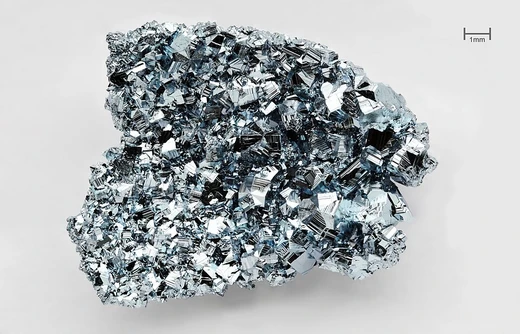
Sodium
Soft, reactive alkali metal essential for life.

Sodium is a chemical element with the symbol Na, derived from Neo-Latin *natrium*, and atomic number 11. It is a soft, silvery-white metal that is highly reactive and classified as an alkali metal, belonging to group 1 of the periodic table. Because it is so reactive, the free metal does not occur naturally and must be extracted from its compounds. Sodium is the sixth most abundant element in the Earth’s crust, found in minerals such as feldspars, sodalite, and halite (common salt). Over eons, water has leached soluble sodium salts from these minerals, making sodium and chlorine the most abundant dissolved elements by weight in the oceans. The element was first isolated in 1807 by Humphry Davy, who used electrolysis to break down sodium hydroxide. Among its many useful compounds, sodium hydroxide (lye) is employed in soap making, while sodium chloride serves as a de-icing agent and an essential nutrient for animals, including humans. Sodium is vital for all animals and some plants. Sodium ions are the major positive ions in extracellular fluid, largely determining its osmotic pressure. Cells use the sodium–potassium pump to actively expel sodium, maintaining a roughly tenfold higher concentration outside the cell than inside. In nerve cells, the rapid influx of sodium ions through voltage-gated channels triggers the action potential, enabling nerve impulse transmission. At standard temperature and pressure, sodium is a soft metal that tarnishes in air, forming oxides, and is typically stored under oil or inert gas. It is a good conductor of heat and electricity, with a melting point of 98 °C and a boiling point of 883 °C. Under extreme pressure, sodium undergoes dramatic changes: at 1.5 megabars it turns black, at 1.9 megabars it becomes transparent red, and at 3 megabars it is a clear, insulating solid. In a flame test, sodium produces a bright yellow glow due to electron transitions that emit light at the D line near 589.3 nanometers. Only one isotope, sodium-23, is stable; it forms in stars through carbon fusion. Radioactive isotopes sodium-22 and sodium-24 are produced by cosmic ray spallation, with half-lives of 2.6 years and 15 hours, respectively. Sodium typically forms ionic compounds as the Na⁺ cation, and its compounds are central to industries producing glass, paper, soap, and textiles.
- symbol
- Na
- atomic_number
- 11
- group
- 1 (alkali metal)
- stable_isotope
- 23Na
- melting_point
- 98 °C
Lore & Background
Sodium is a soft, silvery-white metal that is highly reactive. It does not occur naturally in its free form and must be extracted from compounds. It is the sixth most abundant element in the Earth’s crust, found in minerals such as feldspars, sodalite, and halite. Sodium was first isolated in 1807 by Humphry Davy through the electrolysis of sodium hydroxide. At standard temperature and pressure, sodium is a soft metal that can be easily cut with a knife and is a good conductor of electricity and heat. It combines with oxygen in the air to form sodium oxides, so bulk sodium is typically stored in oil or an inert gas. When burned in air, it forms primarily sodium peroxide with some sodium oxide. Sodium reacts exothermically with water, producing caustic soda (sodium hydroxide) and flammable hydrogen gas; high-speed imaging suggests this explosion is a Coulomb explosion. In a flame test, sodium and its compounds glow a bright yellow due to the emission of photons when excited electrons fall from the 3p to the 3s orbital, producing the D line at about 589.3 nm. Its only stable isotope is 23Na, created in stars through the carbon-burning process. Sodium is an essential element for all animals and some plants, serving as the major cation in extracellular fluid and contributing to osmotic pressure. The sodium–potassium pump actively transports sodium ions out of animal cells, and in nerve cells, the flow of sodium ions through voltage-gated channels enables nerve impulse transmission via the action potential.
Reader's Guide
Sodium is of immense commercial importance, central to industries producing glass, paper, soap, and textiles. Key compounds include table salt (NaCl), soda ash (Na2CO3), baking soda (NaHCO3), and caustic soda (NaOH). Sodium ions are the major cation in extracellular fluid and are actively pumped out of cells by the sodium–potassium pump, enabling nerve impulse transmission via voltage-gated sodium channels. Sodium's high solubility in water means its salts are typically isolated by evaporation or precipitation with organic antisolvents. Acute neutron radiation can convert stable 23Na in human blood to radioactive 24Na, allowing radiation dosage measurement.
Did You Know?
- At high pressures, sodium changes color: at 1.5 Mbar it turns black, at 1.9 Mbar red, and at 3 Mbar it becomes a clear, transparent solid.
- Sodium forms a liquid alloy with potassium called NaK, which is an excellent thermal and electrical conductor.
Frequently Asked Questions
Who is Sodium?
Sodium is element 11, a soft silvery-white alkali metal sitting in Group 1 of the periodic table. It never appears in its bare, free form in nature and is always found locked inside compounds until it is deliberately extracted.
What are Sodium's powers or role in the story?
Its signature ability is extreme reactivity: it eagerly sheds its single outer electron to form ionic bonds and reacts violently with water. In living organisms it governs nerve-impulse transmission and maintains the osmotic pressure of extracellular fluid.
How does Sodium's story end?
In its most dramatic scene, a piece of sodium dropped into water triggers a violent exothermic reaction that releases hydrogen gas and sodium hydroxide, generating enough heat to melt the metal (melting point 98 °C). Inside the body, its arc is subtler—ion pumps constantly shuttle it across cell membranes to sustain electrical gradients.
Why is Sodium important to the wider cast?
As the sixth-most abundant element in Earth's crust, it underpins the chemistry of every animal and many plants. Without it, nerve signals could not fire and osmotic balance would collapse, making it a supporting character no storyline can do without.
Why is Sodium's symbol Na instead of S?
The symbol derives from its Neo-Latin name natrium, which itself traces back to an Arabic term for a mineral salt. That naming quirk is why the letter S on the periodic table belongs to sulfur, not sodium.
More in Chemical Elements & Metals 1-20
Spotted an error? Know more?
This is a living reference — every entry is fact-audited, and reader corrections feed straight into our audit queue. Suggest an edit · See this site's audit record