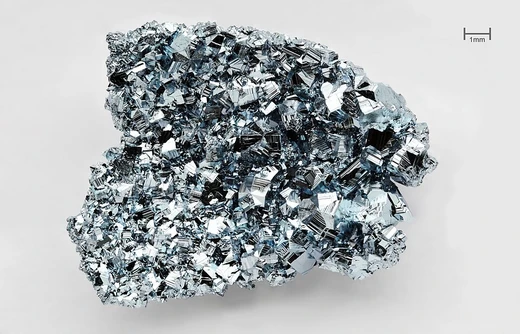
Promethium
A rare, radioactive lanthanide with no stable isotopes.

Promethium is a synthetic chemical element with the symbol Pm and atomic number 61. All of its isotopes are radioactive, and it is extremely scarce—only about 500 to 600 grams occur naturally in the Earth’s crust at any given time. Along with technetium, it is one of just two radioactive elements whose neighbors on the periodic table are both stable. Chemically, it belongs to the lanthanide series and exhibits only one stable oxidation state: +3.
The existence of an element between neodymium and samarium was first suggested in 1902 by Bohuslav Brauner, and Henry Moseley confirmed the gap in 1914 by measuring atomic numbers. In 1926, two separate groups—one Italian, one American—claimed to have isolated it, but both were later disproven. A 1938 nuclear experiment at Ohio State University produced radioactive nuclides that were clearly not isotopes of neodymium or samarium, but chemical proof was lacking, and the discovery went unrecognized. Promethium was first successfully produced and characterized in 1945 at Oak Ridge National Laboratory, from fission products of uranium fuel irradiated in a graphite reactor. Its discoverers proposed the name “Prometheum” (later changed to promethium), after the Titan Prometheus, to symbolize both human daring and the potential for misuse of intellect. A sample of the metal itself was not made until 1963.
Natural promethium comes from two sources: rare alpha decays of europium-151, which yield promethium-147, and spontaneous fission of uranium, which produces various isotopes. Promethium-145 is the most stable isotope, but only promethium-147 has practical uses, appearing in luminous paint, atomic batteries, and thickness-measurement devices. Because natural promethium is so rare, it is usually synthesized by bombarding enriched uranium-235 with thermal neutrons, generating promethium-147 as a fission product.
**Properties**
A promethium atom has 61 electrons arranged as [Xe] 4f⁵ 6s². Its seven 4f and 6s electrons are valence electrons; when forming compounds, it loses its two outermost electrons and one 4f electron from an open subshell. Its atomic radius is the second largest among the lanthanides, only slightly larger than those of its neighbors, and it is the most notable exception to the lanthanide contraction trend. Many of its properties fall between those of neodymium and samarium: its melting point, first three ionization energies, and hydration energy are higher than neodymium’s but lower than samarium’s, while its estimated boiling point, ionic (Pm³⁺) radius, and standard heat of formation of the monatomic gas are higher than samarium’s but lower than neodymium’s. Promethium has a double hexagonal close packed (dhcp) structure and a hardness of 63 kg/mm². This low-temperature alpha form converts to a beta, body-centered cubic (bcc) phase when heated to 890 °C.
**Chemical properties and compounds**
Promethium belongs to the cerium group of lanthanides and is chemically very similar to its neighbors. Due to its instability, chemical studies are incomplete; though a few compounds have been synthesized, they are not fully studied, and they tend to be pink or red. In May 2024, a promethium coordination complex with neutral PyDGA ligands was characterized in aqueous solution. Treating acidic solutions containing Pm³⁺ ions with ammonia yields a gelatinous, light-brown, water-insoluble hydroxide, Pm(OH)₃. Dissolving it in hydrochloric acid produces a water-soluble yellow salt, PmCl₃; in nitric acid, it forms Pm(NO₃)₃, which is also soluble and dries into pink crystals similar to Nd(NO₃)₃. The electron configuration for Pm³⁺ is [Xe] 4f⁴, giving the ion a pink color and a ground state term symbol of ⁵I₄. The sulfate is slightly soluble, like other cerium group sulfates; cell parameters for its octahydrate indicate a density of 2.86 g/cm³ for Pm₂(SO₄)₃·8H₂O. The oxalate, Pm₂(C₂O₄)₃·10H₂O, has the lowest solubility of all lanthanide oxalates. Unlike the nitrate, the oxide resembles the samarium salt rather than the neodymium salt. As synthesized—for instance, by heating the oxalate—it is a white or lavender powder with a disordered structure, which crystallizes into a cubic lattice at 600 °C. Further annealing at 800 °C and then 1750 °C irreversibly transforms it to monoclinic and hexagonal phases, respectively, and these last two phases can be interconverted by adjusting annealing time and temperature.
Promethium forms only one stable oxidation state, +3, as ions, consistent with other lanthanides. It can also form the +2 state; thermodynamic properties of Pm²⁺ suggest its dihalides are stable, similar to NdCl₂ and SmCl₂.
**Isotopes**
Promethium is the only lanthanide and one of only two elements among the first 83 that has no stable or long-lived primordial isotopes. This is due to a rare effect of the liquid drop model of the nucleus and the stability of neutron numbers.
- symbol
- Pm
- atomic_number
- 61
- discovery_location
- Oak Ridge National Laboratory
- element_category
- Lanthanide
Lore & Background
Promethium is a synthetic, radioactive lanthanide element with atomic number 61, and all of its isotopes are radioactive. It is extremely rare in nature, with only a few hundred grams present in the Earth's crust at any time, originating from rare alpha decays of europium-151 and spontaneous fission of uranium. Chemically, it exhibits only one stable oxidation state, +3, and its properties generally fall between those of its neighbors, neodymium and samarium. The element has a double hexagonal close packed structure at low temperatures, converting to a body-centered cubic phase when heated. Promethium compounds tend to be pink or red; for example, its hydroxide forms a light-brown gelatinous sediment, its chloride is a water-soluble yellow salt, and its nitrate yields pink crystals. The oxide can appear as a white or lavender powder. Promethium-145 is the most stable isotope, but promethium-147 is the only one with practical applications, used in luminous paint, atomic batteries, and thickness-measurement devices. Due to its scarcity, it is typically synthesized by bombarding enriched uranium-235 with thermal neutrons to produce promethium-147 as a fission product. The element was first produced and characterized in 1945 at Oak Ridge National Laboratory from uranium fission products.
Reader's Guide
Promethium is significant as the only lanthanide and one of only two elements among the first 83 with no stable or long-lived primordial isotopes. Its chemical properties are intermediate between neodymium and samarium, and it forms only one stable oxidation state (+3). The element's discovery during the Manhattan Project era highlights the intersection of nuclear physics and chemistry, and its name reflects the dual promise and peril of human intellect. All promethium isotopes are radioactive, and it is extremely scarce in nature, with only about 500–600 grams present in the Earth’s crust at any time. Natural sources include rare alpha decays of europium-151 and spontaneous fission of uranium. The only isotope with practical applications is promethium-147, used in luminous paint, atomic batteries, and thickness-measurement devices; it is typically synthesized by bombarding enriched uranium-235 with thermal neutrons. Promethium’s atomic radius is the second largest among lanthanides and is a notable exception to the lanthanide contraction trend. Its melting point, ionization energies, and hydration energy are greater than neodymium’s but lower than samarium’s, while its boiling point, ionic radius, and standard heat of formation of monatomic gas are greater than samarium’s and less than neodymium’s. Chemically, it belongs to the cerium group and forms pink or red compounds; its +3 ion has a pink color and a [Xe] 4f4 electron configuration. The oxide can exist in cubic, monoclinic, and hexagonal phases depending on annealing temperature. Promethium can also form a +2 oxidation state, and its dihalides are thermodynamically stable.
Did You Know?
- Promethium is one of only two radioactive elements preceded and succeeded in the periodic table by elements with stable forms.
A Decades-Long Hunt for Element 61
The story of promethium's discovery spans over four decades of persistent scientific pursuit. The 1920s brought two premature claims—one from an Italian team, one from an American group—both of which were quickly debunked. They proposed the name "Prometheum" (later corrected to promethium), honoring the Greek Titan who stole fire from Olympus—a nod to both the boldness and the potential danger of human ingenuity.
An Element Defined by Absence
Promethium occupies a singular position in the periodic table. It is the only lanthanide—and one of just two elements among the first 83—possessing no stable or long-lived primordial isotopes whatsoever. This makes it the least stable element within the first 84. It stands as one of only two radioactive elements (the other being technetium) that are flanked on both sides by elements with stable forms.
Chemistry Caught Between Neighbors
As a member of the cerium group within the lanthanides, promethium's chemistry is largely defined by its position between neodymium and samarium. It exhibits a single dominant oxidation state of +3, though a +2 state is also thermodynamically accessible, with dihalides expected to be stable. Its physical properties sit squarely between those of its two neighbors: melting point, the first three ionization energies, and hydration energy all exceed neodymium's values while falling short of samarium's. Notably, promethium's atomic radius is the second largest among all lanthanides, making it a striking exception to the steady lanthanide contraction trend. Its compounds tend toward pink or red hues; the Pm³⁺ ion itself is pink with a [Xe] 4f⁴ configuration. The hydroxide forms a light-brown gelatinous precipitate, the chloride is a water-soluble yellow salt, and the nitrate dries into pink crystals. The oxide, unlike the nitrate, more closely mirrors samarium's counterpart.
From Reactor Waste to Practical Use
Compounds of this isotope serve as the active component in luminous paints, power sources for atomic batteries, and devices that measure material thickness. The practical chemistry of promethium remains incomplete due to its instability—few compounds have been fully characterized, and the element's reactivity is only partially mapped. These nuances underscore how much of promethium's chemistry is still being pieced together from small, carefully handled quantities.
Frequently Asked Questions
What is Promethium?
Promethium (symbol Pm, atomic number 61) is a rare radioactive lanthanide that sits between neodymium and samarium on the periodic table. Unlike its neighbors, it has no stable isotopes and is entirely radioactive in every form.
Where was Promethium first identified?
Promethium was first isolated and confirmed at Oak Ridge National Laboratory in the United States. It was among the last naturally occurring elements to be formally identified.
Why is Promethium considered unique among the lanthanides?
It is one of only two elements in the entire periodic table (the other being technetium) that is radioactive yet flanked on both sides by elements possessing stable isotopes. This makes it a conspicuous radioactive gap in an otherwise stable group.
What oxidation state does Promethium exhibit?
Promethium displays a single stable oxidation state of +3, which is consistent with the behavior of the other lanthanides. It does not show the mixed or variable oxidation states characteristic of many transition metals.
Why is Promethium so difficult to obtain?
Every isotope of promethium is radioactive with relatively short half-lives, so any trace quantities decay away before they can accumulate in nature. It must therefore be produced artificially in nuclear reactors or particle accelerators.
More in Chemical Elements & Metals 1-20
Spotted an error? Know more?
This is a living reference — every entry is fact-audited, and reader corrections feed straight into our audit queue. Suggest an edit · See this site's audit record