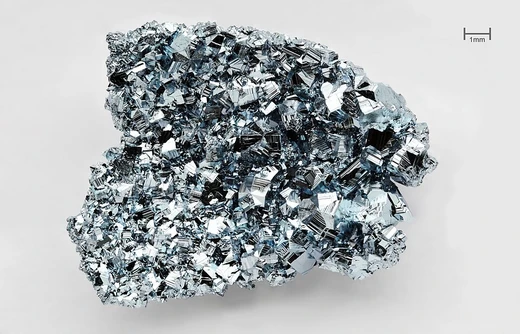
Rhenium
Rhenium is a rare, high-melting transition metal used in superalloys and catalysts.

Rhenium is a chemical element with symbol Re and atomic number 75. It is a silvery-gray, heavy, third-row transition metal in group 7 of the periodic table, and one of the rarest elements in the Earth's crust, with an estimated average concentration of 1 part per billion. It has one of the highest melting and boiling points of any element and is mainly obtained as a by-product of molybdenum and copper ore refinement. Chemically, it resembles manganese and technetium and can assume a wide variety of oxidation states ranging from −3 to +7.
The element was first discovered in 1908 by Japanese chemist Masataka Ogawa, who mistakenly identified it as element 43 (now technetium) and named it nipponium. It was rediscovered in 1925 by Walter Noddack, Ida Tacke, and Otto Berg in Germany, who gave it its present name after the Rhine River in Europe, from which early samples were obtained. Ogawa's original claim is now accepted in hindsight as the discovery of rhenium. Rhenium is perhaps the last stable element to be understood, as hafnium was discovered in 1923 and all elements discovered since then lack stable isotopes.
Rhenium is a silvery-white metal with a hexagonal close-packed crystal structure. It is one of the densest elements, exceeded only by platinum, iridium, and osmium. In bulk form at room temperature, it resists alkalis, sulfuric acid, hydrochloric acid, nitric acid, and aqua regia, though it reacts with nitric acid when heated. Its commercial form is usually a powder, which can be pressed and sintered in a vacuum or hydrogen atmosphere to produce a compact solid over 90% dense. When annealed, the metal becomes very ductile and can be bent, coiled, or rolled. Rhenium-molybdenum alloys are superconductive at 10 K, and tungsten-rhenium alloys are superconductive around 4–8 K.
Naturally occurring rhenium consists of 37.4% stable rhenium-185 and 62.6% rhenium-187, which is unstable with a half-life of 41.6 billion years. A kilogram of natural rhenium emits 1.07 MBq of radiation due to this isotope, whose beta decay is used for rhenium–osmium dating of ores. The available energy for this decay is the second lowest known among all radionuclides.
Nickel-based superalloys containing up to 6% rhenium are used in combustion chambers, turbine blades, and exhaust nozzles of jet engines, making jet engine construction the largest single use for the element. The s
- symbol
- Re
- atomic_number
- 75
- group
- 7
- period
- 6
- block
- d
- electron_configuration
- [Xe] 4f14 5d5 6s2
Lore & Background
Rhenium is a silvery-gray, heavy metal that ranks among the densest elements, surpassed only by platinum, iridium, and osmium. It possesses one of the highest melting points of any element, exceeded solely by tungsten, and also boasts one of the highest boiling points among all stable elements. Its crystal structure is hexagonal close-packed. In its commercial form, rhenium is typically a powder, which can be consolidated through pressing and sintering in a vacuum or hydrogen atmosphere to produce a solid with over ninety percent of the metal's density. When annealed, the metal becomes highly ductile and can be bent, coiled, or rolled. Chemically, it resembles manganese and technetium and can assume a wide variety of oxidation states, from negative three to positive seven. In bulk form at room temperature and pressure, it resists alkalis, sulfuric acid, hydrochloric acid, nitric acid, and aqua regia, though it reacts with nitric acid when heated. Rhenium is one of the rarest elements in the Earth's crust, with an estimated average concentration of just one part per billion. It is mainly obtained as a by-product during the extraction and refinement of molybdenum and copper ores.
Reader's Guide
Rhenium is a silvery-gray, heavy, third-row transition metal in group 7 of the periodic table, with an estimated average concentration of just one part per billion in the Earth’s crust, making it one of the rarest elements. It has one of the highest melting and boiling points of any element, and its density is exceeded only by platinum, iridium, and osmium. The metal is usually supplied as a powder, which can be pressed and sintered in a vacuum or hydrogen atmosphere to form a solid that is very ductile when annealed. Chemically, it resembles manganese and technetium and can assume a wide range of oxidation states from −3 to +7. It resists most common acids and alkalis at room temperature but reacts with nitric acid when heated. Rhenium’s primary commercial application is in nickel-based superalloys, which contain up to six percent rhenium and are used in jet engine combustion chambers, turbine blades, and exhaust nozzles—making jet engine construction the largest single use. Its second-most important role is as a catalyst for hydrogenation and isomerization, particularly in the catalytic reforming of naphtha to produce gasoline, a process known as rheniforming. Due to low availability relative to demand, rhenium is expensive; the price peaked at US$10,600 per kilogram in 2008–09 but had fallen to US$2,844 per kilogram by 2018 because of increased recycling and reduced catalyst demand. The element has one stable isotope, rhenium-185, though natural rhenium is mostly rhenium-187, which is unstable with a half-life of 41.6 billion years and emits 1.07 MBq of radiation per kilogram. This beta decay is used for rhenium–osmium dating of ores.
Did You Know?
- The name 'rhenium' comes from the Latin 'Rhenus' meaning 'Rhine', after the river in Europe.
A Tangled Discovery: From Nipponium to Rhenium
The identification of rhenium is one of chemistry's most tangled misidentifications. In reality, he had isolated element 75 — a confusion made plausible because both elements sit in the same group of the periodic table. Because several of his critical results appeared only in Japanese-language publications, his work was frequently misquoted or overlooked by the wider community. His own fixation on locating element 43 likely blinded him to the possibility that he had actually found element 75. They named it after the Rhine River, the source of the earliest commercial samples.
Extreme Properties of a Silvery-White Metal
Rhenium presents a remarkable combination of physical traits. It is a silvery-white transition metal with one of the highest melting points of any element, surpassed only by tungsten (carbon sublimes at standard pressure rather than truly melting, though its sublimation point is comparable). It also holds the highest boiling point among all stable elements and ranks among the densest materials known, exceeded only by platinum, iridium, and osmium. Its crystal lattice adopts a hexagonal close-packed structure. In commercial form, rhenium is typically handled as a fine powder, which can be consolidated by pressing and sintering in a vacuum or hydrogen atmosphere to produce a compact solid retaining over 90 percent of the metal's theoretical density. Once annealed, the metal becomes remarkably ductile — it can be bent, coiled, or rolled into workable shapes. At room temperature and atmospheric pressure, bulk rhenium resists attack by alkalis, sulfuric acid, hydrochloric acid, nitric acid, and even aqua regia, though heating it in nitric acid does trigger a reaction. Its compounds span oxidation states from −3 to +7 (excluding −2), with +7, +4, and +3 being the most prevalent.
Jet Engines, Catalysts, and a Volatile Market
Despite an estimated average crustal concentration of just one part per billion, rhenium plays an outsized role in modern industry. Its single largest application is in nickel-based superalloys used for combustion chambers, turbine blades, and exhaust nozzles in jet engines, where the alloys can contain up to six percent rhenium. The second major use is catalytic: rhenium excels at hydrogenation and isomerization reactions and is central to the rheniforming process, which reform naphtha into gasoline-grade products. Because the element is so scarce and is mainly recovered as a by-product of molybdenum and copper ore processing, its price tracks supply constraints closely.
A Curious Isotopic Landscape
Rhenium's isotopic composition is unusual in the periodic table. This slow decay underpins rhenium-osmium dating, a powerful tool for determining the age of ores.
Frequently Asked Questions
Who is Rhenium?
Rhenium is a silvery-gray transition metal occupying position 75 on the periodic table, sitting in group 7 and the sixth period of the d-block. It is a dense, heavy element that shares its column with manganese, technetium, and iridium.
What are Rhenium's signature abilities?
Its standout trait is an extraordinarily high melting and boiling point, ranking it among the most heat-tolerant elements known. That extreme thermal resilience is exactly what makes it indispensable in jet-engine superalloys and high-temperature industrial catalysts.
How does Rhenium enter the story?
Rather than being extracted from its own ore, Rhenium shows up as a trace by-product during the refining of molybdenum and copper. Its supply is therefore tightly tied to the output of those two metal industries.
Why is Rhenium so hard to find?
It occurs at roughly one part per billion in the Earth's crust, placing it among the scarcest naturally occurring elements. That extreme rarity is a major driver behind its high market price.
What is Rhenium's electron configuration?
Its full configuration is [Xe] 4f14 5d5 6s2, giving it seven valence electrons distributed across the 5d and 6s subshells. This matches its group-7 placement and mirrors the pattern seen in manganese and iridium.
More in Chemical Elements & Metals 1-20
Spotted an error? Know more?
This is a living reference — every entry is fact-audited, and reader corrections feed straight into our audit queue. Suggest an edit · See this site's audit record