Protactinium
Rare radioactive element used in ocean science and nuclear research.

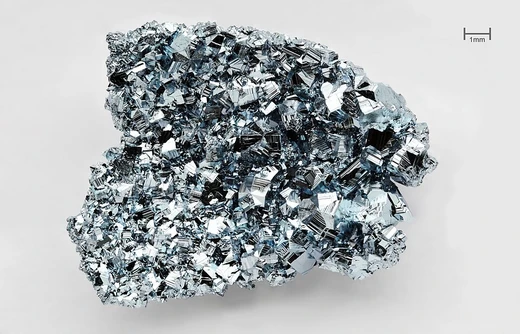
Protactinium (symbol Pa, atomic number 91) is a dense, radioactive, silvery-gray metal belonging to the actinide series. It reacts readily with oxygen, water vapor, and inorganic acids. In its compounds, protactinium most often appears in the +5 oxidation state, though it can also take the +4, +3, or +2 states. On Earth, it is extremely scarce—typically just a few parts per trillion in the crust, though concentrations can climb to a few parts per million in certain uraninite deposits. Because it is so rare, highly radioactive, and toxic, protactinium has no practical applications beyond scientific research, and for that purpose it is usually obtained from spent nuclear fuel. It is also the only highly radioactive element that is mononuclidic (occurring almost entirely as a single nuclide) without being monoisotopic; nearly all natural protactinium comes from the decay of uranium-235.
The element was first detected in 1913 by Kazimierz Fajans and Oswald Helmuth Göhring, who named it “brevium” after the short half-life of the isotope they studied, 234mPa. A more stable isotope, 231Pa, was discovered in 1917–18 by Lise Meitner working with Otto Hahn; they called it protactinium. In 1949, the International Union of Pure and Applied Chemistry (IUPAC) officially adopted the name “protactinium,” meaning “precursor of actinium,” and credited Hahn and Meitner as discoverers. John Arnold Cranston, collaborating with Frederick Soddy and Ada Hitchins, also identified the same stable isotope in 1915 but delayed publication due to his service in World War I.
The longest-lived and overwhelmingly dominant natural isotope is 231Pa, with a half-life of 32,760 years; it arises from the decay chain of uranium-235. Tiny traces of short-lived 234Pa and its nuclear isomer 234mPa come from the uranium-238 decay chain. Another isotope, 233Pa, forms when thorium-233 decays—a step in producing uranium-233 by neutron irradiation of thorium-232. In thorium-based nuclear reactors, 233Pa is an unwanted intermediate and must be removed from the reactor core during breeding. Oceanographers use protactinium to study ancient ocean geography: by measuring the relative amounts of uranium, thorium, and protactinium isotopes in water and sediments, they can date deposits up to 175,000 years old and model geological processes.
Protactinium is unusual among non-primordial elements because its natural isotopic composition is extremely uniform across typical terrestrial samples. This is because essentially all naturally occurring protactinium is 231Pa, produced solely from the decay of primordial uranium-235.
**History**
In 1871, Dmitri Mendeleev predicted an element between thorium and uranium. Since the actinide series was not yet recognized, he placed uranium under tungsten in group VI and thorium under zirconium in group IV, leaving a gap under tantalum in group V. Until the actinide concept was accepted in the late 1940s, periodic tables followed this arrangement. Chemists long searched for “eka-tantalum,” an element chemically similar to tantalum, which made discovering protactinium nearly impossible. Tantalum’s heavier analogue later turned out to be the transuranic element dubnium—though dubnium is actually more similar to protactinium than to tantalum.
In 1900, William Crookes isolated a highly radioactive material from uranium but could not identify it as a new element; he called it uranium X (UX). By dissolving uranium nitrate in ether, he left most of the 234Th and 234Pa in the aqueous phase. This method was used into the 1950s to separate those isotopes from uranium compounds. Protactinium was first identified in 1913, when Kasimir Fajans and Oswald Helmuth Göhring studied the uranium-238 decay chain: 238U → 234Th → 234mPa → 234U. They named the new element “brevium” (from Latin *brevis*, meaning short) because of the 1.16-minute half-life of 234mPa (uranium X2). In 1917–18, two independent groups—Lise Meitner with Otto Hahn in Germany, and Frederick Soddy with John Cranston in Britain—discovered the longer-lived isotope 231Pa (half-life 32,760 years). Meitner changed the name from “brevium” to “protactinium,” since the element preceded actinium in the uranium-235 decay chain (from Greek *prôtos*, meaning “first”). IUPAC confirmed this name in 1949. The discovery filled one of the last gaps in early periodic tables and brought fame to those involved.
Aristid von Grosse produced 2 milligrams of Pa₂O₅ in 1927, and in 1934 he first isolated elemental protactinium from 0.1 milligrams of Pa₂O₅. He used two methods: one irradiated protactinium oxide with 35 keV electrons in a vacuum; the other, the van Arkel–de Boer process, converted the oxide to a halide (chloride, bromide, or iodide) and then reduced it in a vacuum with an electrically heated metal filament: 2 PaI₅ → 2 Pa + 5 I₂. In 1961, the United Kingdom Atomic Energy Authority produced 127 grams of 99.9% pure protactinium-231 by processing 60 tonnes of waste material in a 12-stage process, costing about US$500,000. For many years, this was the world’s only significant supply, distributed to laboratories for research. Oak Ridge National Laboratory in the US also provided protactinium at a cost.
- symbol
- Pa
- atomic_number
- 91
Lore & Background
Protactinium is a dense, silvery-gray metal that belongs to the actinide series and is highly radioactive. It reacts readily with oxygen, water vapor, and inorganic acids. In its compounds, protactinium most commonly exhibits a +5 oxidation state, though it can also assume +4, +3, or +2 states. It is extremely rare in the Earth’s crust, with typical concentrations of only a few parts per trillion, though some uraninite ore deposits may contain up to a few parts per million. Because of its scarcity, intense radioactivity, and high toxicity, protactinium has no uses outside scientific research, and for that purpose it is mostly extracted from spent nuclear fuel. It is the only highly radioactive mononuclidic element that is not also monoisotopic, occurring almost exclusively through the decay of uranium-235. The longest-lived and most abundant naturally occurring isotope is protactinium-231, with a half-life of 32,760 years, which appears in the uranium-235 decay chain. Much smaller traces of short-lived protactinium-234 and its nuclear isomer protactinium-234m occur in the uranium-238 chain. Protactinium-233 arises from the decay of thorium-233 during the production of uranium-233 in thorium-based nuclear reactors, where it is an undesired intermediate and is removed from the reactor’s active zone. In ocean science, analysis of relative concentrations of uranium, thorium, and protactinium isotopes in water and minerals is used for radiometric dating of sediments up to 175,000 years old and for modeling geological processes.
Reader's Guide
Protactinium is a dense, radioactive, silvery-gray actinide metal that reacts readily with oxygen, water vapor, and inorganic acids. It typically exhibits a +5 oxidation state in its compounds, though +4, +3, and +2 states are also possible. Its natural abundance in the Earth’s crust is extremely low, generally a few parts per trillion, though concentrations can reach a few parts per million in certain uraninite deposits. Due to its scarcity, high radioactivity, and toxicity, protactinium has no practical applications outside scientific research, for which it is primarily extracted from spent nuclear fuel. It is the only highly radioactive mononuclidic element that is not also monoisotopic, occurring almost exclusively from the decay of uranium-235. The longest-lived naturally occurring isotope, protactinium-231, has a half-life of 32,760 years and is part of the uranium-235 decay chain. Trace amounts of short-lived protactinium-234 and its isomer protactinium-234m appear in the uranium-238 decay chain. Protactinium-233 arises from the decay of thorium-233 during the production of uranium-233 in thorium-based nuclear reactors, where it is an undesirable intermediate that must be removed from the reactor’s active zone. In ocean science, the relative concentrations of uranium, thorium, and protactinium isotopes in water and minerals are used for radiometric dating of sediments up to 175,000 years old and for modeling geological processes. The element was first identified in 1913 and later named protactinium, meaning “precursor of actinium,” as actinium is a product of its radioactive decay. Its discovery filled one of the last gaps in the early periodic table.
Did You Know?
- Protactinium was first named 'brevium' because of the short half-life of the isotope 234mPa.
- Protactinium is the only highly radioactive mononuclidic element that is not also monoisotopic.
The Long Search and the Naming Controversy
For decades, chemists hunted for this hypothetical 'eka-tantalum,' assuming it would mimic tantalum's chemistry — a mistaken assumption that rendered the true element nearly invisible to them.
Chemical Character and Practical Limitations
Protactinium is a dense, silvery-gray actinide metal that is inherently radioactive and chemically reactive. It readily attacks oxygen, water vapor, and inorganic acids, making its handling a constant challenge for researchers. In its compounds, protactinium most commonly adopts the +5 oxidation state, though it can also stabilize in the +4, +3, and even +2 states, giving it a versatile but complex chemistry. Despite this richness, the element has no practical applications outside the laboratory. Its extreme scarcity in the Earth's crust — typically only a few parts per trillion, rising to a few parts per million in certain uraninite ore deposits — combined with intense radioactivity and high toxicity, renders it economically and safely impractical for industrial use. For the limited scientific research that does employ it, protactinium is extracted primarily from spent nuclear fuel.
From Milligrams to Kilograms: Production and Scientific Legacy
Early quantities of protactinium were vanishingly small. For years this batch was the world's only significant supply, distributed to laboratories for research. This uniformity, together with the element's role in sediment dating and reactor chemistry, has cemented protactinium's place as a vital, if obscure, tool in geochemistry and nuclear science.
Frequently Asked Questions
Who is Protactinium?
Protactinium is a dense, silvery-gray actinide metal carrying the symbol Pa and atomic number 91. It is a highly radioactive element that reacts aggressively with oxygen, water vapor, and inorganic acids, placing it among the more reactive members of the actinide family.
What are Protactinium's powers or abilities?
Its chemical reactivity is its standout trait: it readily bonds with oxygen, water, and acids, making it difficult to keep in a stable metallic form. Combined with its intense radioactivity and high toxicity, these properties make it a fascinating but dangerous subject for nuclear and ocean-science research.
Where does Protactinium appear in the real world?
It lingers in Earth's crust at only a few parts per trillion, though some uraninite ore deposits can concentrate it to a few parts per million. In practice, most of the material available to researchers is pulled out as a byproduct during spent nuclear fuel reprocessing.
Why is Protactinium so rare and expensive?
Its natural abundance is vanishingly low, and the combination of strong radioactivity with high toxicity makes every step of extraction and purification extremely costly. Those hurdles keep it firmly locked into the research-only tier with zero commercial applications.
What is Protactinium's endgame or role in the bigger picture?
As of today, Protactinium has no practical uses outside scientific research, where it shows up in ocean-science tracers and nuclear studies. Its scarcity, radioactivity, and toxicity effectively relegate it to a supporting-lab role rather than any industrial main-character part.
More in Chemical Elements & Metals 1-20
Spotted an error? Know more?
This is a living reference — every entry is fact-audited, and reader corrections feed straight into our audit queue. Suggest an edit · See this site's audit record