Silicon
Elemental silicon is the basis of the Silicon Age.

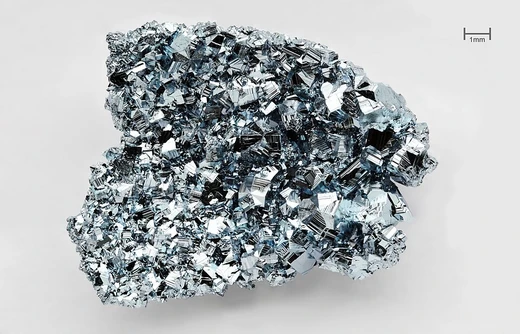
Silicon sits at spot 14 on the periodic table, marked by the symbol Si. This element appears as a hard, brittle crystal with a blue-grey metallic shine. It behaves as a tetravalent non-metal—sometimes grouped with metalloids—and acts as a semiconductor. In group 14, carbon lies above it, while germanium, tin, lead, and flerovium fall below. Silicon is largely unreactive. It plays a vital role in plant biology, supporting several physiological and metabolic processes. In technology, it is the go-to semiconductor for transistors, solar cells, and integrated circuits, dominating this field because of its low cost, strong electronic properties, and adaptable physical traits.
Because silicon bonds so tightly with oxygen, isolating it in pure form took until 1823, when Jöns Jakob Berzelius finally succeeded. Its oxides form a family of anions called silicates. Silicon melts at 1414 °C and boils at 3265 °C—the second highest melting and boiling points among all metalloids and nonmetals, beaten only by boron.
By mass, silicon is the eighth most common element in the universe, yet it rarely appears pure in Earth's crust. It is widespread through space in cosmic dust, planetoids, and planets as silicon dioxide (silica) or silicates. Over 90% of Earth's crust consists of silicate minerals, making silicon the second most abundant element in the crust at about 28% by mass, after oxygen.
Most silicon is used commercially without being separated from its natural minerals, often with minimal processing. This includes industrial construction with clays, silica sand, and stone. Silicates go into Portland cement for mortar and stucco, and are mixed with silica sand and gravel to make concrete for walkways, foundations, and roads. They also appear in whiteware ceramics like porcelain, in traditional silicate-based soda-lime glass, and in many specialty glasses. Silicon compounds such as silicon carbide serve as abrasives and components of high-strength ceramics. Silicon is the foundation of the widely used synthetic polymers called silicones.
The late 20th century through the early 21st century is often called the Silicon Age (also the Digital Age or Information Age), due to the massive impact of elemental silicon on the modern world economy. A small fraction of highly purified silicon—less than 15%—goes into semiconductor electronics, which is essential for the transistors and integrated circuit chips in most modern technology, including smartphones and other computers. In 2019, 32.4% of the semiconductor market was for networks and communications devices, and the industry is projected to reach $726.73 billion by 2027.
Silicon is essential in biology. Most animals need only traces, but some sea sponges and microorganisms—like diatoms and radiolaria—secrete skeletal structures made of silica. Silica is also deposited in many plant tissues.
**History** Because silicon is so abundant in Earth's crust, natural silicon-based materials have been used for thousands of years. Ancient civilizations, including predynastic Egyptians and the ancient Chinese, were familiar with silicon rock crystals, using them for beads and small vases. Egyptians manufactured glass containing silica as early as 1500 BC, as did the ancient Phoenicians. Natural silicate compounds were also used in various mortars for early human dwellings.
**Discovery** In 1787, Antoine Lavoisier suspected that silica might be an oxide of a fundamental element, but silicon's strong affinity for oxygen prevented him from reducing the oxide and isolating the element. In 1808, after an attempt to isolate silicon, Sir Humphry Davy proposed the name "silicium," from the Latin *silex*, *silicis* for flint, adding the "-ium" ending because he believed it to be a metal. Most other languages use transliterated forms of Davy's name, sometimes adapted to local phonology (e.g., German *Silizium*, Turkish *silisyum*, Catalan *silici*, Armenian *Սիլիցիում* or *Silitzioum*). A few others use a calque of the Latin root (e.g., Russian *кремний*, from *кремень* "flint"; Greek *πυρίτιο* from *πυρ* "fire"; Finnish *pii* from *piikivi* "flint"; Czech *křemík* from *křemen* "quartz," "flint").
Gay-Lussac and Thénard are thought to have prepared impure amorphous silicon in 1811 by heating recently isolated potassium metal with silicon tetrafluoride, but they did not purify or characterize the product, nor identify it as a new element. Silicon received its present name in 1817 from Scottish chemist Thomas Thomson. He kept part of Davy's name but added "-on" because he believed silicon was a nonmetal similar to boron and carbon. In 1824, Jöns Jacob Berzelius prepared amorphous silicon using roughly the same method as Gay-Lussac (reducing potassium fluorosilicate with molten potassium metal), purifying the product to a brown powder by repeated washing. He is usually credited with the element's discovery. That same year, Berzelius became the first to prepare silicon tetrachloride (SiCl₄); silicon tetrafluoride had already been prepared in 1771 by Carl Wilhelm Scheele by dissolving silica in hydrofluoric acid. In 1846, J. Von Ebelman synthesized tetraethyl orthosilicate (Si(OC₂H₅)₄).
Silicon in its more common crystalline form was not prepared until 31 years later, by Deville. Passing silicon chloride vapors over pure aluminum produced pure, hard octahedral crystals. Friedrich Wöhler discovered the first volatile hydrides of silicon, synthesizing trichlorosilane in 1857 and silane itself in 1858, but a detailed investigation of the silanes was only completed later.
- symbol
- Si
- atomic_number
- 14
- group
- 14
- abundance_in_earth_crust
- about 28% by mass (second most abundant)
Lore & Background
Silicon is a hard, brittle crystalline solid with a blue-grey metallic lustre, classified as a tetravalent non-metal sometimes considered a metalloid and semiconductor. It is a member of group 14 of the periodic table, positioned below carbon and above germanium, tin, lead, and flerovium. The element is relatively unreactive and has a high chemical affinity for oxygen, which long hindered its isolation. Its melting point is 1414 °C and its boiling point is 3265 °C, the second highest among all metalloids and nonmetals after boron. Silicon is the eighth most common element in the universe by mass, but pure forms are rare in Earth’s crust. It is widely distributed in cosmic dusts, planetoids, and planets as silicon dioxide or silicates. Over 90% of the Earth’s crust consists of silicate minerals, making silicon the second most abundant element in the crust at about 28% by mass, after oxygen. Most commercial silicon is used without separation, in clays, silica sand, stone, Portland cement, mortar, stucco, concrete, whiteware ceramics, porcelain, soda-lime glass, and specialty glasses. Silicon carbide serves as an abrasive and component of high-strength ceramics. Silicon is also the basis of silicone polymers. A small fraction of highly purified elemental silicon is essential for semiconductor electronics, including transistors and integrated circuits used in modern technology. In biology, silicon is essential for some sea sponges and microorganisms like diatoms and radiolaria, which secrete silica skeletons, and silica is deposited in many plant tissues. Natural silicon-based materials have been used for thousands of years, with rock crystals known to predynastic Egyptians and ancient Chinese, and silicate compounds used in early mortar. The element was named silicon in 1817 by Thomas Thomson.
Reader's Guide
Silicon's significance stems from its role as the primary semiconductor material in modern electronics, dominating applications due to its low cost, excellent electronic properties, and adaptable physical characteristics. The late 20th century to early 21st century has been described as the Silicon Age (also known as the Digital Age or Information Age) because of the large impact elemental silicon has on the modern world economy. Although less than 15% of highly purified elemental silicon is used in semiconductor electronics, that portion is essential to transistors and integrated circuit chips used in most modern technology such as smartphones and other computers. Beyond electronics, silicon compounds are widely used in construction (concrete, mortar, glass), ceramics, abrasives, and synthetic polymers called silicones. Silicon is also an essential element in biology, with sea sponges and microorganisms like diatoms secreting silica skeletal structures, and silica deposited in many plant tissues.
Did You Know?
- Silicon is the second most abundant element in the Earth's crust, at about 28% by mass, after oxygen.
- More than 90% of the Earth's crust is composed of silicate minerals.
Frequently Asked Questions
Who is Silicon?
Silicon (Si, atomic number 14) is a hard, brittle crystalline solid with a blue-grey metallic shine. It is a tetravalent non-metal—sometimes classed as a metalloid—occupying group 14 of the periodic table directly beneath carbon.
What are Silicon's powers or role?
Silicon is the foundational material of semiconductor electronics, underpinning transistors, solar cells, and integrated circuits. Its unique ability to conduct electricity under controlled conditions is what defines the era often called the Silicon Age.
How does Silicon's story end?
As a stable, naturally occurring element, Silicon has no narrative arc that concludes; its ongoing significance is tied to the continued evolution of semiconductor technology. It also remains essential to several physiological and metabolic processes in living plants.
Why is Silicon so important?
Making up roughly 28% of the Earth's crust by mass, Silicon is the second most abundant element, which makes it both ubiquitous and indispensable. Its dual role in modern electronics and plant biology gives it a level of cross-disciplinary importance few other elements match.
Where does Silicon sit among its group 14 family?
Silicon is the second member of group 14, positioned directly below carbon with germanium, tin, lead, and flerovium stacked beneath it. This vertical arrangement reflects a shared tetravalent bonding pattern that runs through the entire column.
More in Chemical Elements & Metals 1-20
Spotted an error? Know more?
This is a living reference — every entry is fact-audited, and reader corrections feed straight into our audit queue. Suggest an edit · See this site's audit record