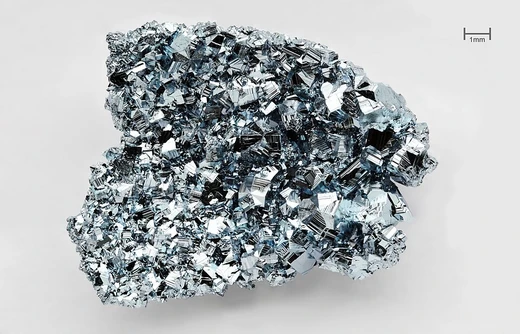
Ruthenium

Ruthenium is the chemical element with the symbol Ru and atomic number 44. This rare transition metal is part of the platinum group and, like its relatives, resists reacting with most chemicals. It was discovered in 1844 by Karl Ernst Claus, a Russian scientist of Baltic-German ancestry working at Kazan State University, who named it after Russia using the Latin name Ruthenia. Ruthenium typically occurs as a minor component of platinum ores, with annual production rising from about 19 tonnes in 2009 to 35.5 tonnes in 2017. Most of it is used in wear-resistant electrical contacts and thick-film resistors, with smaller applications in platinum alloys and as a chemical catalyst. A newer use is as a capping layer for extreme-ultraviolet photomasks in semiconductor lithography. The element is generally found alongside other platinum-group metals in the Ural Mountains, as well as in North and South America. Commercially significant amounts also come from pentlandite mined at Sudbury, Ontario, and from pyroxenite deposits in South Africa.
Ruthenium is a hard, white, polyvalent metal. Although it belongs to group 8 of the periodic table, its outermost shell holds only one electron—unlike the other group 8 elements, which have two—because the final electron sits in a lower shell. This anomaly, which does not affect chemical behavior, also appears in all other elements (except technetium) with atomic numbers 41 through 45. The metal has four crystal modifications and does not tarnish under normal conditions, but it oxidizes when heated to 800 °C. It dissolves in fused alkalis to form ruthenates (RuO₄²⁻). Acids, including aqua regia, do not attack it, but sodium hypochlorite does at room temperature, and halogens attack it at high temperatures. Oxidizing agents are the most effective at attacking ruthenium. Small amounts can harden platinum and palladium, and adding a little ruthenium markedly increases titanium’s corrosion resistance. The metal can be plated by electroplating or thermal decomposition. A ruthenium–molybdenum alloy becomes superconductive below 10.6 K. Ruthenium is the only 4d transition metal that can reach the +8 oxidation state, though it is less stable there than its heavier congener osmium. This is the first group from the left where second- and third-row transition metals show notable chemical differences. Like iron but unlike osmium, ruthenium can form aqueous cations in the +2 and +3 oxidation states. Its melting and boiling points, as well as its atomization enthalpy, begin a downward trend in the 4d series after a peak at molybdenum, because the 4d subshell is more than half full and electrons contribute less to metallic bonding. (Technetium, the element before ruthenium, has an unusually low value off this trend due to its half-filled [Kr]4d⁵5s² configuration, though it deviates less than manganese does in the 3d series.) Unlike its lighter congener iron, ruthenium is mostly paramagnetic at room temperature, but a metastable tetragonal phase—created as a thin film on single-crystal molybdenum—is ferromagnetic at room temperature.
Naturally occurring ruthenium has seven stable isotopes: ⁹⁶Ru, ⁹⁸Ru, ⁹⁹Ru, ¹⁰⁰Ru, ¹⁰¹Ru, ¹⁰²Ru, and ¹⁰⁴Ru. Thirty-four synthetic radioactive isotopes have also been discovered. The most stable radioisotopes are ¹⁰⁶Ru (half-life 371.8 days), ¹⁰³Ru (39.245 days), and ⁹⁷Ru (2.837 days). Fifteen other radioisotopes, ranging from ⁸⁵Ru to ¹²⁵Ru, have been characterized; most have half-lives under five minutes, except ⁹⁴Ru (51.8 minutes), ⁹⁵Ru (1.607 hours), and ¹⁰⁵Ru (4.44 hours). For isotopes lighter than the most abundant ¹⁰²Ru, the primary decay mode is electron capture to produce technetium; for heavier isotopes, it is beta emission to rhodium. ¹⁰⁶Ru is a fission product of uranium or plutonium, and high concentrations detected in the atmosphere over Europe in 2017 were linked to an alleged undeclared nuclear accident in Russia.
Ruthenium makes up about 100 parts per trillion of Earth’s crust, ranking as the 78th most abundant element. It is found with other platinum-group metals in the Ural Mountains, North America, and South America, as well as in pentlandite from Sudbury, Ontario, and pyroxenite deposits in South Africa. Native ruthenium is a very rare mineral, with iridium sometimes replacing part of the ruthenium in its structure.
Roughly 30 tonnes of ruthenium are mined each year, with world reserves estimated at 5,000 tonnes. The composition of mined platinum-group metal mixtures varies widely by location: South African ores average 11% ruthenium, while those from the former USSR averaged only 2% (as of 1992). Ruthenium, osmium, and iridium are considered the minor platinum-group metals. Like other platinum-group metals, ruthenium is obtained commercially as a by-product of processing nickel, copper, and platinum ores. During the electrorefining of copper and nickel, noble metals such as silver, gold, and the platinum-group metals collect as anode mud, which then serves as feedstock for extraction. The metals are converted into ionized solutes through various methods, depending on the feedstock’s composition.
- symbol
- Ru
- atomic_number
- 44
- discovered_by
- Karl Ernst Claus
- group
- platinum group, group 8
- notable_property
- unreactive to most chemicals
Lore & Background
Ruthenium is a polyvalent hard white metal that does not tarnish at ambient conditions but oxidizes upon heating to 800 °C. It is not attacked by acids, including aqua regia, but is attacked by sodium hypochlorite and halogens at high temperatures. Ruthenium has four crystal modifications and is the only 4d transition metal that can assume the +8 oxidation state, though it is less stable than osmium in that state. Naturally occurring ruthenium consists of seven stable isotopes, and 34 synthetic radioactive isotopes have been discovered, with 106Ru being a fission product of uranium or plutonium.
Reader's Guide
Its primary applications include wear-resistant electrical contacts and thick-film resistors, with newer uses in extreme-ultraviolet photomasks for semiconductor lithography. Small amounts of ruthenium increase the hardness of platinum and palladium and markedly improve the corrosion resistance of titanium. The element is obtained commercially as a by-product from processing nickel, copper, and platinum ores, with major deposits in the Ural Mountains, North and South America, Sudbury (Ontario), and South Africa. Its presence in spent nuclear fuel and potential for production via nuclear transmutation from technetium-99 highlight its relevance in both industrial and nuclear contexts.
Did You Know?
- Ruthenium is the only 4d transition metal that can assume the +8 oxidation state.
- Ruthenium is generally found in ores with other platinum-group metals in the Ural Mountains and in North and South America.
- 106Ru, a radioactive isotope of ruthenium, is a fission product of uranium or plutonium.
Frequently Asked Questions
Who is Ruthenium?
Ruthenium (Ru) is a rare transition metal with atomic number 44, sitting in group 8 of the periodic table. It belongs to the platinum group of elements and is one of the least abundant naturally occurring metals on Earth.
What are Ruthenium's powers and role?
Its signature trait is extreme chemical inertness—most common reagents simply cannot touch it. In practical terms, that makes it ideal for wear-resistant electrical contacts and thick-film resistors in electronics, where it must survive repeated mechanical stress without degrading.
How was Ruthenium discovered?
The element was identified in 1844 by the Baltic-German chemist Karl Ernst Claus, who isolated it from platinum-group ores in the Ural Mountains region. His work confirmed that the material was a distinct element rather than an impurity of other platinum-group metals.
Why is Ruthenium important to the metals community?
Because it is so scarce, any sample carries significant value, and its combination of hardness, corrosion resistance, and electrical stability fills a niche that no other platinum-group member covers as well. Engineers in the electronics and catalysis industries rely on it for components that must last under harsh conditions.
Where does Ruthenium sit relative to its platinum-group family?
It occupies group 8, flanked by iron, osmium, and hassium in its column, and sits between technetium and rhodium in period five. Within the platinum group it is the lightest member, giving it a slightly different set of oxidation states and metallic properties compared to heavier relatives like iridium or platinum.
More in Chemical Elements & Metals 1-20
Spotted an error? Know more?
This is a living reference — every entry is fact-audited, and reader corrections feed straight into our audit queue. Suggest an edit · See this site's audit record