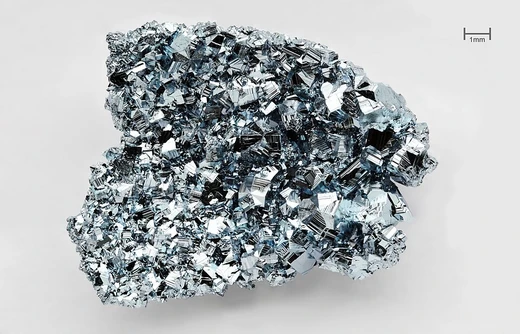
Rubidium

Rubidium (Rb, atomic number 37) is a chemical element. It belongs to the alkali metal group and appears as a very soft, whitish-grey solid, much like potassium and caesium. Among the alkali metals, it is the first one denser than water. On Earth, natural rubidium consists of two isotopes: about 72% is stable ⁸⁵Rb, while the remaining 28% is slightly radioactive ⁸⁷Rb, which has a half-life of 48.8 billion years—over three times the estimated age of the universe.
The element was discovered in 1861 by German chemists Robert Bunsen and Gustav Kirchhoff using the then-new technique of flame spectroscopy. Its name comes from the Latin *rubidus*, meaning deep red, referring to the color of its emission spectrum. Rubidium compounds find use in various chemical and electronic applications. Because the metal vaporizes easily and has a convenient spectral absorption range, it is often used in laser manipulation of atoms. Rubidium is not known to be a nutrient for any living organism, but its ions carry the same charge and behave similarly to potassium ions, so animal cells actively take them up and process them in much the same way.
**Characteristics**
**Physical properties:** Rubidium is a very soft, ductile, silvery-white metal. It melts at 39.3 °C (102.7 °F) and boils at 688 °C (1,270 °F). It forms amalgams with mercury and alloys with gold, iron, caesium, sodium, and potassium, but not with lithium (even though both are in the same periodic group). In a flame test, rubidium and potassium both produce a very similar purple color; telling them apart requires more advanced analysis, like spectroscopy.
**Chemical properties:** Rubidium is the second most electropositive stable alkali metal and has a very low first ionization energy of just 403 kJ/mol. Its electron configuration is [Kr]5s¹, and it is photosensitive. Because it is so strongly electropositive, it reacts explosively with water, forming rubidium hydroxide and hydrogen gas. As with all alkali metals, this reaction is usually vigorous enough to ignite the metal or the hydrogen produced, which can cause an explosion. Rubidium is denser than potassium, so it sinks in water and reacts violently; caesium explodes on contact with water. However, the reaction rate for any alkali metal depends on the surface area of the metal in contact with water—small droplets react explosively. Rubidium has also been reported to ignite spontaneously in air.
**Compounds:** Rubidium chloride (RbCl) is probably the most widely used rubidium compound. Among other chlorides, it is employed to help living cells take up DNA, and it serves as a biomarker because it occurs naturally in only tiny amounts in living organisms and replaces potassium when present. Other common rubidium compounds include corrosive rubidium hydroxide (RbOH), which is the starting material for most rubidium-based chemical processes; rubidium carbonate (Rb₂CO₃), used in some optical glasses; and rubidium copper sulfate (Rb₂SO₄·CuSO₄·6H₂O). Rubidium silver iodide (RbAg₄I₅) has the highest room-temperature conductivity of any known ionic crystal, a property used in thin-film batteries and other applications. When exposed to air, rubidium forms several oxides, such as rubidium monoxide (Rb₂O), Rb₆O, and Rb₉O₂; in excess oxygen it forms the superoxide RbO₂. Rubidium also forms salts with halogens, yielding rubidium fluoride, chloride, bromide, and iodide.
**Isotopes:** Rubidium in the Earth’s crust consists of two isotopes: stable ⁸⁵Rb (72.2%) and radioactive ⁸⁷Rb (27.8%). Natural rubidium is radioactive, with a specific activity of about 670 Bq/g—enough to noticeably expose photographic film in 110 days. Thirty additional rubidium isotopes have been synthesized, all with half-lives under three months; most are highly radioactive and have few uses. ⁸⁷Rb has a half-life of 48.8 billion years, more than three times the age of the universe (13.799 ± 0.021 billion years), making it a primordial nuclide. It readily substitutes for potassium in minerals and is therefore fairly widespread. Rubidium has been used extensively in rock dating: ⁸⁷Rb beta decays to stable ⁸⁷Sr. During fractional crystallization, strontium tends to concentrate in plagioclase, leaving rubidium in the liquid phase. As a result, the Rb/Sr ratio in residual magma may increase over time, and ongoing differentiation produces rocks with elevated Rb/Sr ratios—the highest (10 or more) occur in pegmatites. If the initial amount of strontium is known or can be estimated, the age can be determined by measuring Rb and Sr concentrations and the ⁸⁷Sr/⁸⁶Sr ratio. These dates reflect the true age of the minerals only if the rocks have not been altered afterward (see rubidium–strontium dating). Rubidium-82, a non-natural isotope, is produced by electron-capture decay of strontium-82 (half-life 25.36 days). With a half-life of 76 seconds, ⁸²Rb decays by positron emission to stable krypton-82.
**Occurrence:** Rubidium is not abundant; it is one of 56 elements that together make up 0.05% of the Earth’s crust. Roughly the 23rd most abundant element in the crust, it is more plentiful than zinc or copper. It occurs naturally in the minerals leucite, pollucite, carnallite, and zinnwaldite, which can contain up to 1% rubidium oxide. Lepidolite contains between 0.3% and 3.5% rubidium and is the commercial source of the element. Some potassium minerals and potassium chlorides also contain significant amounts. Seawater averages 125 μg/L of rubidium, compared to 408 mg/L for potassium and 0.3 μg/L for caesium. Rubidium is the 18th most abundant element in seawater. Because of its large ionic radius, rubidium is one of the “incompatible elements.” During magma crystallization, it tends to stay in the liquid phase rather than entering solid minerals.
- symbol
- Rb
- atomic_number
- 37
- discovered_by
- Robert Bunsen and Gustav Kirchhoff
- group
- alkali metal
- melting_point
- 39.3 °C
Lore & Background
Rubidium is a very soft, whitish-grey solid belonging to the alkali metal group, with properties similar to potassium and caesium. It is the first alkali metal denser than water. On Earth, natural rubidium consists of two isotopes: about 72% is stable rubidium-85, while roughly 28% is slightly radioactive rubidium-87, which has a half-life of 48.8 billion years—more than three times the estimated age of the universe. The element was discovered in 1861 by German chemists Robert Bunsen and Gustav Kirchhoff using flame spectroscopy, and its name comes from the Latin word *rubidus*, meaning deep red, due to the color of its emission spectrum. Rubidium metal is easily vaporized and has a convenient spectral absorption range, making it useful for laser manipulation of atoms. It is not a known nutrient for any living organism, but rubidium ions behave similarly to potassium ions and are actively taken up by animal cells. Rubidium is very soft, ductile, and silvery-white, with a low melting point and boiling point. It forms amalgams with mercury and alloys with gold, iron, caesium, sodium, and potassium, but not lithium. Rubidium is the second most electropositive stable alkali metal, with a very low first ionization energy. It reacts explosively with water, producing rubidium hydroxide and hydrogen gas, and can ignite spontaneously in air. Rubidium chloride is the most commonly used compound, employed to induce cells to take up DNA and as a biomarker. Rubidium occurs naturally in minerals such as leucite, pollucite, carnallite, and zinnwaldite, with lepidolite being the commercial source. It is about the 23rd most abundant element in Earth’s crust, more common than zinc or copper.
Reader's Guide
Rubidium is significant as the first alkali metal with a density higher than water and as a key element in laser manipulation of atoms due to its convenient spectral absorption range. Its compounds have various chemical and electronic applications, including rubidium chloride used to induce living cells to take up DNA and as a biomarker. Rubidium-87, with a half-life of 48.8 billion years, is used extensively in dating rocks via the rubidium–strontium dating method. Although not abundant, it is more abundant in Earth's crust than zinc or copper, and its production is limited to 2 to 4 tonnes per year due to limited applications and lack of a mineral rich in rubidium.
Did You Know?
- Rubidium is the first alkali metal in the group to have a density higher than water.
- Natural rubidium comprises two isotopes: 72% stable 85Rb and 28% slightly radioactive 87Rb with a half-life of 48.8 billion years.
- Rubidium reacts explosively with water, producing rubidium hydroxide and hydrogen gas.
- Rubidium was the second element discovered by spectroscopy, shortly after caesium.
Frequently Asked Questions
Who is Rubidium?
Rubidium (Rb, atomic number 37) is a soft, silvery-white alkali metal sitting in Group 1 of the periodic table. It sits just below potassium and above cesium, making it part of the famously reactive 'first column' family.
What are Rubidium's powers or role?
As an alkali metal, Rubidium reacts explosively with water and ignites on its own in moist air, so it must be stored under oil. Its melting point is a mere 39.3 °C, meaning it can soften in a warm hand—far lower than most metals.
How does Rubidium's story end?
Rubidium is so reactive that it essentially 'ends' in a violent flash the moment it meets water or oxygen, producing rubidium hydroxide or oxide. In nature it never appears as a free metal; you only find it locked inside minerals like leucite or pollucite.
Why is Rubidium important to the wider element community?
Rubidium atoms are the working heart of precision atomic clocks and rubidium-vapor laser cells used in GPS satellites and spectroscopy labs. Its single outer electron makes it a go-to tool for studying quantum behavior and ultra-precise timekeeping.
What is Rubidium's origin story?
Robert Bunsen and Gustav Kirchhoff spotted Rubidium in 1861 by running mineral samples through a flame and reading the deep-red lines in the emission spectrum. They named it from the Latin 'rubidus,' meaning deep red, after that signature crimson glow.
More in Chemical Elements & Metals 1-20
Spotted an error? Know more?
This is a living reference — every entry is fact-audited, and reader corrections feed straight into our audit queue. Suggest an edit · See this site's audit record