Rhodium
Rare noble metal used in catalytic converters and jewelry plating.

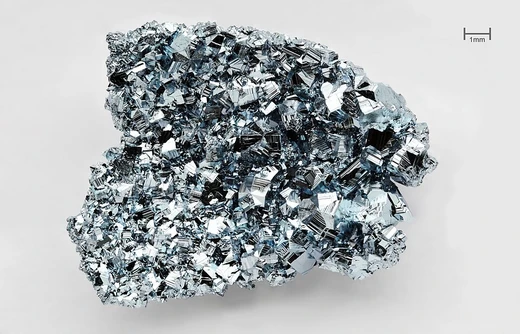
Rhodium sits in the periodic table with the symbol Rh and the atomic number 45. This transition metal is very rare, hard, and resistant to corrosion, with a dark silvery-white appearance. It qualifies as a noble metal and belongs to the platinum group. Only one naturally occurring isotope exists for rhodium: 103Rh. In nature, it typically appears as a free metal or alloyed with similar metals; it is seldom found as a chemical compound, though it does occur in minerals like bowieite and rhodplumsite. Among precious metals, it ranks as one of the rarest and most valuable. It falls into group 9 (the cobalt group) and is used to enhance jewelry.
Rhodium is obtained from platinum or nickel ores alongside other platinum group metals. William Hyde Wollaston discovered it in 1803 while working with one such ore, naming it after the rose color of one of its chlorine compounds.
The biggest use of rhodium—consuming roughly 80% of global production—is as a catalyst in three-way catalytic converters for automobiles. Because it resists corrosion and most aggressive chemicals, and because it is so scarce, rhodium is usually alloyed with platinum or palladium for coatings that withstand high temperatures and corrosion. White gold often gets a thin rhodium plating to improve its look, and sterling silver is frequently rhodium-plated to prevent tarnishing.
In nuclear reactors, rhodium detectors measure neutron flux levels. Other applications include asymmetric hydrogenation to create drug precursors and processes for making acetic acid.
**History**
The name rhodium comes from the Greek word *rhodon*, meaning 'rose.' Wollaston discovered it in 1803, shortly after he found palladium. He started with crude platinum ore, likely from South America. His method involved dissolving the ore in aqua regia, then adding ammonium chloride to precipitate platinum as ammonium chloroplatinate. Adding zinc caused a mixture of copper, lead, palladium, and rhodium to precipitate. Dilute nitric acid dissolved the copper and lead. After dissolving the remaining material in aqua regia again and adding sodium chloride, the solution was evaporated to yield rose-red Na₃[RhCl₆]·nH₂O. Extracting with hot ethanol and then adding zinc displaced the rhodium from the ionic compound, leaving free rhodium metal.
For decades, this rare element saw only minor uses. By the turn of the century, thermocouples containing rhodium measured temperatures up to 1800 °C, showing exceptional stability between 1300 and 1800 °C.
The first major application was electroplating for decoration and corrosion-resistant coatings. Demand for rhodium surged in 1976 when Volvo introduced the three-way catalytic converter. Earlier catalytic converters used platinum or palladium, but the three-way design used rhodium to cut down NOx emissions.
**Characteristics**
Rhodium is hard, silvery, durable, and highly reflective. It does not normally form an oxide, even when heated. Oxygen is absorbed from the air only at rhodium's melting point and is released when it solidifies. Compared to platinum, rhodium has a higher melting point and a lower density. Most acids do not attack it: it is completely insoluble in nitric acid and dissolves only slightly in aqua regia—a property used to separate it from platinum ore.
Rhodium sits in group 9 of the periodic table, but its ground state valence electron configuration is unusual for that group, with just one electron in its outermost s orbital. The same pattern appears in niobium (41) and ruthenium (44).
**Chemical properties**
Common oxidation states for rhodium are +3 and +1. Complexes with oxidation states 0, +2, and +4 are also well known. A few compounds reach higher oxidation states, such as rhodium pentafluoride (a tetramer with the formula Rh₄F₂₀) and rhodium hexafluoride.
Three rhodium oxides exist: Rh₂O₃ (a paramagnetic black powder), RhO₂ (black when anhydrous, green as a hydrate), and RhO₃ (stable only as a gas). A rhodium sulfide, Rh₁₇S₁₅, occurs naturally as the rare mineral miassite. Synthetic RhₓSᵧ compounds serve as catalysts in applications like H₂-Br₂ fuel cells.
All Rh(III) halides are known. Many rhodium complexes start from RhCl₃·3H₂O, the hydrated trichloride, though anhydrous RhCl₃ is largely inert. Other rhodium(III) chlorides include sodium hexachlororhodate (Na₃RhCl₆) and pentaamminechlororhodium dichloride ([Rh(NH₃)₅Cl]Cl₂). These are used in recycling and purifying this very expensive metal. Heating a methanolic solution of hydrated rhodium trichloride with sodium acetate yields blue-green rhodium(II) acetate, Rh₂(O₂CCH₃)₄, which contains a Rh–Rh bond. This complex and related rhodium(II) trifluoroacetate have drawn attention as catalysts for cyclopropanation reactions.
When heated with triphenylphosphine in ethanol, hydrated rhodium trichloride converts to RhCl(P(C₆H₅)₃)₃. This square planar complex, known as Wilkinson's catalyst, is a common early example of a well-defined homogeneous catalyst for hydrogenating alkenes.
**Organorhodium compounds**
Rhodium is known for many organometallic derivatives. Rhodium(I) complexes are widely used as catalysts, including BINAP-Rh(I), DIPAMP-Rh(I), and BDPP-Rh(I).
Cyclopentadienyl complexes of rhodium have been studied as analogues of ferrocene. The parent compound is rhodocene, which participates in an unusual monomer-dimer equilibrium. Related cyclopentadienyl compounds include the Rh(I) and Rh(III) half-sandwich complexes (C₅H₅)Rh(CO)₂ and pentamethylcyclopentadienyl rhodium dichloride dimer (C₅(CH₃)₅RhCl₂)₂. The latter is prepared by reacting rhodium trichloride trihydrate with pentamethylcyclopentadiene in hot methanol.
- symbol
- Rh
- atomic_number
- 45
- discovered_by
- William Hyde Wollaston
- group
- 9 (cobalt group)
- natural_isotope
- 103Rh
- major_use
- Catalyst in three-way catalytic converters (80% of production)
Lore & Background
Rhodium is a very rare, dark silvery-white, hard, and corrosion-resistant transition metal belonging to the platinum group and classified as a noble metal. It has a high reflectance and is durable, with a higher melting point but lower density than platinum. The metal does not normally form an oxide, even when heated, and only absorbs oxygen from the atmosphere at its melting point, releasing it upon solidification. It is not attacked by most acids, being completely insoluble in nitric acid and only slightly soluble in aqua regia, a property historically used to separate it from platinum ore. Naturally occurring rhodium is almost always found as a free metal or alloyed with similar metals, rarely as a chemical compound in minerals such as bowieite and rhodplumsite. It has only one naturally occurring isotope, 103Rh, and is one of the rarest and most valuable precious metals. Rhodium is a group 9 element (cobalt group) but exhibits an atypical ground state valence electron configuration for that group, with only one electron in its outermost s orbital, a trait shared with niobium and ruthenium. Its common oxidation states are +3 and +1, though complexes with states 0, +2, and +4 are well characterized, and higher states exist in compounds like rhodium pentafluoride and hexafluoride. Three rhodium oxides are known, and a rhodium sulfide occurs naturally as the rare mineral miassite. All rhodium(III) halides are known, and many rhodium complexes begin with the hydrated trichloride. Organorhodium compounds are numerous, with rhodium(I) complexes widely used as catalysts, including Wilkinson's catalyst for alkene hydrogenation. Rhodium is found in platinum or nickel ores alongside other platinum group metals.
Reader's Guide
Rhodium's significance lies in its extreme rarity and unique chemical properties. As one of the rarest elements in the Earth's crust (less than one part per billion), it is highly valued for its corrosion resistance and catalytic activity. Rhodium is also used to plate white gold and sterling silver to improve appearance and resist tarnishing. In nuclear reactors, rhodium detectors measure neutron flux. Despite its high cost, rhodium-based catalysts have displaced cheaper cobalt-based ones in hydroformylation of alkenes. Used nuclear fuel is a potential source, but extraction is complex and expensive.
Did You Know?
- Naturally occurring rhodium has only one isotope, 103Rh.
- Rhodium is completely insoluble in nitric acid and dissolves only slightly in aqua regia.
Frequently Asked Questions
Who is Rhodium?
Rhodium is a rare, hard, silvery-white transition metal with atomic number 45, belonging to the platinum group of noble metals. It sits in group 9 of the periodic table alongside cobalt and iridium.
What are Rhodium's powers or role?
Rhodium's standout ability is its exceptional corrosion resistance and catalytic activity, making it the star ingredient in three-way catalytic converters that scrub toxic gases from car exhaust. It also lends a brilliant, tarnish-free shine to high-end jewelry plating.
How does Rhodium's story end?
Because Rhodium is a naturally occurring element rather than a fictional character, it has no narrative arc, but its only stable isotope is 103Rh, so every atom you encounter is that single variant. Its extreme scarcity—far rarer than gold—limits how widely it can appear in everyday applications.
Why is Rhodium important?
Roughly 80% of all rhodium produced goes into catalytic converters, where it helps convert harmful pollutants into less dangerous gases, making it quietly critical to automotive emissions control. Its noble-metal chemistry and rarity also make it a prized plating material in luxury jewelry.
Who discovered Rhodium?
The English chemist William Hyde Wollaston identified rhodium in 1803 while studying platinum ore. The name derives from the Greek word 'rhodon,' meaning rose, a nod to the pink-colored salts he observed during his experiments.
More in Chemical Elements & Metals 1-20
Spotted an error? Know more?
This is a living reference — every entry is fact-audited, and reader corrections feed straight into our audit queue. Suggest an edit · See this site's audit record