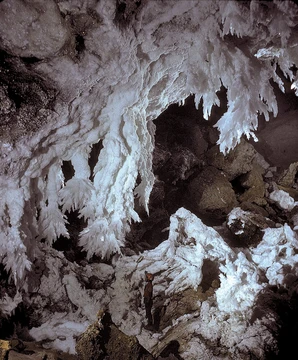
Ledenika
A Bulgarian cave known for icicles and karst formations.

Ledenika, whose name means "icy" or "glacial" in Bulgarian, is a cave located in the northwestern Balkan Mountains, about 16 kilometers from the city of Vratsa. Its entrance sits roughly 830 meters above sea level. The cave is known for its many galleries and striking karst features, such as stalactites and stalagmites. First discovered near the start of the 20th century, it has been open to tourists since 1961. The cave also lends its name to Ledenika Peak in Antarctica, on Graham Land, honoring its cultural significance.
Stretching around 300 meters in length, the cave contains ten separate halls. Visitors begin in the Antechamber, move through smaller passages to the Concert Hall, and then continue through more passages to reach the White Hall. The largest gallery, the Great Temple, has a ceiling 15 meters high. The Concert Hall, though smaller, boasts a wide variety of stalactites and stalagmites. In winter, icicles can form on the ceiling, and this abundance of ice likely inspired the cave’s name.
Geologically, the limestone formations in Ledenika date back to the Pliocene era. The Bulgarian Tourist Union has included the cave in its 100 Tourist Sites of Bulgaria program, a campaign to showcase the country’s top attractions. Since opening to tourists, it has been one of Bulgaria’s most famous caves, drawing a record 100,000 visitors annually in the late 1980s.
- location
- Northwestern Balkan Mountains, 16 km from Vratsa, Bulgaria
- number_of_halls
- ten separate halls
- discovery
- around the beginning of the 20th century
- largest_gallery
- Great Temple, with a ceiling of 15 m
Lore & Background
Visitors enter through the Antechamber, then pass through several smaller passages into the Concert Hall. Visitors then pass through several more smaller passages, eventually emerging in the White Hall. The largest gallery is known as the Great Temple, with a ceiling of 15 m. The Concert Hall is smaller, but has an enormous variation of stalactites and stalagmites. During the winter, icicles may form on the ceiling. The abundance of icicles in winter is thought to have led to the cave's name, which in English translates to icy or glacial.
Reader's Guide
The Bulgarian Tourist Union has included Ledenika in their 100 Tourist Sites of Bulgaria, a promotional effort aimed at highlighting the nation's best tourist spots. The limestone formations in the cave have been dated back to the Pliocene era. Ledenika Peak on Graham Land in Antarctica is named after the cave, in recognition of its cultural importance. The cave's name derives from the winter icicles that form on its ceiling, reflecting its icy character.
Did You Know?
- The largest gallery is the Great Temple, with a ceiling of 15 m.
- The cave's name translates to 'icy' or 'glacial' in English.
- Ledenika Peak on Graham Land in Antarctica is named after the cave.
Architecture of Stone and Ice
Tucked into the northwestern reaches of the Balkan Mountains, roughly sixteen kilometers from the town of Vratsa, Ledenika presents visitors with a subterranean landscape that unfolds over approximately three hundred meters of passage. The cave is divided into ten distinct halls, and the journey through them follows a deliberate sequence. Visitors first step into the Antechamber, the welcoming threshold, before threading through a series of narrower passages that lead to the Concert Hall. From there, additional constricted corridors guide the way onward until one finally emerges into the White Hall. The most commanding space is the Great Temple, whose ceiling soars to fifteen meters, creating a cathedral-like sense of scale. The Concert Hall, while more modest in size, compensates with an extraordinary density of karst formations—stalactites and stalagmites in such profusion that the chamber feels almost crowded with mineral sculpture. The entrance itself sits at roughly eight hundred and thirty meters above sea level, placing the cave in a cool, elevated setting that shapes everything from its geology to its seasonal character.
Pliocene Roots and a Frosty Name
The limestone that forms Ledenika's walls and ceilings was laid down during the Pliocene epoch, meaning the raw geological canvas predates human civilization by millions of years. Over that immense span, water and mineral deposition sculpted the karst features that define the cave's interior—stalactites hanging from overhead, stalagmites rising from the floor, and in some cases the two meeting to form columns. Yet the feature that gave the cave its very name is not a permanent mineral growth but a seasonal one. Each winter, icicles take hold of the ceiling in such numbers that the cave earns its Bulgarian title, Ledenika, which translates in English as icy or glacial. The sheer abundance of these frozen formations during the cold months is widely believed to be the origin of the name, distinguishing it from other Bulgarian caves. This seasonal transformation adds a dynamic, almost theatrical quality to an already striking underground environment, reminding visitors that the cave is not a static museum of stone but a living system responsive to the rhythm of the seasons.
From Hidden Grotto to National Treasure
Ledenika was first identified by explorers around the turn of the twentieth century, though it remained largely unknown to the wider public for several decades. That changed in 1961, when the cave was officially opened to tourists, and it quickly established itself as one of Bulgaria's most celebrated underground sites. Its reputation grew steadily over the following years, and by the late 1980s the cave was drawing a record one hundred thousand visitors in a single year—a remarkable figure for a site nestled in the northwestern Balkan foothills. The Bulgarian Tourist Union later enshrined Ledenika in its curated list of one hundred Tourist Sites of Bulgaria, a promotional initiative designed to spotlight the nation's finest destinations. Inclusion on that list cemented the cave's status not merely as a local curiosity but as a flagship attraction representing the country's natural heritage. The steady stream of visitors over more than six decades of public access has made Ledenika a familiar name in Bulgarian tourism, a destination that generations of travelers have added to their itineraries.
A Cave That Reached the Poles
Few Bulgarian landmarks have achieved a form of recognition that extends as far from home as Ledenika's. The cave's cultural significance was acknowledged on a truly global scale when a peak on Graham Land in Antarctica was named Ledenika Peak in its honor. This naming, a deliberate act of international cartographic tribute, elevates the cave from a regional tourist attraction to a point of reference on a continent thousands of kilometers away. It speaks to the depth of the cave's place in Bulgarian cultural identity—so strong that it warranted being inscribed on the landscape of the far southern pole. The fact that an icy, glacial-named cave in the Balkan Mountains found its echo on Antarctic ice is a fitting parallel, one that underscores the cave's defining character. For a site whose very name evokes frost and ice, having its legacy carried to the world's coldest continent is almost poetic, a testament to how a single natural wonder can transcend its local geography and become a shared symbol recognized far beyond its borders.
Frequently Asked Questions
What does Ledenika look like inside?
The cave runs through ten distinct halls filled with galleries, stalactites, stalagmites, and other striking karst formations. It is especially noted for its icicle-like features.
Does Ledenika have any recognition outside of Bulgaria?
Yes—Ledenika Peak on Graham Land in Antarctica was named after the cave, a nod to its cultural significance in the region.
More in Caves And Karst Formations 1-24
Spotted an error? Know more?
This is a living reference — every entry is fact-audited, and reader corrections feed straight into our audit queue. Suggest an edit · See this site's audit record