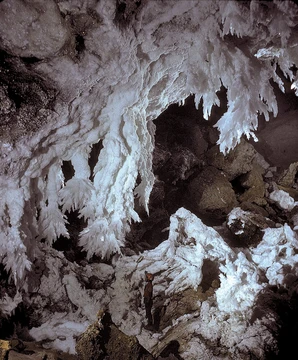
Carlsbad Caverns National Park
A national park featuring a vast, accessible limestone cave system.

Carlsbad Caverns National Park sits in New Mexico’s Guadalupe Mountains, in the southeastern part of the state. Its main draw is the show cave known as Carlsbad Cavern, which is widely considered one of the most accessible and best-preserved cave complexes on the planet. Visitors can either hike down through the natural entrance on their own or take an elevator from the visitor center.
The park’s entrance is on US Highway 62/180, about 18 miles southwest of Carlsbad, New Mexico. Two areas are listed on the National Register of Historic Places: the Caverns Historic District and the Rattlesnake Springs Historic District. Roughly two-thirds of the park is designated as wilderness, which protects the habitat from future changes.
Inside the cavern is a huge limestone chamber called the Big Room. It measures nearly 4,000 feet long, 625 feet wide, and reaches a height of 255 feet at its highest point. This makes it the largest chamber in North America and the 32nd largest in the world.
The park was established in 1930 and became a World Heritage Site in 1995.
**Geology**
**Capitan Reef** About 250 million years ago, the area that is now the park was the coastline of an inland sea. That sea teemed with marine life, and the remains of those organisms built up into a reef. Unlike modern reefs, this Permian reef was made of bryozoans, sponges, and other tiny organisms. After the Permian Period, most of the water evaporated, and the reef was buried under evaporites and other sediments. Later, during the late Cenozoic, tectonic activity lifted the reef above ground. Water erosion then sculpted the Guadalupe Mountains into their current shape.
**Speleogenesis** The park sits in a limestone bed above the groundwater table, though during the cave’s formation it was within that zone. Deep beneath the limestone lie petroleum reserves, part of the Mid-Continent Oil Field. Near the end of the Cenozoic, hydrogen sulfide began seeping upward from the oil into the groundwater. There, it combined with oxygen in the water to form sulfuric acid. This acid then moved upward, aggressively dissolving the limestone and creating the caverns. The presence of gypsum inside the cave confirms this process, as gypsum is a byproduct of the reaction between sulfuric acid and limestone.
After the acidic groundwater drained away, speleothems began to form. Erosion above ground created the natural entrance to the cavern within the last million years. That opening let air flow into the cave. Rainwater and snowmelt percolating through the ground pick up carbon dioxide; when this water reaches a cave ceiling, it precipitates and evaporates, leaving behind a small deposit of calcium carbonate. Growths that hang from the ceiling are called stalactites. Water on the floor can also contain carbonic acid and leave mineral deposits as it evaporates, forming stalagmites that rise from the floor. Other speleothem formations include columns, soda straws, draperies, helictites, and popcorn. The growth rate of speleothems depends on air temperature and rainfall—higher temperatures boost carbon dioxide production in the soil above. The color of the formations comes from trace minerals in the deposits.
**Climate** Under the Köppen climate classification, the Carlsbad Caverns Visitor Center has a cool semi-arid climate.
**History**
In 1898, a teenager named Jim White explored the cavern using a homemade wire ladder. He gave names to many of the rooms, including the Big Room, New Mexico Room, Kings Palace, Queens Chamber, Papoose Room, and Green Lake Room. He also named many prominent formations, such as the Totem Pole, Witch’s Finger, Giant Dome, Bottomless Pit, Fairyland, Iceberg Rock, Temple of the Sun, and Rock of Ages.
The town of Carlsbad, which gives the cavern and park their name, is itself named after the Czech town formerly known by the German name Karlsbad (English spelling Carlsbad) and now called Karlovy Vary—both meaning “Charles’ Baths.”
Until 1932, visitors had to walk down a switchback ramp that descended 750 feet below the surface. The climb back up was exhausting for some. That year, the park opened a large visitor center with two elevators to take people in and out of the cavern. The new center also included a cafeteria, waiting room, museum, and first aid area.
**Legislative history** On October 25, 1923, President Calvin Coolidge signed a proclamation establishing Carlsbad Cave National Monument. The proclamation described the cavern as “of extraordinary proportions and of unusual beauty and variety of natural decoration,” noting that beyond the explored chambers, other vast chambers of unknown character existed, and that the stalactites, stalagmites, and other formations were so numerous and beautiful as to make the cavern equal or superior to better-known caves in both scientific and popular interest.
On April 2, 1924, Coolidge issued an executive order for a possible national park or monument at the site. A supplemental executive order on May 3, 1928, reserved additional land for that purpose. On May 14, 1930, an act of Congress established the national park.
- location
- Guadalupe Mountains, southeastern New Mexico
- area
- Approximately two-thirds designated as wilderness
- primary_attraction
- Carlsbad Cavern show cave
- visitor_access
- Natural entrance hike or elevator from visitor center
Lore & Background
Marine life remains formed a reef, which after the Permian Period was buried by evaporites and sediments. Tectonic movement during the late Cenozoic uplifted the reef, and erosion sculpted the Guadalupe Mountains. The caverns formed when hydrogen sulfide from deep petroleum reserves seeped into groundwater, creating sulfuric acid that dissolved the limestone. Gypsum within the cave confirms this process. After acidic groundwater drained, speleothems such as stalactites and stalagmites began to form from calcium carbonate deposits.
Reader's Guide
Carlsbad Caverns National Park is significant for its geological history and preservation. The park's caverns were formed by a rare sulfuric acid dissolution process, not typical carbonic acid erosion. The Big Room is the largest chamber in North America and the 32nd largest in the world. The park includes two historic districts on the National Register of Historic Places: the Caverns Historic District and the Rattlesnake Springs Historic District. Approximately two-thirds of the park is designated wilderness, ensuring minimal future habitat changes. The park's accessibility—via a natural entrance or elevator—makes it a globally notable cave complex.
Did You Know?
- The Big Room is the largest chamber in North America and the 32nd largest in the world.
- The caverns were formed by sulfuric acid dissolving limestone, not by carbonic acid.
- The park's natural entrance was created by erosion above ground within the last million years.
- The town of Carlsbad is named after the Czech town formerly known as Karlsbad, meaning 'Charles' Baths'.
More in Caves And Karst Formations 1-24
Spotted an error? Know more?
This is a living reference — every entry is fact-audited, and reader corrections feed straight into our audit queue. Suggest an edit · See this site's audit record