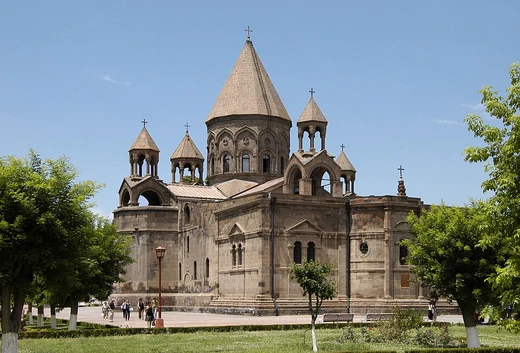
St Mark's Basilica
Venetian state sanctuary and cathedral holding relics of Saint Mark.
Last updated

via Wikipedia: St Mark's Basilica · see source
Where it is
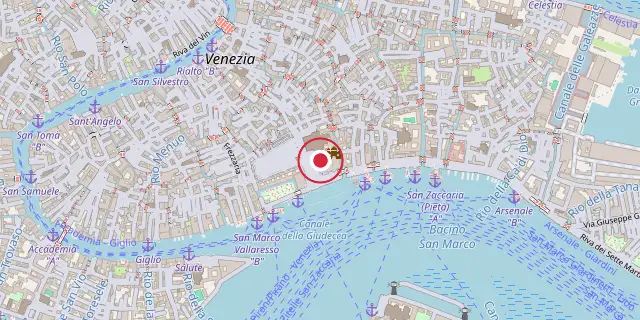
Coordinates: 45°26′02″N 12°20′24″E (45.4340, 12.3400) · Open in OpenStreetMap
Coordinates and connected clubs: the infobox of Wikipedia: St Mark's Basilica (CC BY-SA 4.0). Map: drawn by Codexery from OpenStreetMap tiles.
St Mark's Basilica in Venice was built as a state sanctuary rather than an ecclesiastical seat, a purpose underscored by its Byzantine cruciform plan modeled on the Church of the Holy Apostles in Constantinople.[1][2] The church's exterior and interior were later enriched with marble revetments, columns, and sculptures, many of which were spolia taken from ancient or Byzantine buildings.[3] After the Fourth Crusade, a quadriga of four gilded bronze horses that had adorned the Hippodrome was among the early spoils taken from Constantinople, and by the mid-thirteenth century they had been placed on St Mark's main façade to signify Venice's military victory over Byzantium and its imperial ambitions.[4]
Last updated 2026-10-08 from the source article.
Geography and history
According to medieval chronicles, Saint Mark's body was removed from Alexandria by two Venetian merchants and transferred to Venice in 828/829.[5] Excavations have shown that this first church was cruciform with at least a central dome, likely made of wood.[6] The Participazio church was severely damaged by fire in 976 during an uprising against Doge Pietro IV Candiano.[7] In 1063, under Doge Domenico I Contarini, St Mark's was substantially rebuilt and enlarged, with wooden domes replaced by brick.[8][9]
The crypt was enlarged, and the high altar was moved from under the central dome to the raised chancel.[10] The relics of Saint Mark were moved to the newly finished church in 836, the year construction was completed.[11] The Orseolo family paid entirely for the church's repair, which took under two years, and the fire damage turned out to be fairly minor.[7] On 8 October 1094, the church was consecrated and Saint Mark's relics were deposited in the newly built crypt.[12]
What the cited sources add
Demus's The Church of San Marco in Venice is the source for the claim that the Participazio church was cruciform from the start, featuring at least a central dome, probably made of wood.[6] According to Demus's work, the Orseolo church's wooden parts were destroyed by fire, but its walls and supports survived largely undamaged.[13] The same source states that the mosaics in the vaults above the choir chapels are the earliest surviving depiction of Saint Mark's relics being transferred.[14]
References
- Wikipedia, "St Mark's Basilica" (CC BY-SA 4.0), which cites: Howard, The Architectural History of Venice, p. 29 (original not read by us) en.wikipedia.org
- Wikipedia, "St Mark's Basilica" (CC BY-SA 4.0), which cites: Demus, The Church of San Marco in Venice, p. 67 (original not read by us) en.wikipedia.org
- Wikipedia, "St Mark's Basilica" (CC BY-SA 4.0), which cites: Howard, The Architectural History of Venice, p. 32 (original not read by us) en.wikipedia.org
- Wikipedia, "St Mark's Basilica" (CC BY-SA 4.0), which cites: Perry, 'Saint Mark's Trophies...', pp. 27–28; Vlad Borrelli, 'Ipotesi di datazione per i cavalli di San Marco', p. 39–42, 45; Perry, 'Saint Mark's Trophies...', p. 28; Touring Club Italiano, Venezia, p. 248 (original not read by us) en.wikipedia.org
- Wikipedia, "St Mark's Basilica" (CC BY-SA 4.0), which cites: Demus, The Church of San Marco in Venice, p. 9; Demus, The Church of San Marco in Venice, p. 63 (original not read by us) en.wikipedia.org
- Wikipedia, "St Mark's Basilica" (CC BY-SA 4.0), which cites: Demus, The Church of San Marco in Venice, p. 66; Howard, The Architectural History of Venice, p. 28–29; Draghici-Vasilescu, 'The Church of San Marco...', pp. 713–714 (original not read by us) en.wikipedia.org
- Wikipedia, "St Mark's Basilica" (CC BY-SA 4.0), which cites: Rendina, I dogi, p. 54 (original not read by us) en.wikipedia.org
- Wikipedia, "St Mark's Basilica" (CC BY-SA 4.0), which cites: Demus, The Church of San Marco in Venice, p. 71; Demus, The Church of San Marco in Venice, p. 72 (original not read by us) en.wikipedia.org
- Wikipedia, "St Mark's Basilica" (CC BY-SA 4.0), which cites: Demus, The Church of San Marco in Venice, p. 74; Howard, The Architectural History of Venice, pp. 19–22 (original not read by us) en.wikipedia.org
- Wikipedia, "St Mark's Basilica" (CC BY-SA 4.0), which cites: Demus, The Church of San Marco in Venice, pp. 74, 88; Demus, The Church of San Marco in Venice, p. 72 (original not read by us) en.wikipedia.org
- Wikipedia, "St Mark's Basilica" (CC BY-SA 4.0), which cites: Demus, The Church of San Marco in Venice, p. 12 (original not read by us) en.wikipedia.org
- Wikipedia, "St Mark's Basilica" (CC BY-SA 4.0), which cites: Demus, The Church of San Marco in Venice, pp. 74–75; Dodwell, The Pictorial arts of the West..., p. 184; Demus, The Church of San Marco in Venice, p. 75; Draghici-Vasilescu, 'The Church of San Marco...', p. 704, note 32; Demus, The Mosaic Decoration of San Marco Venice, p. 3; Messe proprie della Chiesa patriarcale di Venezia, Prot. CD 1165/52 (Venezia, Patriarcato di Venezia, 1983), pp. 74–77; Muir, Civic Ritual in Renaissance Venice, p. 87 (original not read by us) en.wikipedia.org
- Wikipedia, "St Mark's Basilica" (CC BY-SA 4.0), which cites: Demus, The Church of San Marco in Venice, pp. 69–70 (original not read by us) en.wikipedia.org
- Wikipedia, "St Mark's Basilica" (CC BY-SA 4.0), which cites: Demus, The Mosaic Decoration of San Marco Venice, pp. 28, 30–31, 33 (original not read by us) en.wikipedia.org
Each numbered sentence above was checked against the source it cites before publication. Sentences citing Wikipedia adapt text from the English Wikipedia article St Mark's Basilica (contributors), used under CC BY-SA 4.0; this entry is available under the same licence. Other sources were used for facts only; no text or images are copied from them.
More in Great Cathedrals
Sources
Compiled from Wikipedia and the sources listed below. Text from Wikipedia is available under CC BY-SA 4.0; this entry is adapted from it.
- Wikipedia: St Mark's Basilica (CC BY-SA 4.0).
Spotted an error? Know more?
Reader corrections go straight into our review queue. Suggest an edit · How this site is sourced