Acts 28
Paul reaches Rome after shipwreck and a winter on Malta.
Last updated
Acts 28 closes the New Testament book known as the Acts of the Apostles. It follows Paul’s travels from Malta to Italy, ending with his settlement in Rome. Church tradition has consistently held that Luke wrote both this book and the Gospel of Luke. However, by the late 20th century, scholarly opinion on Luke’s authorship was split evenly.
Quick Facts
- Book
- Acts of the Apostles
- Location of shipwreck
- Malta (Melitē; also argued to be Meleda in the Adriatic)
- Final destination
- Rome
- Ship figurehead
- Twin Brothers (Castor and Pollux)
Facts from the source article.
Miracle on Malta (verses 1–10)
After escaping the sea, the castaways learned the island was called Malta. The Greek term Μελίτη is generally taken to mean Malta, though a tenth-century reading by Constantine the Porphyrogenite proposed the Dalmatian island of Meleda, a view later advocated by the native Meledan monk Padre Georgi; William Robertson Nicoll dismissed Georgi's argument as motivated by local pride. The inhabitants, called barbaroi (the standard Greek term for non-Greek speakers), were originally from Carthage and spoke Punic.
They showed unusual kindness, lighting a fire against the rain and cold. A viper attached itself to Paul's hand; the onlookers concluded he must be a murderer whom Dike (the goddess of justice) would not allow to live. When he suffered no harm, they changed their minds and declared him a god. The castaways were brought to a local landowner named Publius, whose title 'first man' is attested in Maltese inscriptions.
Paul healed Publius's sick father, a miracle recalling Jesus' healing of Peter's mother-in-law, prompting other islanders to come for healing and loading Paul with honor.
Journey from Malta to Rome (verses 11–16)
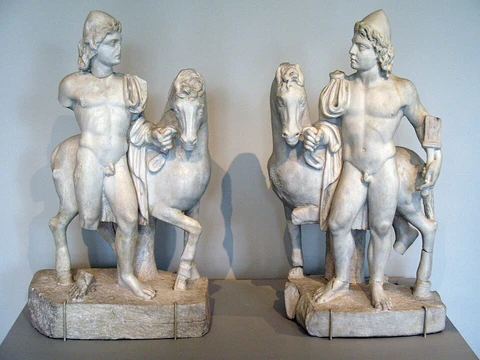
After three months, the party sailed on an Alexandrian ship whose figurehead was the Twin Brothers (Castor and Pollux), which had wintered at the island. The identification of Melita with Malta is supported by the fact that an Alexandrian ship would winter there on the usual route from Alexandria to Italy, whereas Meleda was far out of the way. The ship stopped at ports along the east coast of Sicily and the 'toe' of Italy, places featured in ancient Greek voyage writings, though the account thereafter prefers Italian names such as Puteoli over the Greek Dicaearchia.
In Rome, believers came out to provide Paul a ceremonial escort along the Appian Way. Verse 16 notes that Paul remained a prisoner with limited liberty. The mention of the Dioscuri as figurehead is purely decorative; Paul did not need their help, relying instead on God to get through the storm.
Paul's reception in Rome (verses 17–22)
Paul, as a faithful Jew, first approached the leaders of the Jewish community in Rome, calling them 'brothers' and assuring them that his appeal to Caesar did not imply disloyalty to 'my nation'. He hoped to gain their support before word arrived from Jerusalem. The Jewish community showed an open-minded attitude, with no sign of the animosity Paul had encountered in Asia Minor. They saw his teaching as related to the 'sect which is spoken against' but wanted to decide for themselves, as Paul preached using the term 'hope of Israel'.
Paul's last words (verses 23–31)
Paul's preaching to the local community is not recorded verbatim but can be inferred as a repetition of arguments presented elsewhere in Acts. Some listeners were convinced, but overall the community was in disharmony (Greek asymphonoi, 'disagreed').
A prophecy from Isaiah was cited to reflect Jewish rejection of Jesus as a tragic failure of 'this people' to take advantage of proffered salvation. Paul then declared that the salvation of God had been sent to the Gentiles, and they would hear it. The narrative ends with Paul preaching the kingdom of God and teaching about the Lord Jesus Christ with all confidence, no one forbidding him (Greek ἀκωλύτως, 'unhinderedly'), over a two-year period.
More in Castor and Pollux
Sources
Compiled from Wikipedia and the sources listed below. Text from Wikipedia is available under CC BY-SA 4.0; this entry is adapted from it.
- Wikipedia: Acts 28 (CC BY-SA 4.0).
Spotted an error? Know more?
Reader corrections go straight into our review queue. Suggest an edit · How this site is sourced