Dilberjin Tepe
Ancient Afghan town with Hellenistic murals and Kushan remains.
Last updated

via Wikipedia: Dilberjin Tepe · see source
Dilberjin Tepe (also Dilberjin or Delbarjin) is the modern name for the remains of an ancient town in northern Afghanistan. Possibly founded during the Achaemenid Empire, it became a major local centre under the Kushan Empire and was abandoned after the Kushano-Sassanid period. The site is notable for its Hellenistic-style wall paintings and a mural possibly dedicated to the Dioscuri.
Quick Facts
- Modern name
- Dilberjin Tepe (also Dilberjin or Delbarjin)
- Location
- northern Afghanistan
- Town size
- about 390 × 390 m / 1,280 ft
- Period of foundation
- perhaps in the time of the Achaemenid Empire
- Period of abandonment
- after the Kushano-Sassanids
- Major period
- Kushan Empire
Facts from the source article.
Archaeological remains
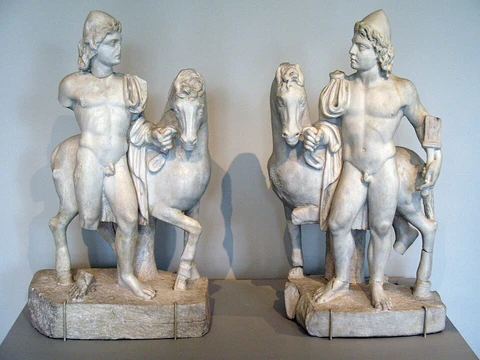
The main part of the settlement at Dilberjin Tepe formed a square roughly 390 meters on each side. During the Kushan period, a defensive wall was built around it, and at the same time a circular citadel was raised at the town’s center. Excavations in the northeastern corner uncovered a temple complex containing numerous wall paintings, several of which are purely Hellenistic in style. One such mural depicts the Dioscuri, suggesting the temple may have originally been dedicated to them.
A lengthy inscription in the Kushan language was also found there; based on its script, it dates to the early great Kushan era, around the time of Kanishka I, and appears slightly more recent than the Surkh Kotal inscription. Outside the city walls, substantial structures were uncovered, along with Bactrian inscriptions—most too damaged to be historically useful—as well as sculptural fragments and a large number of coins. The paintings from Dilberjin Tepe are generally placed in the 5th to 6th centuries CE, though some scholars, citing coin evidence, argue they could be as early as the 4th century CE.
They share stylistic features with the murals at Balalyk Tepe and some at Bamiyan. A comparison with the swordsmen depicted in the Kizil Caves also supports a date between the 5th and early 6th centuries CE. The same researchers believe the Balalyk Tepe paintings are roughly a century later, from the late 6th to early 7th centuries CE. The Dilberjin murals are widely interpreted as portraying Hephthalites, identifiable by their tunics with a single lapel folded to the right, short hair, and personal ornaments.
One well-known mural shows a line of warriors wearing kaftans, closely resembling a scene from Kyzyl. A much later fresco, dating to the 8th century CE, depicts an Indian subject: Shiva and Parvati riding the bull Nandi.
Did You Know?
- The town proper was about 390 × 390 m in size.
- About 72 coins from the early Sasanian period were found, belonging to Ardashir I, Peroz I, Hormiz I, and each type of Varahran I.
- In 2023, Iconem reported the detection of massive damage that had occurred to the site.
More in Castor and Pollux
Sources
Compiled from Wikipedia and the sources listed below. Text from Wikipedia is available under CC BY-SA 4.0; this entry is adapted from it.
- Wikipedia: Dilberjin Tepe (CC BY-SA 4.0).
Spotted an error? Know more?
Reader corrections go straight into our review queue. Suggest an edit · How this site is sourced