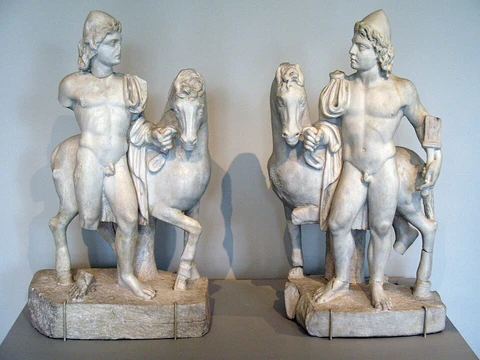
Castor et Pollux
Rameau's tragédie en musique, revived with substantial revisions in 1754.
Last updated
Castor et Pollux, an opera by Jean-Philippe Rameau, premiered on 24 October 1737 at the Palais-Royal theatre in Paris, staged by the Académie royale de musique. The libretto, by Pierre-Joseph-Justin Bernard, established his name as a salon poet.
It was Rameau’s third opera and his second tragédie en musique. For its 1754 revival, he made major cuts, alterations, and additions. Experts still debate which version is better, but the work has always been considered one of Rameau’s finest.
Composition history
Charles Dill proposes that Rameau composed the 1737 opera just after working with Voltaire on the unfinished opera Samson, implementing Voltaire's aesthetics. Voltaire sought the presentation of static tableaus that expressed emotion, as in the first act of the 1737 version which begins at Castor's tomb with a Chorus of Spartans singing 'Que tout gemisse', followed by a recitative between Telaire and Phoebe, culminating in Telaire's lament aria 'Tristes apprets'.
In contrast, the 1754 version begins with more background behind Telaire's love for Castor and depicts his death at the end; the events of Act I in 1737 appear in Act II of 1754. Dill notes a difference in plots: the 1737 version focuses on Pollux's moral dilemma between love and duty, while the 1754 version concerns the tests Pollux must face. Some scholars have assumed the 1754 version superior, but Dill argues that Rameau made the changes at a different point in his career.
In 1737 he was testing the limits of tragédie lyrique; by 1754 he had done more work with ballet-oriented genres. Dill proposes commercial concerns behind the 1754 changes, as the revision conformed more to the traditional Lullian aesthetic, and he considers the 1737 version the more daring.
Performance history and reception
Castor et Pollux appeared in 1737 while the controversy ignited by Rameau's first opera Hippolyte et Aricie was still raging. Conservative critics held the works of Jean-Baptiste Lully to be unsurpassable, and a war of words broke out between Lullistes and supporters of Rameau, the Rameauneurs. Rameau had not altered the dramatic structure of Lully's tragédie lyrique genre, retaining the five-act format with the same types of musical numbers, but expanded the musical resources.
Some welcomed Rameau's new idiom; more conservative listeners found it unappealing. Supporter Diderot remarked that 'Old Lulli is simple, natural, even, too even sometimes... Young Rameau is singular, brilliant, complex, learned, too learned sometimes.' Lullistes complained that Rameau's idiom was far more expressive and called it distastefully 'Italianate'.
Rameau's recitative style included wider melodic leaps, and he added a richer harmonic vocabulary including ninth chords. His more demanding vocal style led to the remark that while Lully's operas required actors, his required singers. The opera was a success, receiving twenty performances in late 1737, and the substantially revised version in 1754 received thirty performances plus ten in 1755. Graham Sadler writes that Castor et Pollux was regarded as Rameau's crowning achievement from the time of its first revival onwards.
Synopsis
The synopsis is based on the 1737 version. The allegorical prologue, unrelated to the main story, celebrates the end of the War of the Polish Succession; Venus subdues Mars with Minerva's help. The main story: Castor and Pollux are twin heroes; Pollux is immortal, Castor mortal. Both love Princess Telaira, but she loves only Castor.
The opera opens with his funeral rites; Telaira expresses grief in 'Tristes apprets'. Pollux and Spartans bring Lynceus's dead body. Pollux confesses his love for Telaira; she asks him to plead with his father Jupiter to restore Castor. Pollux expresses conflicting emotions in 'Nature, amour, qui partagez mon coeur' but yields.
Jupiter descends; he says the only way to save Castor is for Pollux to take his place among the dead. Pollux decides to go to the Underworld. Jupiter tries to dissuade him with a ballet of Celestial Pleasures, but Pollux is resolute. At the Underworld entrance, Phoebe gathers Spartans to prevent Pollux; she declares her love for him.
When Telaira arrives and sees Pollux's true love, Phoebe realizes her love is unrequited and urges demons to stop him. Pollux fights the demons with Mercury's help and descends into Hades.
Musical analysis
In the 1737 version, the first act opens with a tomb scene; a chorus of Spartans mourns Castor. The music in F minor features a descending tetrachord motive associated with lamentation. Telaira's 'Tristes apprets' is in da capo form with a recitative-like B-section, a bassoon obbligato, and a high register outburst on 'Non!'.
The march for Pollux and the Spartans is martial; the Spartans chorus and dance in rejoice. The second air of the Spartans is in C Major, allowing a trumpet obbligato with military associations. The act concludes with a lengthy recitative in which Pollux professes his love for Telaira.
Did You Know?
- The 1754 revision eliminated the prologue, which was no longer politically relevant.
- In the 1754 version, a wholly new Act One was created explaining the background, and Acts Three and Four were merged.
More in Castor and Pollux
Sources
Compiled from Wikipedia and the sources listed below. Text from Wikipedia is available under CC BY-SA 4.0; this entry is adapted from it.
- Wikipedia: Castor et Pollux (CC BY-SA 4.0).
Spotted an error? Know more?
Reader corrections go straight into our review queue. Suggest an edit · How this site is sourced